A role opens on Monday. By Wednesday, 300 resumes are sitting in your inbox. By Friday, your hiring manager wants a shortlist, two candidates have already accepted other offers, and you’ve reviewed maybe 40 applications. And you did it inconsistently, because you were also juggling three other things.
Sound familiar? This isn’t a volume problem. It’s a category problem. Most teams buy the wrong type of resume screening software because they compare features instead of asking what kind of tool they actually need.
This article gives you a decision framework, the High-Volume Screening Stack Framework (HVSSF), to choose the right category for you. We’ll look at when to use an ATS, a standalone screener, or an API-first approach based on where your hiring operation is today. Get the category right, and you’ll cut your shortlist time, reduce the chaos, and finally get your pipeline visible again. Get it wrong, and you’ll either buy a platform that slows you down or a point tool that creates more problems than it solves.
What’s Broken in High-Volume Resume Screening Today?
The problem most hiring leads describe isn’t a lack of tools. It’s that what they have falls apart at scale.
A role that got 20 applications six months ago now gets 200. But the first-pass screening process hasn’t changed. It’s still a recruiter opening resumes one by one. That process just doesn’t scale, and the symptoms get ugly, fast:
- Fatigue-driven inconsistency. The criteria you apply to resume #12 aren’t the same as resume #180. Let’s be honest, the recruiter who reviews the first resume is not the same person who reviews the last. Standards drift.
- Slow follow-up. Qualified candidates wait days for a response. The best ones don’t wait; they just move on. You’ll never even know you lost them.
- Coordination breakdown. Applications land in different places: job boards, email, referrals, career pages. With no single source of truth, good candidates fall through the cracks.
- Hidden funnel loss. You don’t see which stage is leaking because nothing is measured. You just know hiring is slow and everyone is frustrated.
The cost here is real. Time wasted on irrelevant resumes delays shortlists. Delayed shortlists push back offers. Delayed offers delay headcount. And delayed headcount hurts the business. A resume screening bottleneck isn’t just a recruiting problem, it’s a business velocity problem.
Why Do “Just Add AI” and Keyword Filters Fail as Existing Approaches?
When teams hit this wall, they usually try one of two things: add a keyword filter or bolt on an AI scoring tool. Both fail in predictable ways.
Keyword matching misses context. A candidate with “Python scripting” experience applying to a “Python developer” role might get filtered out because the exact phrase isn’t there. Keyword filters don’t understand synonyms, transferable skills, or adjacent roles. The result? You automatically reject qualified candidates while advancing people who just learned how to stuff their resumes with the right words.
Opaque AI scores break trust. If a recruiter can’t explain why a candidate scored 74 instead of 81, they stop trusting the score. Hiring managers push back. The tool gets ignored. And you’ve just paid for something nobody uses.
Disconnected tools create duplicate work. A standalone screener that doesn’t connect to your pipeline means manually copying scores into spreadsheets, exporting CSVs, and trying to reconcile data across systems. Your “efficiency tool” just created its own admin nightmare.
Compliance risk grows with opacity. Automated resume screening without audit trails, documented criteria, and a human in the loop isn’t just a legal risk, it’s a fairness problem. And regulators are starting to pay close attention.
The “cheap” tool isn’t cheap. When you factor in the manual maintenance, the rework from bad shortlists, and the candidates you lose to a slow process, the cost of a bad tool is often far higher than the price of a good system.
What Framework Should You Use to Choose Between an ATS, a Standalone Screener, and an API?
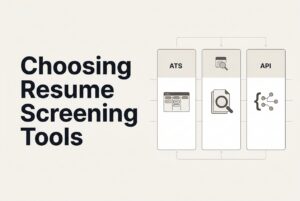
Before you look at a single vendor, you need to compare categories. Here’s how to think about each one:
ATS (Applicant Tracking System): This is your system of record. It manages the full recruiting pipeline, including stages, candidate records, collaboration, reporting, and communications. Some have great AI screening, some don’t.
Standalone screener: This tool is laser-focused on parsing, matching, and ranking resumes. It’s lighter and faster to deploy, but it doesn’t manage your pipeline. You still need a place for candidates to live after they’re scored.
API-first screening: These are modular components (like parsing, scoring, and formatting) that you integrate into your own systems. This gives you maximum flexibility but requires a significant engineering investment.
The High-Volume Screening Stack Framework (HVSSF) helps you map your reality to the right category. Just ask yourself these five questions:
- Volume & velocity: How many applications per role, and how fast do you need a shortlist?
- Workflow complexity: How many stages, reviewers, and handoffs does a candidate go through?
- Existing stack reality: Do you already have an ATS? Where does your candidate data live right now?
- Matching quality & explainability needs: Do your reviewers need to understand why a candidate ranked where they did? (Hint: yes, they do.)
- Compliance/privacy posture: Do you need audit trails, disclosure mechanisms, or specific data controls?
Your answers to these questions, not a vendor’s feature list, will tell you which category you belong in.
How Does the High-Volume Screening Stack Framework Work?
Find your organization on this map. Then, choose the simplest tool category that solves your main bottleneck without creating a new one.
Stage 1: Inbox & Spreadsheets
You’re managing applicants across email, shared docs, and job board portals. There’s no single place where candidates live. Your shortlists are inconsistent because everyone is working from different information.
- Best fit: ATS (or a lightweight structured system). Your bottleneck is coordination and visibility, not fancy screening.
- Watch-out: Don’t over-engineer it. A simple ATS with pipeline stages and a shared candidate view will solve 80% of your pain.
Stage 2: We Have Tracking, But Screening Is the Bottleneck
You have some structure, maybe a basic ATS, but the first-pass review is a manual slog. The quality of your shortlists depends entirely on who did the review that day.
- Best fit: A standalone screener or an ATS with strong contextual screening built in. If your tracking system is solid, just add a screening layer. If your ATS is weak, it might be time to replace it with one that has screening built-in.
- Watch-out: Explainability is critical here. Reviewers have to understand why a candidate ranked high or low, or they’ll just ignore the tool.
Stage 3: Multi-Team, Multi-Role Scaling
You have multiple open reqs, multiple hiring managers, and you need analytics to figure out where you’re losing candidates.
- Best fit: An ATS with integrated workflow automation and reporting. You need screening to be part of the pipeline, not a separate, bolted-on step.
- Watch-out: Adoption is your biggest risk. Don’t over-customize everything on day one. Get everyone on the same basic workflow before you start optimizing.
Stage 4: Platform / Productized Hiring Ops
You’re a recruiting agency, a talent marketplace, or a company running hundreds of reqs at once. You need modular control, custom workflows, and the ability to swap components in and out.
- Best fit: API-first components integrated into your internal tools, likely alongside a core ATS.
- Watch-out: This path requires dedicated engineering ownership and ongoing model calibration. It’s a product you build, not just a tool you buy.
Rule of thumb: If your biggest pain is coordination, invest in an ATS.
For teams at Stage 2 or 3, an AI-powered ATS can be the sweet spot. A system that combines pipeline tracking, contextual resume screening, real-time ranking, and workflow automation removes the friction between separate tools. This integrated model works best when screening decisions need to live in the same system where candidate records and team collaboration happen.
Decision Table: Stage → Category → What You Gain → What You Risk
| Stage | Best-Fit Category | Primary Win | Primary Risk | You’re Ready When… |
|---|---|---|---|---|
| 1: Inbox & spreadsheets | ATS | Visibility + coordination | Implementation overhead | You’ve mapped your basic pipeline stages |
| 2: Screening bottleneck | Standalone screener or ATS w/ AI | Faster, consistent shortlists | Disconnected workflow (standalone) | Reviewers agree on criteria |
| 3: Multi-team scaling | ATS + workflow automation | Pipeline analytics + collaboration | Over-customization, adoption lag | You have buy-in from hiring managers |
| 4: Platform/agency ops | API-first (+ ATS hybrid) | Composability, modular control | Engineering + compliance burden | You have dedicated engineering resources |
HVSSF Visual Model
Hiring Maturity / Operational Complexity →
Low ──────────────────────────────────────────────── High

┌─────────────────┬───────────────────┬─────────────────────┐
│   ATS Lane      │ Standalone Lane   │   API-First Lane    │
│                 │                   │                     │
│  Stage 1 ✓      │                   │                     │
│  Stage 2 ✓      │  Stage 2 ✓        │                     │
│  Stage 3 ✓      │                   │  Stage 4 ✓          │
│                 │                   │                     │
│  Coordination   │  Screening speed  │  Composability +    │
│  + records      │  + ranking        │  custom control     │
└─────────────────┴───────────────────┴─────────────────────┘
Pick the smallest system that resolves your current bottleneck and doesn’t create new workflow debt.
What Should You Evaluate in Resume Screening Software?
Once you know your category, you can filter out the noise. Here’s what actually matters when you’re evaluating tools.
Evaluate these:
- Contextual matching, not keyword matching. The tool must handle synonyms, adjacent skills, and transferable experience. Ask vendors how they handle a candidate who has the right skills but uses different words to describe them.
- Relative ranking, not just pass/fail. When you’re under pressure, you need to know who to call first, not just who met a minimum bar. Ranked shortlists let recruiters prioritize their time effectively.
- Explainability. Can you see why a candidate ranked where they did? This is essential for building trust with hiring managers, enabling human review, and meeting compliance needs.
- Integration and data flow. Where do resumes come from? Where do screening decisions go? Every manual step between systems is a failure point where data gets lost.
- Automation that actually saves work. Real value comes from triggers for emails, stage-change notifications, and pre-screening question responses. These are the features that give you back hours every week.
- Total cost of ownership. The license cost is just one line item. Don’t forget to account for implementation time, training, and the ongoing cost of slow hiring if the tool doesn’t actually fix your process.
For teams drowning in high-volume coordination, an integrated system is a lifesaver. Combining screening, ranking, automation, and communication in one place dramatically cuts down on administrative work. The value is in having those pieces connected, not just having them installed.
Ignore early:
Complex custom workflows you haven’t even tried to run manually. Vague AI claims without any explainability.
When Do APIs and Modular AI Architectures Beat Buying Software?
Going API-first makes sense only under specific conditions: you have engineering resources, you need a level of custom control that off-the-shelf tools can’t offer, and you’re ready to own the integration work forever.
Think of it like building with Legos (API-first) versus buying a pre-built Lego castle (software). With APIs, you can pick the best AI resume parser from one vendor and the best scoring model from another, then plug them into your internal systems. No single vendor locks you in.
Good fit for API-first:
- You have an internal tool or an existing ATS you can’t or won’t replace.
- You need very different scoring criteria for different job families.
- You want modular control to swap models and components.
- You can use modern APIs to retrieve job-specific criteria on the fly, which reduces the need for constant retraining.
Not a good fit for API-first:
- You don’t have engineers to build and maintain the integrations.
- You need a solution that works now, not in three months after QA and security reviews.
- You have high compliance needs; you’ll have to design and build those controls yourself.
A middle path exists for teams that want AI screening without replacing their ATS. You can use an API to parse and score resumes, then feed the ranked results back into your current system. This can work, but you need to integrate AI for resume parsing into your ATS.
How Do You Handle Bias, Compliance, and Privacy Without Slowing Down Hiring?
Let’s be clear: speed is not the enemy of fairness. Opacity is.
The risk with any automated screening is that historical data can teach the model old hiring biases about what “qualified” looks like. You counteract that with a focus on skills-based criteria and regular human review.
Operationally, “controls” means having:
- An audit trail to see who reviewed what, when, and what decision was made.
- Consistent, documented criteria applied to all candidates.
- The ability for a human to review and reverse automated decisions.
- Human oversight at every critical decision point. AI should be a filtering tool, not the final hiring authority.
Candidate transparency is also quickly moving from a best practice to a legal requirement. NYC Local Law 144 and the EU AI Act are just the beginning. The expectation of disclosure (“this process uses automated tools to screen applications”) is the direction everything is heading.
For small and mid-sized businesses, the advice is simple: start practical. Run AI screening on one role family first. Measure the outcomes. Look for any signs of adverse impact. Iterate and validate before you roll it out everywhere. Basic privacy hygiene also applies: set data retention policies, use role-based access, and know your responsibilities under GDPR or similar laws.
What Does “Working” Look Like?
Define success with a small set of measurable signals, and track them before you flip the switch on a new tool.
Speed metrics:
- Time-to-shortlist (from application close to shortlist delivered)
- Time-to-first-response (from application to candidate acknowledgment)
- Time-to-fill per role family
Efficiency metrics:
- Recruiter hours per hire
- Resumes reviewed per shortlist slot
Quality signals:
- Shortlist-to-interview conversion rate
- Interview-to-offer conversion rate
- Offer acceptance rate
Consistency signals:
- Reviewer alignment (do different reviewers produce similar shortlists?)
- Criteria drift (are the same standards being applied across all reqs?)
Candidate experience:
- Average response time by stage
- Drop-off rate between application and first contact
Here’s a simple plan: track these metrics manually for 30 days. Then, implement your new tool and measure again at 30 and 60 days. If time-to-shortlist drops and shortlist quality holds steady, it’s working. If quality drops, you have a calibration problem to solve before you scale.
How Can You Apply the Framework to Real Scenarios?
Scenario A: Founder hiring 5 roles simultaneously, drowning in inbound
Coordination is totally broken. Resumes are in three inboxes, feedback is in Slack, and no one knows who is still in play.
→ Choose ATS-first. Stop everything. Your problem is coordination, not screening sophistication. Get a single system of record before you do anything else.
Scenario B: SMB with a basic ATS, but screening is the slow part
You have a pipeline, but first-pass review takes days of manual work. Shortlists are inconsistent because they depend on which recruiter is having a good day.
→ Add a standalone screener or upgrade to an ATS with good contextual AI. Don’t rip out what’s working. Augment your current system with a screener that feeds into it, or migrate to a better ATS that has screening built-in.
Scenario C: Agency managing multiple clients and 20+ open roles
You need client-specific submissions, shared visibility, and candidate tracking across multiple accounts. Juggling a bunch of separate tools is a recipe for disaster.
→ Get an ATS with agency CRM functionality. Centralized candidate records, client portals, and submission tracking are more important here than the world’s most advanced AI screening.
Scenario D: Engineering team where the resume isn’t enough
You can use contextual ranking to get a good shortlist, but now the bottleneck is the technical screen. You’re wasting time scheduling calls, running assessments, and chasing feedback.
→ Consolidate your tools after the shortlist. Once you have a ranked list, use integrated tools for early technical screens, like video interviewing and a live code editor. Reducing the number of platforms at this stage cuts down on scheduling and keeps all the candidate context in one place.
The thread connecting these scenarios is simple: identify your current bottleneck, and choose the simplest category of tool that removes it. Don’t buy a capability you’re not ready to use. The next bottleneck will eventually reveal itself, and when it does, you’ll know exactly what to do.