Mid-market teams usually do not outgrow Lever because pipeline management breaks. They outgrow it because screening gets noisy, interviews stay too manual, and decision-making still happens in spreadsheets. If that sounds familiar, the right Lever alternative is less about a shiny new ATS and more about picking the system that fixes your biggest bottleneck.
For a 100–500 employee company hiring 20–300 people a year, the best choice depends on the pain you feel most. If you are drowning in resume review, look first at AI-powered recruitment options like Ashby, CVViZ, SmartRecruiters, or Kula. If structured hiring is the issue, Greenhouse usually leads. If cost is the main problem, transparent-pricing tools like CVViZ, Workable, Breezy HR, or JazzHR deserve a serious look. That is the basic map, and it matters because mid-market recruiting is rarely one problem. It is usually three at once.
Why mid-market companies look for a Lever alternative
The short answer is that Lever is strong, but it is not the right fit for every scaling team. It works well for collaborative hiring, and it gives you ATS plus Recruitment CRM in one record. It also has 200+ integrations, NurtureKit CRM, and newer AI features like an AI Interview Companion, screening support, and a channel-optimization engine.
Still, mid-market buyers usually start shopping for a Lever alternative when one of four gaps becomes hard to ignore: screening quality, interview rigor, decision-making, or pricing clarity. In practice, that often shows up as 300+ applications on a remote role, recruiters manually reviewing only the first batch, and hiring managers waiting for someone to translate messy feedback into a decision.
There is also a compliance angle. Lever does not publish public pricing, and EU customers cannot access some features such as the ROI Dashboard and AI Interview Transcripts because of GDPR restrictions. So if you operate across regions, or if your CFO wants a cleaner cost story, the renewal conversation can get uncomfortable fast.
The key point is simple: most mid-market teams do not need a totally different recruiting philosophy. They need a system that better supports screening, structured evaluation, and faster decisions.
What does a mid-market ATS evaluation framework actually look like?
A useful evaluation framework should score each ATS on six things: sourcing reach, AI resume screening, workflow automation, CRM or candidate rediscovery, reporting, and integrations. That is the shortest honest version. Anything else is usually vendor theater.
Start with sourcing. Ask how many free and paid job boards you can post to from one place, and whether LinkedIn, GitHub, Dice, Indeed, or other niche boards are first-class. Then test screening. Do not settle for keyword search in a nicer font. You want contextual candidate matching, relative ranking, and explainable scores.
After that, check the workflow layer. Can the system trigger emails, notifications, reminders, and stage-based actions without a recruiter babysitting every step? Can it route candidates with pre-screening questions? If not, you are just buying a better spreadsheet.
Reporting matters too. Mid-market leaders need funnel conversion, source effectiveness, time-to-fill, and recruiter productivity without begging for analyst support. Finally, verify the integrations you actually use: HRIS, calendar, video, assessment, background check, and Slack or Teams. If those are weak, adoption falls apart.
In other words, an evaluation framework should not ask “does it have AI?” It should ask whether the AI helps your team hire faster, with less manual work, and with enough explainability to survive stakeholder scrutiny.
Which buying criteria should mid-market TA leaders use?
Your buying criteria for choosing a scalable hiring platform should be blunt, measurable, and tied to the way your team works. If a vendor cannot answer these questions clearly, that is a signal in itself.
First, ask how the ATS handles different role types. A platform that works for high-volume roles but falls apart on executive searches is a problem if your company hires both. Second, ask how configurable the workflows are after implementation. Mid-market teams change fast, and support tickets for simple updates are a tax you do not need.
Third, inspect the screening logic. You want to know whether it handles nontraditional resumes, career gaps, and role changes fairly well. Fourth, test scheduling. Self-scheduling and Google Calendar or Outlook integration should be real, not decorative. Fifth, look at the sourcing layer and the job distribution network. If you rely on two boards and hope for the best, your pipeline will stay thin.
Finally, do not ignore contract behavior. Ask for the annual escalator, what is included in base price, and what becomes an add-on later. Pricing clarity matters because the cheapest-looking option often becomes expensive after modules, support, and reporting add up.
That is why choosing an ATS is really a buying discipline problem. The product matters, but the contract, implementation shape, and workflow fit matter just as much.
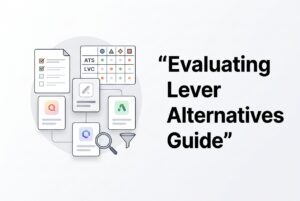
How do the leading Lever alternatives compare?
Here is the practical shortlist for mid-market companies. The right answer depends on what hurts most.
| Vendor | Best for | Public pricing | Main strength | Main tradeoff |
|---|---|---|---|---|
| CVViZ | AI screening, broad sourcing, transparent pricing | Yes | NLP + ML ranking, 2,000+ job boards, agency CRM | Smaller brand than Lever |
| Ashby | Analytics-driven teams | Yes | Explainable AI and custom dashboards | Learning curve |
| Greenhouse | Structured hiring | No | Deep scorecards and interview kits | More process-heavy |
| Workable | Speed-to-value | Yes | 200+ job boards and mature automation | Reporting is less deep |
| Breezy HR | Simplicity and automation | Yes | Free tier and easy collaboration | Less depth for complex teams |
| JazzHR | Very tight budgets | Yes | Low entry cost | Often outgrown as teams scale |
| SmartRecruiters | Enterprise-leaning teams | No | Winston AI and global hiring | Usually pricey for mid-market |
| iCIMS | Modular enterprise needs | No | Deep add-ons and partner ecosystem | TCO can climb quickly |
| Workday | HCM-first organizations | No | HCM and recruiting in one stack | Overkill for many mid-market buyers |
If your biggest issue is screening 300 applications and ranking them quickly, CVViZ and Ashby are strong first calls. If structured hiring and scorecards are the problem, Greenhouse is hard to beat. If you want a lower-cost, transparent option with broad job distribution, Workable and CVViZ are easy to compare side by side.
If your biggest issue is screening 300 applications and ranking them quickly, CVViZ and Ashby are strong first calls. If structured hiring and scorecards are the problem, Greenhouse is hard to beat. If you want a lower-cost, transparent option with broad job distribution, Workable and CVViZ are easy to compare side by side.
How does CVViZ fit into the shortlist?
CVViZ is a credible Lever alternative for growing companies that want AI depth, transparent pricing, and broad sourcing in one system. It uses NLP and machine learning for contextual resume screening, learns from hiring patterns, and ranks candidates in real time. It also posts jobs to 20+ free boards and distributes to 2,000+ job boards worldwide.
That makes it especially relevant if your team is buried in manual review. The product also includes workflow automation with rules and triggers, email sync, bulk email, reminders, campaigns, and open/click tracking. For recruiting teams that rely on re-engaging past candidates, that matters. So does the built-in Recruitment CRM for agencies, which adds client and lead management, a client portal, and collaboration features.
CVViZ also has practical mid-market features that are easy to miss when scanning a vendor page. Those include an AI Resume Parser, Semantic Search across the resume pool, passive candidate search from sites like LinkedIn and GitHub, and video interviewing with a live code editor for technical roles.
The real comparison is not “Lever versus CVViZ on every dimension.” It is whether you want Lever’s broader ATS + CRM ecosystem or CVViZ’s stronger AI resume screening, job distribution, and price clarity.
What should you ask in a vendor demo?
Use a checklist, not a vibes test. Good demos are specific. Bad ones are polished.
Mid-market ATS demo checklist
| # | What to ask or observe | Pass criterion |
|---|---|---|
| 1 | Use your hiring scenario and your resume sample | Recruiter can screen in under 5 minutes |
| 2 | Show AI screening accuracy for structured and contextual signals | Both are stated clearly |
| 3 | Give the all-in price | No “depends” answer |
| 4 | State implementation timeline in weeks | Under 8 weeks for mid-market |
| 5 | Disclose annual escalator | Under 10% |
| 6 | Explain GDPR coverage | Vendor can produce evidence on request |
| 7 | Show bias audit availability | Quarterly audit agreement possible |
| 8 | Demonstrate HRIS, calendar, video, assessment, and background check integrations | First-party integrations |
| 9 | Show sourcing reach | Free and paid boards are real, not limited |
| 10 | Provide references in the 100–500 employee band | At least two verifiable |
A few of these deserve special attention. Ask how the AI ranking works, and whether it can be explained to a candidate if needed. Ask whether you can run the AI in shadow mode before letting hiring managers use it. And ask what happens when a recruiter overrides the score, because that is where most “smart” systems get real.
Also, ask for references from companies your size. A tool that works beautifully for enterprise can still be a mess for a 250-employee company with a lean recruiting team.
Which Lever alternative should you choose by pain point?
The cleanest way to make a decision is to match the tool to the pain.
If your team is manually screening hundreds of resumes per role, start with CVViZ, Ashby, SmartRecruiters, or Kula. If structured scorecards and interview rigor are missing, Greenhouse should be in the first round. If reporting is the issue, Ashby, Greenhouse, SmartRecruiters, and CVViZ are the strongest options to test.
If cost is the blocker, look at CVViZ, Workable, JazzHR, Breezy HR, and Ashby’s lower entry tier. If sourcing reach is the bottleneck, CVViZ and Workable have the broadest practical job distribution among mid-market-friendly tools in this group. If you care most about silver-medalist re-engagement, Lever still has an edge with NurtureKit CRM, but Ashby and CVViZ also give you strong CRM-style candidate reuse.
And if your company is really enterprise-leaning, then Workday, iCIMS, and SmartRecruiters belong on the list, even if they are often overkill for pure mid-market use.
The main thing is not to shop by logo. Shop by failure mode.
Is Lever still the right choice for some teams?
Yes, for some teams it still is. Lever remains a strong ATS + Recruitment CRM for sourcing-led, collaborative hiring cultures. It has a clean user experience, strong bulk pipeline actions, and a deep integration ecosystem. For teams that like its workflow and already use NurtureKit well, staying put can be the right call.
But if you are hitting the limits in screening, scorecards, or reporting, staying on Lever may just mean paying for a system your team has already outgrown. That is especially true if you are a mid-market company dealing with rapid growth, a rising agency bill, or pressure to improve recruiter productivity without adding headcount.
So the question is not whether Lever is “bad.” It is whether it still matches your operating reality. For many mid-market teams, the answer is no.
FAQ
What is the best Lever alternative for a mid-market company?
There is no single best choice. CVViZ and Ashby are strong if AI screening and ranking are the main pain. Greenhouse is strongest for structured hiring. Workable and Breezy HR are better if simplicity and lower cost matter most.
Is Lever overpriced for mid-market companies?
It can be, depending on your volume and what you need. Lever does not publish public pricing, and observed buyer-report ranges put mid-tier accounts in the $15,000 to $40,000 per year band. For some teams, that is fair. For others, it is too much for the value delivered.
How should I evaluate AI resume screening?
Ask whether the tool uses contextual matching or just keyword search. Then check whether it explains match scores, supports overrides, and has a bias audit process. Also remember that AI is better on structured signals than contextual judgment.
Should I worry about GDPR or bias when choosing an ATS?
Yes. Mid-market teams with EU footprint or formal compliance obligations should ask for data subject rights support, auditability, and explainability. AI screening should be treated as decision support, not a black-box decision maker.
Can I switch without planning a technical migration project here?
That is outside this guide. The better first step is to choose the right system, validate the workflow fit, and confirm the contract and implementation path before you think about data movement.