Measure ATS ROI by comparing the benefits you can substantiate with the full cost of using the system over the same period. For a company, that may include recruiter capacity recovered and avoidable spending reduced. For an agency, it may also include additional placement contribution—but only where you can explain the connection to the workflow change.
An applicant tracking system supports the process; it does not automatically cause better hires, lower turnover or more revenue. Use a conservative calculation for the buying decision and keep uncertain benefits in a separate scenario.
1. Establish a comparable hiring baseline
Choose a recent period with enough completed recruiting activity to be useful, and record the roles, application volume, team size and channels involved. Compare similar work before and after adoption. A seasonal hiring spike, different role mix or a larger recruiting team can change the result.
| Measure | Record before and after |
|---|---|
| Recruiter effort | Minutes spent collecting applications, screening, scheduling, updating records and compiling reports. |
| Process speed | Time to first review, agreed shortlist and offer or placement, using consistent start and end points. |
| External spending | Actual job advertising, agency, assessment and other relevant invoices. |
| Workflow quality | Missing records, duplicate work, shortlist acceptance and candidate follow-up completion. |
| Business outcomes | Accepted offers or placements; treat retention and performance as longer-term outcomes with other contributing factors. |
Keep candidate and role definitions consistent. A lower cost per application is not automatically useful if the additional applications do not meet the role requirements.
2. Include the full cost of the ATS
- Subscription cost for the plan and number of users you actually need.
- Implementation, data migration and training effort, including internal staff time.
- Required integrations, paid add-ons and ongoing administration.
- Separate job-board advertising, assessment or messaging charges where applicable.
- Transition costs such as running the previous system during migration.
Check current plan inclusions and any implementation quote before assigning amounts. The numbers in the example below are hypothetical planning inputs, not CVViZ prices.
3. Separate cash savings from recovered capacity
Cash savings reduce a payment you would otherwise make—for example, retiring an overlapping tool or reducing avoidable contractor hours. Recovered capacity means existing staff can use time differently. It has value, but it does not reduce payroll automatically.
Calculate recovered capacity as: hours saved × fully loaded hourly cost. Include time needed to check AI output, correct data and maintain the workflow. Do not value the same saved hour again under “faster hiring” or “increased productivity.”
For employers, only count lower agency spend when the team has demonstrably replaced that work without hiding it elsewhere. For agencies, only count additional placement contribution when the extra capacity leads to actual placements, allowing for delivery costs and the terms of the placement.
4. Work through a conservative example
Illustrative example—not a customer result. A team measures 10 hours of net administrative time saved each month, values that capacity at $40 per hour, and retires $100 per month of overlapping software. Its assumed first-year ATS and implementation cost is $4,000.
| Item | Calculation | Annual value |
|---|---|---|
| Recovered capacity | 10 hours × $40 × 12 months | $4,800 |
| Avoided software spending | $100 × 12 months | $1,200 |
| Total quantified benefit | $4,800 + $1,200 | $6,000 |
| First-year cost | Assumed total cost | $4,000 |
| Net quantified benefit | $6,000 − $4,000 | $2,000 |
| ROI including capacity | ($6,000 − $4,000) ÷ $4,000 × 100 | 50% |
The cash-only result is different: ($1,200 − $4,000) ÷ $4,000 × 100 = −70%. The business case therefore depends on whether the team can use the recovered capacity productively. Present both views, and label estimates clearly.
Use three scenarios when the result depends on an assumption: no measurable improvement, a conservative improvement and the improvement observed in your pilot. A seven-day trial can test workflow usefulness; it cannot establish annual ROI or long-term hiring quality.
5. Track job-board return separately from ATS return
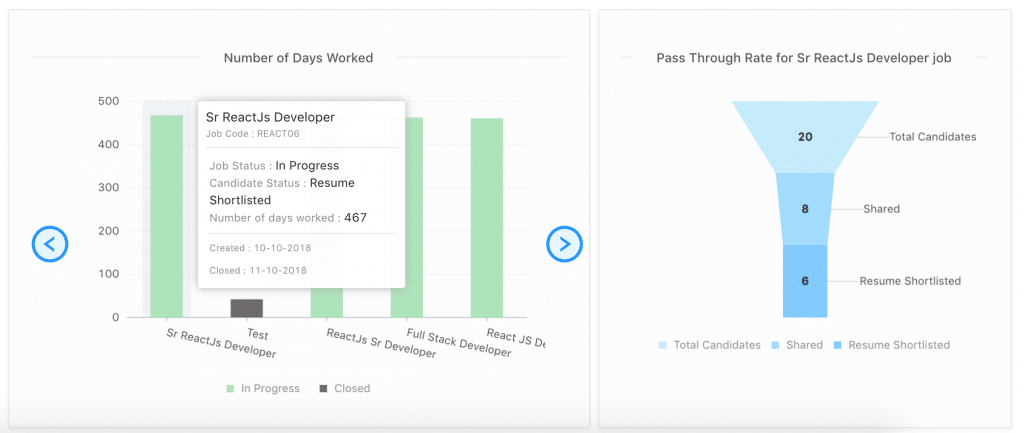
If you advertise on Indeed or another board, connect actual campaign spending to candidates and hiring stages over an appropriate reporting window. Keep the job, source and campaign definitions consistent, and reconcile the source records with the advertising account. Confirm what the ATS captures automatically and what requires an export or a manual reconciliation.
- Cost per qualified applicant = advertising spend ÷ applicants meeting your agreed job-related criteria.
- Cost per interview = advertising spend ÷ candidates reaching the defined interview stage.
- Cost per hire or placement from the campaign = advertising spend ÷ completed attributed hires or placements.
These are cost measures, not revenue ROI. For revenue ROI you also need an attributable financial return. If there are no completed hires in the window, report the stage results and the unresolved outcome; do not divide by zero or treat pending candidates as hires.
The job-board guide can help assess distribution options. Free listings on an external board depend on eligibility and policy; sponsored advertising is a separate cost. An ATS does not itself guarantee advertising savings.
6. Keep quality-of-hire assumptions out of the core calculation
A hire leaving within 12 months is not, by itself, evidence of a bad hiring decision. Retention and performance also depend on management, compensation, role changes and working conditions. Do not assign a standard “bad hire” cost or claim a percentage improvement from the ATS without evidence appropriate to your business.
Similarly, company-wide revenue per employee is not the incremental profit created by one new hire. If finance wants to model vacancy costs or extra agency placements, record the assumptions separately and avoid counting the same value in two categories.
7. Review the business case after adoption
Assign an owner to review actual usage, costs and outcomes after the rollout. Track whether recruiters complete the intended workflow in the system, not just whether they log in. Use the recruitment metrics guide to build a consistent review and revisit assumptions when hiring demand changes.
CVViZ provides a connected recruiting platform for job distribution, AI-assisted screening and subsequent hiring activity. Evaluate it against the work your company or agency needs to complete.
Bring one representative role, your current process and a short list of measurable tasks to your CVViZ evaluation. Start your 7-day free trial.