If you are comparing AI candidate sourcing tools, start with the hiring problem, not the logo. The right tool depends on whether you need candidate sourcing from external networks, faster screening for inbound applicants, rediscovery of people already in your ATS, or one workflow that does all of it.
That distinction matters because a technical sourcing tool, a high-volume recruiting platform, and an agency CRM solve different bottlenecks. CVViZ fits best when sourcing is not a standalone task. It helps teams source, screen, rank, engage, schedule, and report in one hiring flow, which is usually what growing companies actually need.
Which AI candidate sourcing tools fit our hiring problem?
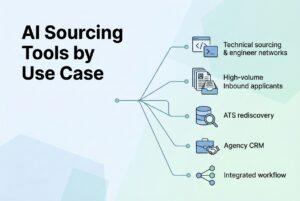
The short answer is this: match the tool to the bottleneck. If you need to source engineers from GitHub or Stack Overflow, use technical sourcing. If you are drowning in applications, use a high-volume recruiting platform. If your best candidates already live in your ATS or CRM, use rediscovery first. If you are an agency, pick a CRM built for client work and submissions.
| Hiring problem | Best-fit sourcing motion | What to prioritize |
|---|---|---|
| Hard-to-find software engineer or data specialist | Technical sourcing | GitHub, Stack Overflow, Kaggle, publications, patents, technical filters |
| Hundreds or thousands of applicants | High-volume inbound recruiting | Job distribution, AI screening, bulk communication, scheduling |
| Candidates hidden in old ATS records | Candidate rediscovery | ATS search, duplicate detection, ranking against a new role |
| Multiple clients and submissions | Agency recruiting CRM | Client records, ownership, outreach, collaboration |
| Several needs in one team | Integrated AI ATS | Sourcing, screening, tracking, communication, analytics |
The practical rule is simple. Start with the constraint, not the vendor category. A tool that is great at finding profiles may still be weak at scheduling, tracking, or collaboration. Likewise, an ATS that handles volume well may not surface technical signals from the open web. CVViZ sits in the integrated camp, which is why it works when teams want one system instead of a stack of disconnected point tools.
What is AI candidate sourcing?
AI candidate sourcing is the use of machine learning, NLP, search, matching, enrichment, or automation to find people who may fit a role and move them into a hiring workflow. It is useful to separate sourcing from screening. It can search job boards, external profiles, referrals, talent pools, a candidate database, or an ATS.
It is useful to separate sourcing from screening. Sourcing answers where to find people. Screening answers whether they appear to fit the role. Matching and ranking sit between the two because they compare the job brief with a candidate’s skills, experience, and other signals.
A practical sourcing flow usually looks like this:
- Define the role, location, and criteria.
- Choose the source: ATS, web, job boards, referrals, or technical networks.
- Search, parse, enrich, and remove duplicates.
- Rank candidates by relevance.
- Review the evidence behind the rank.
- Reach out by email, SMS, or other approved channels.
- Record source, stage, and outcome in the ATS or CRM.
That is why AI candidate sourcing tools are not interchangeable. The best one is the one whose data source and workflow fit your actual process. CVViZ supports this full flow with job distribution, web and social sourcing, contextual AI resume screening, ranking, searchable storage, outreach, scheduling, and analytics.
What should technical recruiters use for engineers?
For engineering hiring, the best fit is usually technical sourcing across public technical networks, followed by real evaluation. That means GitHub, Stack Overflow, Kaggle, publications, patents, or technical writing can matter more than a plain resume search.
However, profile discovery does not prove coding ability. It only gives stronger signals than a keyword match. You still need recruiter review, structured screening, and a technical assessment step.
| Technical hiring need | What to look for |
|---|---|
| Discover engineers outside job boards | GitHub, Stack Overflow, Kaggle, publications, patents |
| Check depth, not just title | Project scope, ownership, recent activity |
| Move fast without guessing | Contextual ranking and recruiter review |
| Validate skills | Video interviews or live coding evaluation |
This is where CVViZ helps growing teams. CVViZ offers automated candidate sourcing from the web and platforms like GitHub and Stack Overflow, then connects that search to contextual AI resume screening, video interviews, and an integrated live code editor for developer interviews. That makes it useful when the real problem is not just “find engineers,” but “find them, screen them, and move them through the workflow without losing context.”
A specialist tool can be useful too, especially if the team only wants discovery across technical communities. But if your process includes screening, scheduling, and reporting, an integrated workflow usually removes more friction.
What works best for high-volume hiring?
High-volume hiring needs distribution, triage, consistency, and speed. It is not solved by profile volume alone. If a role attracts hundreds of applicants, the real bottleneck is usually resume review, communication, and scheduling.
The strongest setup includes job posting to multiple sites, prescreening questions, contextual screening, ranking, bulk communication, and interview coordination.
| High-volume requirement | What it solves |
|---|---|
| Multi-board posting | More reach from one job post |
| AI resume screening | Faster filtering of large applicant pools |
| Knockout questions | Early qualification without manual calls |
| Bulk emails and reminders | Less back-and-forth |
| Scheduling automation | Fewer delays |
| Analytics | Better source and funnel visibility |
CVViZ is built for that kind of workflow. It posts jobs to 20+ free job boards and distributes roles to 2000+ job boards worldwide for paid and free ads in one click. It also supports contextual screening, prescreening questions, email and SMS communication, follow-ups, interview scheduling, reminders, and recruitment analytics.
That matters for a growing company because the pain is usually operational, not theoretical. People do not need another dashboard that looks smart and adds work. They need a system that reduces repetitive screening and keeps candidates moving. For teams facing spikes in applications, resume review should help with both discovery and triage.
How can companies rediscover past applicants?
Candidate rediscovery should often come before external sourcing when a company already has a meaningful ATS or resume database. Past finalists, silver medalists, referrals, and previous applicants may already have the right background and known communication history.
Rediscovery is about searching what you already own before buying more reach. That is especially useful when the company has recurring roles or a messy history of old requisitions, spreadsheets, and email threads.
| Rediscovery step | Why it matters |
|---|---|
| Search the existing database | Finds warm candidates first |
| Remove duplicates | Cleans up stale records |
| Review evidence behind the match | Avoids blind ranking |
| Check contact permissions | Protects candidate experience |
| Send personalized outreach | Improves response quality |
CVViZ supports searchable resume storage, duplicate detection, candidate tags, source tracking, talent pools, and candidate rediscovery. It also enables automated email and SMS outreach to people already in the database. So, when the question is “Do we really need to search externally yet?”, CVViZ helps teams answer that in a practical way.
The broader lesson is simple. External sourcing matters when the existing database is too small, stale, or missing the needed skill set. But if the candidate is already in your system, rediscovery is usually the faster first move.
What do recruitment agencies need from sourcing tools?
Agencies need more than sourcing. They need candidate search, client records, submissions, recruiter ownership, collaboration, and reporting. In other words, they need a recruiting CRM, not just a search box.
An internal hiring tool may find candidates, but that does not solve client workflows. Agencies usually have to manage several moving parts at once: jobs from different clients, candidate ownership, submissions, feedback, and outreach on behalf of the client.
| Agency need | Why it matters |
|---|---|
| Client and contact records | Keeps accounts organized |
| Recruiter ownership | Prevents duplicate effort |
| Candidate pools | Reuses warm talent |
| Submissions and sharing | Supports client delivery |
| Outreach tracking | Shows what happened and when |
| Analytics | Connects activity to placements |
CVViZ includes recruitment CRM capabilities for agencies. It supports companies and contacts, leads, account managers, communication, client portal, and collaboration features. It also combines sourcing, screening, workflow automation, and analytics in one system. That combination is useful when agencies want one operating layer instead of separate tools for sourcing and client management. If your team is juggling multiple accounts, that structure matters more than raw profile volume.
Where does CVViZ fit in all of this?
CVViZ fits teams that want sourcing connected to the rest of hiring. It is not just a sourcing extension, and it is not just an ATS. It combines job distribution, web and social sourcing, contextual AI resume screening, ranking, searchable resume storage, rediscovery, outreach, scheduling, video interviews, live coding interviews, analytics, and agency CRM capabilities.
That makes CVViZ relevant across several use cases:
- technical hiring
- high-volume recruiting
- rediscovery of past applicants
- agency workflows
- growing teams that want one system
It also supports candidate import through a Chrome extension, resume import from email, full-text and Boolean search, workflow automation, templates, reminders, and integrations with email and calendar tools. In short, CVViZ is strongest when the workflow starts with sourcing but does not end there.
The key buying question is not “Which vendor has the biggest database?” It is “Do we need a specialist source of external talent, or do we need one system that can source, screen, track, engage, and measure candidates?” If you need the second option, CVViZ belongs on the shortlist.
How should teams evaluate AI matching?
Do not buy on a generic “best talent” promise. Instead, test whether the tool shows useful evidence and lets recruiters stay in control.
Ask these questions in every demo:
- What sources does it search?
- Does it use context or only keywords?
- Can recruiters set must-have and disqualifying criteria?
- Can you see why a candidate ranked highly?
- Does it detect duplicates?
- Can a human review before rejection or advancement?
- Can you track source, stage, outreach, and outcome?
- What happens when a candidate asks for access or deletion?
The reason this matters is simple. A ranking is only a prioritization aid. It should not replace recruiter judgment. A strong system gives you explainable signals and enough workflow control to trust the result.
CVViZ follows that pattern with contextual screening, recruiter review, role-based access, duplicate detection, and GDPR toolkit support for rights such as access, rectification, erasure, and portability. That does not remove the buyer’s compliance work, but it does give teams a more structured foundation.
FAQ
What is the difference between candidate sourcing and resume screening?
Candidate sourcing finds or retrieves people from external sources, talent pools, or stored records. Resume screening evaluates whether a resume or profile fits the job. Some platforms, including CVViZ, combine both.
Should we search our ATS before using external sourcing?
Usually yes, if the ATS has enough historical data. Past applicants and finalists may already fit the role. External sourcing becomes more important when the database is thin, stale, or missing the required skill.
Is LinkedIn-style search enough for technical hiring?
Not always. Technical sourcing often needs signals from GitHub, Stack Overflow, Kaggle, publications, patents, or project ownership. Still, public activity does not prove availability or interest.
Can AI ranking replace recruiter judgment?
No. Ranking helps prioritize, but recruiters should review the evidence and make the final decision.
What should a high-volume team automate first?
Start with job distribution, prescreening, duplicate detection, status updates, bulk communication, scheduling, reminders, and source analytics. Those steps usually save more time than a black-box score alone.