If your inbox is full of resumes and most of them are off target, the problem is usually not “too few applicants.” It is weak filtering. The fix is not more manual skimming or a bigger Boolean string. It is a tighter hiring workflow built around AI Resume Screening, contextual ranking, and a human override at the end.
That is the core idea behind the Candidate Screening Framework, a 3-step playbook for turning a noisy applicant pile into a shortlist you can actually trust. Used well, it helps a recruiter move from 250 resumes to 5 to 10 serious candidates with far less reading, less back-and-forth, and much better visibility.
Problem: Why irrelevant resumes keep eating your week
The short version: applicant volume is high, attention is short, and most screening stacks are still built for a world that no longer exists. A typical corporate posting draws about 250 candidate applications, and volume roles can pull 400 or more. If you are reviewing manually, even a decent pace becomes a time sink fast. At around 100 resumes per hour, 250 applications still means roughly 2.5 hours of pure reading for one requisition.
The deeper issue is that recruiters do not get unlimited time to think. A first-pass resume scan is measured in seconds, not minutes, which is exactly why weak filters cause so much damage. The result is predictable: qualified people get dropped, less relevant people get through, and hiring teams spend more time than they should on screening calls that repeat the same questions. Not exactly a dream workflow.
The candidate side is ugly too. Poor hiring experiences lead to ghosting, abandoned processes, and declined offers. For the buyer, that means the shortlist is not just a speed problem. It is a quality problem of the hiring process, a candidate experience problem, and a team coordination problem all at once.
Why existing approaches fail
Traditional screening usually breaks in one of four ways: keyword filters, keyword scoring, historical ML matching, or rigid manual review. Each one solves a small piece of the problem, then falls apart under real hiring volume.
Keyword filters are fast, but brittle. They miss synonyms, penalize career changers, and often reject strong people because they used different wording. Keyword scoring is a little better, but it rewards stuffing the resume with phrases instead of showing depth. Historical machine learning can rank candidates more intelligently, but it can also replicate old hiring bias if it is trained on past hiring patterns without enough guardrails.
Here is the practical takeaway: none of those approaches can reliably tell you which resume is relevant in context. They can tell you who matched the tokens. That is not the same thing.
| Approach | What it does well | What it misses | Best use case |
|---|---|---|---|
| Boolean search | Fast, precise, transparent | Synonyms, career changers, hidden-fit candidates | Very narrow queries |
| Keyword scoring | Simple ranking by term count | Keyword stuffing, shallow matches | Basic triage |
| Historical ML matching | Learns from prior hires | Bias replication, opacity | Mature systems with strong governance |
| Contextual AI screening | Reads fit in context | Needs audit trails and human review | Modern shortlist building |
This is why a “just add another Boolean” strategy stops working at SMB scale. When volume rises and hiring is spread across email, spreadsheets, and job portals, manual judgment gets inconsistent fast. The shortlist starts reflecting the filter, not the role.
The Candidate Quality Framework: a 3-step way to build a better shortlist
The Candidate Quality Framework is a three-stage method for taking a noisy applicant pile and turning it into a defensible shortlist. The point is simple: move from manual skimming to structured filtering, then contextual ranking, then human review with override. That is how recruiting should work when you are drowning in irrelevant resumes.
In CVViZ, that plays out through AI Resume Screening, Relative Resume Ranking, workflow automation, and recruiter review. But the framework itself matters more than the tool. You can use it to evaluate any ATS that claims to help with shortlist quality.
The promise is not magic. It is control. A recruiter working a 250-application requisition should be able to reach a ranked shortlist in well under an hour of active review, with a clear reason for every cut. If your system cannot do that, it is not reducing chaos. It is just moving it around.
Stage 1: Skills & Experience Fit
This first stage removes obvious mismatches before a human has to look at them. You define must-have and good-to-have criteria, then let the ATS apply them uniformly through resume parsing and pre-screening questions.
That matters because the first filter should be consistent, not subjective. If the role needs a certain skill, minimum experience, a certification, or a basic eligibility answer, the system should check it the same way for every applicant. In CVViZ, this is done through configurable screening criteria, recruiter-defined skill weightage, pre-screening questions tied to each application, and automated rejection emails with courteous templates.
The measurable outcome is straightforward: this stage typically narrows a 250-application pool to about 75 to 125 baseline-fit resumes. That is still a lot, but it is a manageable lot.
The real value here is not speed alone. It is consistency. You stop wasting time on candidates who fail a clear requirement, and you stop relying on memory to remember who answered what in an email thread three days ago.
Stage 2: Contextual Relevance
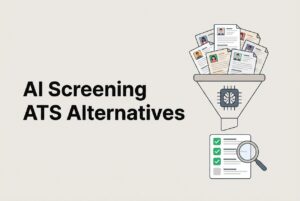
Stage 2 is where AI candidate matching earns its keep. The goal is not to match exact words. It is to rank surviving candidates by overall fit, using contextual NLP, semantic search, and the hiring pattern of the recruiter or team.
This is the difference between “contains Python” and “has the right kind of Python experience for this job.” It is also where Relative Resume Ranking becomes useful. Instead of flattening candidates into a keyword pile, the system evaluates role similarity, industry, location, and prior hiring patterns to sort the pool in a more realistic order.
In CVViZ, that ranking happens against the job and against your own resume database, which enables talent rediscovery too. The outcome is that the top part of the inbound pool can be identified in minutes, with explainable scores. That is a much better way to work than clicking open each resume and hoping the good ones float to the top.
This is also where the framework starts to feel different from standard ATS features. The ATS is no longer just storing applicants. It is helping you decide who deserves attention first.
Stage 3: Shortlist Review and Recruiter Override
The last stage is human judgment, and it should stay that way. AI can rank, explain, and route candidates, but the recruiter makes the final call. That is especially important for edge cases like career returners, internal referrals, or strong adjacent-domain candidates who do not fit a narrow filter.
In practice, this stage means reviewing a ranked shortlist, adding notes, advancing candidates, and documenting any override so the system keeps learning. Your ATS should support this with structured hiring workflow stages, scorecards, shared resumes, notes, email history, activity tracking, and key recruitment analytics.
And for agencies, the Recruitment CRM layer keeps client communication and collaboration in one place too.
The measurable outcome most teams feel immediately is that recruiter review per requisition can drop from about 2.5 hours to about 30 to 45 minutes. The other payoff is quieter but important. When the shortlist is genuinely relevant, interview-to-offer conversion tends to improve because fewer weak candidates leak through at the top.
That is the point of the framework: not to remove humans, but to stop making them do machine work.
Visual diagram: what the funnel should look like
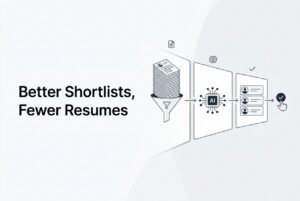
A good framework needs a visible shape. The Candidate Quality Framework works as a three-stage funnel that narrows from a large inbound pile to a small, reviewed shortlist.
Picture this:
250 applications
↓
Stage 1: Skills & Experience Fit
About 75 to 125 baseline-fit resumes remain
↓
Stage 2: Contextual Relevance
The system identifies the top 20% of the pool in minutes
↓
Stage 3: Shortlist Review and Recruiter Override
You forward 5 to 10 shortlisted candidates to the hiring manager
The visual should feel like a filter, not a black box. The left side is action, the right side is outcome. The first band is about rules, the second is about ranking, and the third is about judgment. If you are briefing a designer, label the stages with the tools that power them: Resume Parsing, AI Resume Screening plus Relative Resume Ranking, then Hiring Workflow plus Scorecards plus Analytics.
The useful insight here is simple. If your process cannot be drawn like this, it is probably too vague to run consistently. Recruiting falls apart when the system is invisible.
Practical application: what this looks like in real hiring
The framework is most useful when the team is busy, because that is when sloppy screening hurts most. A software startup hiring several engineers in a month, for example, can post once to multiple job boards, use Stage 1 to filter on must-haves like experience level and core stack, then use Stage 2 to rank the candidates who actually fit the role rather than the ones who merely repeated the job description.
At the end, Stage 3 lets the recruiter review the top slice, override a few exceptions, and move the strongest candidates forward quickly. That is how you cut screening time without turning hiring into a guessing game.
It also works in a staffing agency environment. The agency can auto-reject clear non-fits, rank the rest by contextual fit, and package a cleaner shortlist for the client. In that setup, the ATS is doing more than tracking candidates. It is helping the team deliver a more useful submission faster.
For a hard-to-fill technical role, the same logic applies to your own database. Talent rediscovery can surface past applicants who were good enough to keep, but not quite right for the last job. That is often where the hidden value is. The best ATS software for growing small businesses is not the one with the most buttons. It is the one that helps a lean team do this repeatably without adding headcount.
Metrics: how to know the system is working
You do not need a giant analytics stack to know whether shortlist quality is improving. You need a few clean measures that tell you whether the funnel is getting tighter and more useful.
Start with time-to-screen per requisition. A manual process can take about 2.5 hours for a 250-resume role, while the first two stages of the framework can bring that down to about 30 to 45 minutes. That is the clearest operational win.
Then watch application-to-shortlist conversion. If Stage 1 is too strict, you may starve the top of the funnel. If Stage 2 is weak, too many loose fits will leak through. The goal is not volume for its own sake. It is a shortlist that is small enough to review and strong enough to trust.
Other useful metrics include time-to-hire, interview-to-offer conversion, and recruiter hours saved per hire. Recruitment analytics should also tell you which sources produce usable candidates, not just more candidates. That is one of the practical advantages of a system with exportable reports.
If you are shopping for ATS features for growth & experience, this is the checklist that matters:
- AI Resume Screening included, not tacked on as an expensive add-on
- Unlimited users, so hiring does not get bottlenecked by seats
- Multi-board posting for broad reach
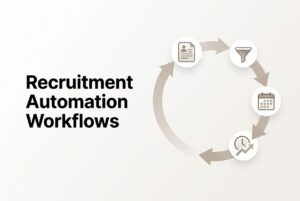
- Workflow automation for status updates and reminders
- Email and calendar sync
- Recruitment Analytics that show bottlenecks and source quality
- GDPR toolkit and access controls
- A clear human review path, with auditable overrides
That is what makes an ATS useful in the real world. Not just storage. Not just posting. A process that helps you think less like a firefighter and more like a hiring operator.
Which ATS is best for candidate experience?
The best ATS for candidate experience is the one that keeps applicants informed, moves them through the process quickly, and avoids the silence that makes people quit. In practice, that means automatic acknowledgments, status updates, courteous rejections, and a workflow that does not leave candidates wondering whether their resume disappeared into a black hole.
Candidate experience matters because poor communication drives real fallout. People abandon processes when scheduling drags, and many candidates report being ghosted. Strong employer brand, on the other hand, lowers cost-per-hire and attracts more qualified applicants. So candidate experience is not a nice-to-have. It is part of shortlist quality.
This is why the stage-3 behavior in the Candidate Quality Framework matters so much. If you want the best ATS for candidate experience, look for systems that automate acknowledgments and reminders, keep notes and history in one place, and let recruiters respond quickly without hunting through inboxes. CVViZ supports that through workflow automation, email tools, reminders, and a structured hiring flow that keeps status changes visible.
Which ATS is best for candidate experience?
If you are asking which ats is best for candidate experience, the honest answer is: the one that combines fast screening with clear communication and a human review path. A polished candidate portal alone does not solve a slow process. Neither does automation without judgment.
For a growing company, the better question is whether the ATS can do three things at once: filter irrelevant applicants, keep the candidate informed, and keep the recruiter in control.
The same logic applies if you are comparing options for a small team. The best AI ATS for growing small businesses should scale active jobs, support multiple users, and keep AI Resume Screening inside the core product rather than priced like a tax on efficiency.
In other words, the best ATS is not the one that promises everything. It is the one that helps a small team hire like a larger, better organized team.
FAQ
What is AI resume screening?
AI resume screening is software that uses NLP and machine learning to evaluate a resume against a job’s requirements. Instead of relying only on exact keyword matches, it looks at skills, experience, contextual relevance, and overall fit.
How does contextual candidate matching beat keyword matching?
Contextual matching understands that different candidates describe the same work in different language. It can connect synonyms, role similarity, and transferable skills, while keyword matching tends to miss those people entirely.
What is resume parsing?
Resume parsing is the automated extraction of structured data from an unstructured resume document. It pulls out fields like contact information, skills, experience, education, and certifications.
Will AI replace recruiters?
No. Good AI ranks, explains, and routes candidates, but the recruiter stays the decision authority. The best systems make human review better, not optional.
What is the difference between an ATS and a Recruitment CRM?
An ATS tracks applicants through the hiring pipeline. A Recruitment CRM manages relationships with clients, leads, contacts, and communication, which is especially useful for agencies.
How do I evaluate which ATS is best for a small business?
Look for AI Resume Screening included in the product, unlimited users, scalable job tiers, multi-board posting, email and calendar sync, workflow automation, analytics, and a trial that does not force a credit card up front.
Why are recruiters spending more time screening but hiring worse candidates?
Because application volume has gone up while manual attention has not. Without contextual filtering, recruiters skim quickly, and keyword-only systems drop qualified people while letting weaker matches through.
How long does it take to screen 100 resumes manually?
At a quality-review pace, it can take about an hour. If you are going deeper on each candidate, it can take much longer. AI screening can run that first pass in minutes.
Does AI screening cost extra?
It depends on the vendor. Some tools include it in lower tiers, while others charge for it as an add-on or gate it behind premium plans.
How can small businesses improve shortlist quality?
Use a structured framework: auto-filter for must-haves, rank by contextual fit, then review with human judgment and documented override. That is the cleanest way to reduce noise without overcorrecting.
How do I avoid bias in AI hiring?
Use systems that show decision rationale, document overrides, and keep a human review path. If you hire in regulated jurisdictions, you also need to pay attention to local rules around automated employment tools.
What is talent rediscovery?
Talent rediscovery is reapplying AI matching to your existing candidate database so you can surface past applicants who fit a new opening instead of starting from scratch.
Why this playbook matters
If your hiring process feels chaotic, the problem is usually not effort. It is structure. The Candidate Quality Framework gives you that structure in three steps: filter for fit, rank by context, and keep a human at the center of the final decision.
That is what better shortlist quality actually looks like. Less noise, faster review, clearer communication, and a process your team can repeat without heroics. And for a growing business, that is usually the difference between staying on top of hiring and letting it run you.