Most teams do not need another shiny demo of AI resume screening software. They need a way to tell whether the tool will actually surface good candidates, explain why it ranked them, and let recruiters stay in charge when the system gets it wrong.
That is the real buying test. Before you trust any vendor, run a controlled pilot on your own labeled resumes, measure whether qualified candidates appear near the top, inspect the reasons behind the ranking, test recruiter control live, and confirm the output fits your hiring workflow. If a tool cannot do that, it may still be impressive. It is not yet trustworthy.
The easiest trap is to confuse a polished interface with real utility. A clean dashboard does not prove screening accuracy. “Semantic AI” does not prove that the system understands your roles. And a single score, without explanation, is just a number wearing a tie.
What problem are recruiters actually trying to solve?
Recruiters are usually not buying software because they want an ATS overhaul. They are trying to fix a mess: too many resumes, too much Level 1 screening, scattered records, slow scheduling, and hiring managers asking for updates that no one can give quickly.
Manual review creates inconsistent decisions and burns time. Keyword search creates a different problem. It can miss qualified people who use different wording, and it can over-rank resumes that repeat job-description language without showing real depth. A disconnected workflow then makes things worse because screening, email, calendars, and reporting live in different places.
The better mental model is evidence triage. Use software to make the pool searchable and ranked, then make it easy for a human to inspect the evidence and decide what happens next. That is what buyers should evaluate in AI resume screening software.
The core distinction
A screening engine can be technically capable and still be unusable if recruiters cannot understand, challenge, correct, and measure its recommendations.
That one line should shape the demo.
Why do existing approaches fail?
Traditional screening usually breaks in four ways.
| Approach | What it does well | Where it fails |
|---|---|---|
| Keyword search | Finds exact terms quickly | Misses synonyms, transferable skills, and equivalent titles |
| Boolean search | Handles strict constraints and auditability | Is brittle when vocabulary varies |
| Opaque AI ranking | Produces a ranked list | Hides the reason for the rank and can be hard to challenge |
| Fully automated workflow | Speeds up handoffs | Can turn ranking into rejection without human review |
The first failure is obvious: keyword-only screening is too literal. A “Golang microservices” requirement may be represented in a resume as Go-based event-driven services, but literal search may not catch it.
The second failure is subtler. A match score without a definition is not an explanation. A candidate might rank high because of recent experience, skills, seniority, or prior hiring patterns. Unless the system shows the basis, recruiters are left guessing.
The third failure is workflow-related. Automation can make a bad decision faster. If a rule advances or rejects a candidate without a pause or approval step, the process may be efficient and still unsafe.
The fourth failure is data quality. Resumes with unusual layouts, OCR issues, or malformed parsing can feed the ranking engine bad inputs. If the parser is wrong, the score may be wrong for the wrong reason.
What framework should buyers use?
Use the TRACE Framework.
TRACE is a practical buying model for AI screening:
- T — Test the evidence
- R — Rank the candidates
- A — Audit the reasoning
- C — Control the decision
- E — Execute in the workflow
Here is the simple version: first test whether the tool finds the right resumes, then check how it ranks them, then inspect how it explains its choices, then see whether recruiters can control the outcome, and finally verify that it works inside your real hiring process.
TRACE at a glance
        DEFINE THE JOB + LABEL REAL RESUMES
                         |
                         v
                 T  TEST THE EVIDENCE
                         |
                         v
                  R  RANK THE LIST
             precision | recall | rank order
                         |
                         v
                 A  AUDIT THE REASONS
           criteria | weights | evidence | logs
                         |
                         v
                 C  CONTROL THE DECISION
       review | correct | override | approve | pause
                         |
                         v
                 E  EXECUTE AND MEASURE
        shadow mode | workflow fit | outcomes | drift
                         |
                         v
              GO / CONDITIONAL GO / NO-GO
A vendor should not get an unconditional yes because the top results “look good.” They need to pass the evidence gate, the control gate, and the execution gate.
How do you build a real accuracy test?
Start with the job, not the tool. Define the role criteria before the vendor configures the demo.
Separate:
- must-have requirements
- preferred requirements
- acceptable equivalents and transferable experience
- minimum level and recency expectations
- evidence that counts as strong, weak, or unknown
- conditions that require human review instead of automatic exclusion
Then build a labeled test set from real resumes. CVViZ’s own buyer guidance recommends testing on 1,000 actual resumes rather than a demo dataset and including historical, borderline, and nontraditional backgrounds. That number is a vendor recommendation, not a universal rule. The real requirement is that the set reflects your actual roles and resume formats.
Create role-specific labels such as:
- strongly relevant
- review
- not relevant
Use two reviewers when possible, label independently, and resolve disagreements before measuring the tool. Do not use the eventual hire as the only truth. Hiring outcomes also depend on compensation, interview quality, timing, and business changes.
Include hard cases on purpose
Your test set should include:
- equivalent terms and abbreviations
- projects or outcomes instead of skill lists
- adjacent or transferable skills
- different titles for similar work
- junior and senior versions of the same skill
- “exposure to” versus ownership
- career gaps and career changes
- nontraditional education or experience
- resumes with tables, columns, PDFs, or OCR issues
- missing information that should remain unknown
- resumes that repeat job-description keywords but show weak evidence
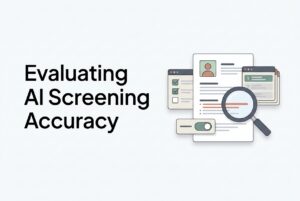
Also run a parser test before the matching test. If the parser extracts the wrong employer, title, or date, the ranking issue may be upstream. Ask the vendor to show the structured fields used for matching and compare them with a human-checked version.
How do you measure screening accuracy?
Do not stop at overall accuracy. In hiring, that number can hide too much.
A model can look good on paper while still missing qualified candidates. That is why recruiters need cutoff-based metrics tied to the review process.
| Metric | What it tells you | Why it matters |
|---|---|---|
| Precision | How many selected candidates were relevant | Measures review noise |
| Recall | How many relevant candidates were found | Exposes missed candidates |
| F1 | Balance between precision and recall | Useful when both matter |
| Precision@K | Relevance in the first K candidates | Tests the actual shortlist view |
| Recall@K | Relevant candidates found within the first K | Shows whether the cutoff hides talent |
| NDCG@K | Graded ranking quality near the top | Useful when labels include strong fit and review |
| False-negative rate | Qualified people the system missed | Often the most painful failure |
| Rank stability | Whether ordering stays consistent | Reveals shaky recommendations |
| Parser field accuracy | Whether extraction was correct | Separates parsing errors from matching errors |
Set K before the test. Do not choose it after seeing the result. Then compare the tool with your current baseline on the same labeled set.
There is no universal pass percentage that works for every role. A high-volume support role, a scarce security role, and a senior engineering role all have different error costs. Set your own internal threshold for must-have recall and acceptable review noise.
The scorecard to capture
For each role, record:
- number of labeled resumes
- number labeled strongly relevant, review, and not relevant
- top-K precision and recall
- qualified false negatives
- irrelevant top-K candidates
- parser errors by field
- rank changes after one criterion changes
- reviewer agreement with the recommendation
- reviewer override rate and reason
- time to a usable shortlist
That gives you screening accuracy in a way a vendor brochure never will.
How do you test ranking transparency?
A usable explanation should let a recruiter move from the candidate’s position to the evidence behind it.
Ask for:
- the job criteria used in the run
- required versus preferred criteria
- factors that increased or decreased relevance
- resume evidence supporting each factor
- missing, ambiguous, or conflicting information
- weight or priority assigned to important factors
- the model or scoring version and run date
- the effect of editing a criterion or weight
- a record of recruiter changes and overrides
If the answer is “strong match,” keep asking. That is not an explanation.
Live test questions
Use two resumes with similar keywords but different depth and ask:
- Why is Candidate A above Candidate B?
- Which evidence was decisive?
- What would move Candidate B higher?
- Did the system treat a listed skill, project, certification, and work history differently?
- What happens when a preferred criterion is removed?
- Can a recruiter see missing evidence without opening multiple systems?
Then test an ambiguous resume. A trustworthy system should distinguish “not present,” “not parsed,” and “not enough evidence” where the product supports those states.
What CVViZ publicly shows
CVViZ publicly describes configurable screening criteria and weighting, and it says ranking is relative to the job and candidate pool. The reviewed public material did not publish a detailed per-candidate score explanation or a clearly documented override function.
That means the right buyer move is simple: ask CVViZ to demonstrate the explanation and override workflow live. Do not assume it exists just because the ranking looks sensible.
What does recruiter control look like in practice?
Recruiter control means more than “a human can look at the list.” It means the recruiter can actually shape and stop the process.
Test whether the recruiter can:
- edit must-have and preferred criteria
- assign or change weights
- exclude or include a candidate manually
- override a recommendation while preserving the original result
- add a reason, note, or scorecard
- return a candidate to the review queue
- pause a rule or automated message
- require approval before rejection or advancement
- see who changed a status and when
- restrict access by role
- export the evidence for a hiring-manager review
CVViZ allows its users to customize criteria, review recommendations, manually shortlist candidates, adjust priorities, and retain control of final decisions. It also says recruiters can assign different weights to factors such as qualifications, work experience, domain knowledge, skills, and job stability. Those are useful control claims, but the live demo still needs to prove the exact edit, override, logging, and permission behavior.
Human-review operating model
A clean setup looks like this:
- AI produces a ranked list and structured evidence
- A recruiter reviews the top group and a sample below the cutoff
- The recruiter labels agree, disagree, or insufficient evidence
- An exception queue captures false negatives, ambiguous profiles, and parser errors
- A hiring manager reviews the shortlist with evidence visible
- Automation sends only the approved next action
- Override reasons feed the next evaluation cycle
That is recruiter control. Not a checkbox. A workflow.
How do you test workflow fit?
A screening engine can be accurate in isolation and still fail if it does not fit the hiring workflow.
Test the full path:
| Workflow point | What to test | Failure signal |
|---|---|---|
| Intake | Import from job boards, email, referrals, and career page | Manual re-keying or lost source data |
| Parsing | View structured fields and original documents side by side | Wrong dates, titles, skills, or duplicates |
| Matching | Run the golden set and inspect the top-K list | Good candidates vanish or keyword-heavy profiles dominate |
| Review | Shortlist, reject, hold, note, and assign candidates | Recruiter cannot correct the result or preserve the record |
| Communication | Trigger templates, reminders, and candidate messages | Rules fire without approval or pause control |
| Scheduling | Connect calendars and create a test interview | Double booking or broken time zones |
| Collaboration | Let a hiring manager review a shortlist | Manager needs a second spreadsheet |
| Reporting | Export source, pipeline, override, and timing data | Team cannot measure whether screening improved |
| Rediscovery | Open a new role and search the historical pool | Past candidates cannot be found or are not explained |
| Migration/API | Send a test record to and from the ATS | Duplicate IDs or unclear ownership |
What CVViZ says publicly
CVViZ is a complete AI recruiting software comprising AI ATS, recruitment CRM, AI screening, workflow automation, email and calendar sync, collaboration tools, reporting, and resume parser API access. It also says it can source from job boards, LinkedIn, GitHub, internal databases, and other channels, and it can distribute jobs broadly.
Those are capability statements, not proof that every connector or action works in every plan. Buyers should verify the current integration matrix, data-sync direction, error handling, rate limits, record ownership, and entitlement.
What should buyers know about CVViZ specifically?
Here is the practical fact sheet.
| Area | What CVViZ states | What still needs verification |
|---|---|---|
| Screening | Contextual AI/NLP screening evaluates skills, experience, relevance, and fit | Accuracy on your roles and edge cases |
| Ranking | Ranking is real time and relative | Score meaning, stability, and cutoff behavior |
| Controls | Recruiters can customize criteria, review recommendations, manually shortlist, adjust priorities, and retain final decision control | Exact override, approval, pause, and logging behavior |
| De-identification | The product page says names, locations, and ethnicity are removed before evaluation | Exact fields removed and whether they can be reconstructed |
| Rediscovery | The system can rank matching candidates already in the database | Historical coverage and duplicate handling |
| Intake and sourcing | Public material claims sourcing from many channels and broad job-board distribution | Current source coverage, plan limits, and regional availability |
| Workflow | ATS, CRM, automation, messaging, interviews, calendars, and analytics are described | Which actions are native and which are integrated |
| API | API access is listed on Standard and Pro, with a parser API add-on | Documentation, limits, and scope |
| Evidence | Public product claims and user reviews are available | No public independent screening benchmark was found |
How should teams run a pilot?
A good pilot is staged. Do not jump straight to production.
Phase 1: Baseline
Record the current process for a set of requisitions:
- applicants received
- time spent on parsing and first review
- candidates advanced to recruiter screen
- candidates advanced to hiring manager review
- qualified candidates below the usual cutoff
- source of each candidate
- time to a usable shortlist
- recruiter and hiring-manager disagreement rate
- duplicate and missing-data rate
Keep the role definition fixed.
Phase 2: Blind screening test
Run the vendor on the labeled set without labels. Capture:
- full ranked output
- extracted fields
- score or reason display
- timestamps
Compare top-K precision, recall, false negatives, parser errors, and rank stability against the current process.
Phase 3: Explanation and control test
For at least five strong matches, five borderline matches, and five misses, ask the recruiter to explain the result using only the product interface. Change one criterion or weight and rerun. Exercise shortlist, hold, reject, restore, note, approval, and pause actions.
Phase 4: Workflow shadow mode
Connect a test mailbox, calendar, ATS or CRM endpoint, and communication channel. Let the system prepare actions, but require a human to approve messages, status changes, and rejections. Measure duplicate creation, missing fields, sync latency, failed triggers, and record ownership.
Phase 5: Limited live pilot
Start with a small number of real requisitions owned by engaged recruiters. Keep manual review for every candidate group until false negatives and workflow failures are understood.
Phase 6: Go / no-go review
Approve production only if:
- top-K relevance is at least as useful as the baseline under an agreed internal rule
- critical false negatives have a handling path
- ranking reasons are adequate for recruiter and hiring-manager review
- recruiters can change or stop the next action
- records, notes, source, and decision history remain intact
- integrations do not create duplicate or orphaned candidates
- outcome and override metrics can be exported
- the team has an owner and review cadence for drift
What metrics should teams track after rollout?
After launch, keep the measurement simple and disciplined.
Accuracy and quality
- precision@K
- recall@K
- qualified false negatives
- NDCG@K
- parser field accuracy
- recruiter override rate
- reviewer agreement with AI recommendation
- percentage of top-K candidates reaching recruiter screen
- percentage of recruiter-screen candidates reaching hiring-manager review
- percentage of silver-medalist candidates rediscovered later
Productivity and workflow
- time from application to usable shortlist
- recruiter review time per applicant
- time spent on screening calls
- time spent scheduling
- time from shortlist to first interview
- trigger failure and manual-repair rate
- duplicate-record rate
- candidate response time
- pipeline aging by stage
- time to fill, measured consistently with the baseline
Drift monitoring
Re-test when job-family definitions, scoring criteria, model version, source mix, resume format mix, geography, language mix, automation rules, or ATS configuration changes.
A better-looking score after a workflow change may reflect a changed label or cutoff, not a better model.
FAQ
Does AI resume screening replace recruiters?
No. It should prioritize and organize evidence so recruiters spend less time on repetitive review. Recruiters still define the role, inspect edge cases, make or approve decisions, and watch for false negatives and overrides.
How can a recruiter test screening accuracy?
Create a role-specific labeled set of real resumes, run the tool without labels, and compare the top-K results with recruiter judgments. Measure precision, recall, false negatives, parser errors, and rank changes after controlled edits to job criteria.
What is the difference between parsing, matching, and ranking?
Parsing extracts structured facts. Matching compares those facts and the resume context with the job. Ranking orders the matching candidates. A system can parse well but rank poorly, so test the layers separately.
Is semantic matching better than keyword search?
It can capture equivalent wording and context that literal search misses, but it can also introduce opaque or incorrect matches. Keep exact search and filters available, and validate semantic results with labeled resumes.
What should an AI ranking explanation contain?
It should show the job criteria, required and preferred factors, evidence used, missing or ambiguous information, important weights, and what changed the candidate’s position. A generic match score is not enough.
Can a candidate’s score be compared across jobs?
Not necessarily. CVViZ describes its ranking as relative to the job and comparison pool. Ask whether scores are calibrated and comparable; otherwise compare candidates only within the same role and run.
What does recruiter control mean in practice?
It means the recruiter can change criteria and weights, review the evidence, shortlist or hold a candidate, override a recommendation, pause an automation, require approval, and preserve the original record and reason for the change. Each action should be demonstrated.
Does CVViZ publish a screening-accuracy percentage?
No public percentage or independent precision/recall benchmark was found in the reviewed material. Buyers should run their own labeled-resume test and ask CVViZ for validation data relevant to their roles.
Can CVViZ work with an existing ATS?
Yes – it can integrate with another ATS or online recruitment software. Standard and Pro list API access, and the page lists a $25-per-job integration add-on. The buyer still needs to test synchronization, duplicate handling, notes, statuses, IDs, and error recovery.