A strong hiring funnel does not start with an application form. It starts much earlier, with recruitment marketing that helps the right people discover an employer, understand the work, and decide whether it is worth applying. For a lean TA team, that matters because the real question is not just “Do we have open jobs?” It is “Do enough suitable people know we exist, understand the opportunity, and feel confident enough to move forward?” That is the heart of talent attraction, and it is where a candidate funnel becomes useful.
The model is simple on purpose: awareness, consideration, application, and nurture alongside or after those steps. It is not a perfect map of human behavior. Candidates do not move in a neat line. Some apply fast. Some linger. Some come back later. But as a planning tool, the funnel gives you a cleaner way to see where interest is growing and where it is disappearing.
What is a recruitment marketing funnel?
A recruitment marketing funnel is a simplified way to understand how a potential candidate moves from first discovering an employer to submitting an application. Recruitment marketing covers the employer-brand and candidate-engagement work that helps people notice the company, learn what the role is really like, and decide whether to apply. It can begin before a specific vacancy exists.
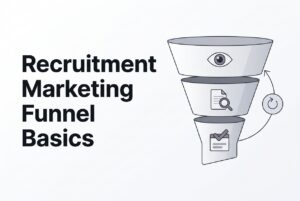
A candidate funnel is just the planning model underneath that work. It moves from awareness to consideration to application, with nurture running alongside those stages and after them when someone is not ready yet or a later role is a better fit. That is why this model is useful for talent attraction. It helps you separate “people know us” from “people want us” from “people actually apply.”
One important caution: the funnel is not the same thing as the full candidate journey. The journey can continue through interviews, offers, and onboarding. The funnel is the employer’s narrower view of discovery and submission. Also, a prospect is not an applicant until they submit an application. Opening a form is not the same thing as finishing it.
Key takeaway: Recruitment marketing helps people move toward interest and action, but the funnel is a simplified model, not a promise that everyone behaves the same way.
What happens at awareness?
Awareness is the first stage. It answers a basic question: “Who is this employer?” At this point, the candidate may have seen a job listing, employee story, referral, event mention, or careers page. They are not judging fit yet. They are just deciding whether the company is worth a closer look.
For a mid-market employer, this is where many funnels quietly fail. If someone cannot find a truthful introduction to the organization and the work, there is no next step to measure. That does not mean every visitor is ready to apply. It means enough information should exist for someone to recognize what the company does and why it might be worth exploring.
Awareness is also where recruitment marketing should stay honest. You do not need to pretend every first encounter is with a hot applicant. Plenty of people are passive at this stage. They are simply noticing. That is still valuable.
Key takeaway: Awareness is not application intent. It is the moment someone first notices the employer and decides whether to learn more.
How does a candidate decide whether to apply?
This is the consideration stage, and it is where the candidate starts asking, “Would I want this job, and am I a plausible fit?” They may read the job description, scan careers pages, check benefits and work arrangements, or ask people they know what the company is like.
This is also where talent attraction has to do real work. Slogans do not help much here. Candidates need a realistic preview of the role, not a vague promise. They need to know what the work involves, what is required versus preferred, and what practical details are known. If the role is hybrid, say so. If location matters, say so. If the job has a hard must-have, say that too.
That honesty is useful even when it reduces volume. In fact, it often should. A well-written description helps suitable candidates move forward and helps unsuitable candidates self-select out. That is not a failure. That is a sign the funnel is doing its job.
Consideration can also end in a decision not to apply. For a lean recruiting team, that is not automatically a loss. If the role truly does not fit, the best outcome may be a clear no from the candidate instead of a weak application that goes nowhere.
Key takeaway: Consideration is where candidates decide whether the opportunity fits their needs, not just whether they can technically apply.
What turns interest into a submitted application?
Application is the point where intent becomes action. The keyword is submitted. Someone who opens a form or starts entering details is not yet counted as an applicant in this guide. A submitted application is the real event that enters the hiring process.
So what helps someone finish? Clarity. They need to know what information is being asked for, why it matters, and what happens next. A clear application experience does not need to be flashy. It needs to be understandable. Essential questions should be easy to identify. Instructions should be plain. Next-step expectations should not feel like a mystery.
This is also where many recruiters overestimate what is causing friction. The research does not support a universal maximum number of questions or clicks. There is no fixed threshold that guarantees completion for every employer. So instead of hunting for a magic number, look at whether the application is asking for the right information at the right time. A form can be too long, but it can also be simply unclear.
One useful distinction here: an application start problem is not the same as a relevance problem. If lots of people start but do not submit, the issue may be with the form or process.
Key takeaway: Application completion depends on clarity, not just interest. A started form is not a submitted application.
Where does nurture fit if someone is not ready?
Nurture is the part of the funnel people often misunderstand. It is not a fourth mandatory stage that happens only after the application. It is a relationship loop that can happen before, during, or after the main path, as long as it is relevant and permission-based.
A candidate may like the employer but not be ready to move now. A strong runner-up may be worth reconnecting with later. A past applicant may be a fit for a future role. In each case, nurture helps keep the relationship warm without pressuring the person to act before the timing is right.
That distinction matters. Nurture is not a license to keep candidates waiting or to treat every saved profile like permission for marketing contact. An application or résumé is not automatically consent for ongoing outreach. The person should understand why you are staying in touch and have the right kind of opt-in for that relationship.
This is where recruitment marketing becomes more than posting jobs. It sustains interest between openings and creates a path back into the candidate funnel when timing changes.
Key takeaway: Nurture is respectful re-engagement, not indefinite delay or noisy follow-up.
How can you tell where candidates stop moving?
If your funnel feels leaky, the first job is not to guess. It is to identify where uncertainty begins. A lean TA team does not need a perfect analytics stack to do that. It needs clean event definitions and a consistent denominator.
| If the observed problem is… | First question to investigate |
|---|---|
| Appropriate people do not seem to know the employer | Can they readily discover a truthful introduction to the organization and its work? |
| People see a role but hesitate | Does the description answer the fit and practical-work questions needed to decide? |
| People start but do not submit | Is the initial application understandable and limited to information needed now? |
| Good prospects are interested but timing is wrong | Is there a relevant, permission-based way to reconnect later? |
| Applicants disengage after submission | Are decisions and next-step expectations communicated honestly and promptly? |
This is a diagnostic table, not a scoreboard. It helps you form hypotheses. For example, many visitors with few starts may point to a consideration problem. Many starts with poor submissions may point to application friction. Strong applicant volume with poor follow-through may point to communication gaps after submission.
Key takeaway: Use the funnel to locate the first place uncertainty appears, then investigate the candidate experience at that point.
What should a lean TA team measure?
The right measure depends on the question. Do not compare rates unless the numerator, denominator, and time period are defined the same way. That sounds obvious, but in recruiting it gets mixed up fast.
A practical starting point looks like this:
| Question | Simple observation or calculation | Interpretation limit |
|---|---|---|
| Are people reaching relevant information? | Views or distinct visitors for a relevant careers or role page, where measurable. | A view does not prove the person is qualified or considering applying. |
| Are interested people taking the next step? | Application starts ÷ distinct role-page visitors for the same role and period, if both events are consistently available. | Some candidates start elsewhere or visit repeatedly. |
| Are starters completing? | Submitted applications ÷ application starts. | Define what counts as a start and do not assume every noncompletion is caused by form design. |
| Are applications relevant? | Review whether submitted candidates meet the role’s essential criteria. | More applications do not necessarily mean more suitable candidates. |
| Is the relationship being maintained appropriately? | Observe permission-based interest, responses, and returns to consider later roles, where available. | A signup is not a completed application or a hire. |
There are two useful candidate behavior signals worth keeping in mind. In the research, poor employer communication was cited by 47% of survey respondents as a reason they had withdrawn applications. In the same reported survey, 35% said they had quit a job application because they were asked to write a long presentation or business case. Those are not universal benchmarks, but they do show a simple truth: communication and burden matter.
That is why the most useful TA questions are often plain ones. Where are people dropping off? What was unclear? What was too much? What was missing?
Key takeaway: Measure the event you actually care about, then interpret it with care. Not every drop-off has the same cause.
What mistakes distort the funnel?
Several mistakes show up again and again.
First, treating nurture as the final mandatory box. It is not. Nurture is a possible loop, not a forced stage.
Second, using candidate, prospect, and applicant as if they mean the same thing. They do not. A person can discover the employer, express interest, begin a form, and submit it. Those are different events.
Third, assuming more top-of-funnel reach always improves hiring. It may increase volume without improving fit. Recruitment marketing should help suitable people make an informed choice, not just attract more clicks.
Fourth, hiding job realities to get more applications. That usually creates more noise, not better hiring. Clear requirements and a truthful preview help the right candidates self-select.
Fifth, confusing abandonment during the application with withdrawal later in the process. Those are different problems. One is often about form friction. The other may be about communication, delay, or trust.
Sixth, assuming every saved candidate record is permission to market to them later. It is not. Permission matters.
Key takeaway: The funnel breaks when terms blur and when teams chase volume without checking fit, clarity, or consent.
Where does CVViZ fit in this picture?
Use this only as a practical example, not as the point of the article. CVViZ provides tools that can support parts of the recruitment marketing funnel by distributing eligible vacancies to supported job boards, building career pages, capturing applications and source data in a centralized job-linked candidate database, and maintaining searchable candidate records for later fit. It also supports candidate communication history, email sequences, and talent rediscovery.
That can be useful when you want to connect discovery, application records, and later re-engagement in one system. But the system does not create candidate interest by itself, and it does not guarantee movement through the funnel. The work still starts with a clear employer story, honest role information, and a respectful candidate experience.
For a mid-market team, that is the real lesson. Tools can help you manage the process. They cannot replace the process.
Key takeaway: CVViZ can support parts of recruitment marketing and re-engagement, but it does not replace the need for clear information and good candidate decisions.
What is the practical decision aid for a TA leader?
If you are leading a lean recruiting team, use this simple decision aid to diagnose where the candidate funnel is weakening.
| If the observed problem is… | First question to investigate |
|---|---|
| Appropriate people do not seem to know the employer | Can they readily discover a truthful introduction to the organization and its work? |
| People see a role but hesitate | Does the description answer the fit and practical-work questions needed to decide? |
| People start but do not submit | Is the initial application understandable and limited to information needed now? |
| Good prospects are interested but timing is wrong | Is there a relevant, permission-based way to reconnect later? |
| Applicants disengage after submission | Are decisions and next-step expectations communicated honestly and promptly? |
That table is the whole playbook in miniature. If awareness is weak, improve discoverability and the first impression. If consideration is weak, improve the role story. If application is weak, simplify the ask. If nurture is weak, make re-engagement relevant and permission-based. If candidates disappear after submission, fix communication.
That is what a recruitment marketing funnel is for. Not vanity metrics. Not jargon. Just a clearer way to see where people move, where they stall, and what they need next.
Key takeaway: The best funnel work is diagnostic. Find the first point of friction, then make that stage easier for the candidate to complete.