Recruitment marketing is the set of practices used to find, attract, engage, and nurture potential employees before they apply. In plain terms, it is how an employer gets on a candidate’s radar, earns interest, and nudges the right next step. The key distinction is simple: employer brand is what an organization is known for as an employer, recruitment marketing communicates that proposition to relevant people, and recruiting evaluates and hires applicants.
That boundary matters because people often use these terms interchangeably when they are not the same thing. Some teams include the full candidate journey in recruitment marketing. Others keep it narrower and focus on pre-application work. Both usages exist, so the safest move is to define the term in context.
What Is Recruitment Marketing?
Recruitment marketing is the use of employer-brand messaging, content, career pages, job promotion, outreach, and candidate relationships to attract and engage potential hires. It is a strategy, not just a job post. It often starts before someone applies and may continue through application-stage touchpoints depending on how a team defines the term.
Why It Matters
A growing company does not want to start from zero every time a role opens. Recruitment marketing helps build familiarity with relevant people ahead of time, so when a vacancy appears, the employer is not an unknown name. That matters most when hiring is urgent or competitive.
Example
An engineering team publishes a write-up about a technical problem it solved, invites interested readers to hear about future roles, and later reaches out to people who match a new opening.
Related Terms
Employer brand, candidate attraction, recruitment campaign, talent community
Common Misconceptions
Recruitment marketing is not just posting more jobs. It is also not something only a marketing team can do.
What Is Candidate Attraction?
Candidate attraction is the work of making relevant people aware of an employer and interested enough to learn more. It can come from a clear job description, a credible career page, employee stories, referrals, search visibility, direct outreach, or advertising. The point is not raw volume. It is reaching people who are actually plausible fits.
Why It Matters
More reach without relevance usually creates more screening work, not better hiring. A strong attraction strategy makes the role understandable and honest before the application starts.
Example
A small software company explains the team’s technical problems and location expectations before sharing an engineering role in a specialist community.
Related Terms
Employer brand, candidate persona, job advertising, inbound recruiting
Common Misconceptions
Candidate attraction is not measured well by application count alone.
What Is an Employer Brand?
An employer brand is how an organization is understood and differentiated as a place to work. It includes the promises the employer communicates and the reputation people form from employee experience, public information, and recruiter interactions. Every employer has one, even if no formal branding project exists.
Why It Matters
Candidates use their impression of the employer to decide whether a role deserves attention. If the promise is not supported by reality, trust erodes fast.
Example
A growing company describes engineering autonomy on its career page, while employees explain how decisions actually get made.
Related Terms
Employee value proposition, employee experience, candidate journey
Common Misconceptions
An employer brand is not a logo, a slogan, or a tagline. It is the actual reputation of the employer.
What Is an Employee Value Proposition, or EVP?
An EVP describes what an organization stands for, expects, and offers people who work there. It can include the work itself, development, management, flexibility, compensation, and culture, as long as those claims reflect actual practice. The EVP is the substance behind employer-brand communication.
Why It Matters
A clear EVP helps recruiters explain why this opportunity is worth considering instead of relying on vague promises. It also keeps the message grounded in real working conditions.
Example
A startup explains the scope of ownership an incoming engineer would have and the trade-off of working in a smaller team.
Related Terms
Employer brand, candidate persona, employee experience
Common Misconceptions
An EVP is not just a benefits list. It is not a slogan you can invent separately from the actual employee experience.
What Is a Candidate Persona?
A candidate persona is a practical description of a type of person a recruiting team wants to reach. It brings together job-relevant characteristics, motivations, likely questions, and the places that person might encounter career information. Personas help shape messages and channels, but they are not a stereotype checklist.
Why It Matters
The same role may need different framing for different audiences. A message that works for an experienced engineer may not work for a recent graduate.
Example
For a developer role, the team identifies candidates interested in architectural ownership and creates content that addresses that interest.
Related Terms
Audience segmentation, personalization, content marketing
Common Misconceptions
A persona is not permission to stereotype candidates or add unnecessary demographic filters.
What Is Audience Segmentation?
Audience segmentation means dividing potential candidates into relevant groups so communications can address different needs. Those groups may reflect job family, skills, location, career stage, or relationship to the employer, such as past applicant versus new prospect. The goal is relevance, not blanket outreach.
Why It Matters
Segmentation reduces irrelevant messaging and makes existing candidate records more useful. It also helps recruiters avoid sending the same vacancy to everyone.
Example
A recruiter sends a technical-team update to people who expressed interest in engineering roles, rather than to every previous applicant.
Related Terms
Candidate persona, nurture, talent pool, personalization
Common Misconceptions
Segmentation is not the same as ranking people by presumed quality.
What Is a Candidate Lead?
A candidate lead is a person who may be interested in working for an organization now or later but generally has not applied for a particular job. They may have joined a talent network, attended an event, or responded to outreach. A lead signals possible interest, not qualification.
Why It Matters
Keeping leads separate from applicants preserves the distinction between relationship building and formal selection. That helps teams follow up appropriately.
Example
A conference attendee asks to hear about future design openings but has not submitted an application.
Related Terms
Talent network, conversion, candidate relationship management
Common Misconceptions
Not everyone whose profile a recruiter finds online is an engaged lead.
What Is a Talent Pool?
A talent pool is a group of potentially relevant people retained for present or future recruiting needs. It may include former applicants, sourced prospects, referrals, event contacts, or former employees. A pool describes who is stored or available for consideration, not who is already warm or qualified for a specific opening.
Why It Matters
A strong pool lets recruiters revisit known people instead of treating every vacancy like a brand-new search. That saves time and preserves useful context.
Example
A company keeps a group of previously interviewed designers who agreed to be considered for later roles.
Related Terms
Talent pipeline, talent community, candidate rediscovery
Common Misconceptions
Everyone in the database is not automatically a warm candidate.
What Is a Talent Pipeline?
A talent pipeline is the developing supply of people who could move toward a hiring need, often with visibility into their relevance and engagement stage. In some organizations, it means cultivated future candidates. In others, it means applicants moving through an active requisition. The usage should be made clear each time.
Why It Matters
The term helps a growing team distinguish promising, engaged prospects from a large pile of unreviewed records.
Example
A recruiter identifies developers for an anticipated role, records who has spoken with the team, and follows up when the role opens.
Related Terms
Talent pool, candidate journey, recruitment funnel
Common Misconceptions
A pipeline does not guarantee that people will be available or willing to apply when needed.
What Is a Talent Community or Talent Network?
A talent community or talent network is an ongoing group of people who may want information about future work. The terms are sometimes used interchangeably with talent pool. When they are distinguished, pool emphasizes records and community emphasizes active, permission-based interaction.
Why It Matters
A community gives an employer a way to stay in touch when no suitable role is open yet. That keeps interest warm without forcing an immediate application.
Example
People opt in to receive occasional updates about a company’s engineering projects and relevant openings.
Related Terms
Talent pool, candidate lead, nurture
Common Misconceptions
A large subscriber list does not prove that people want every future job alert.
What Is Candidate Relationship Management?
Candidate relationship management is the practice of organizing and maintaining relationships with prospective, passive, and former candidates over time. A recruitment CRM can support that practice by recording contacts, interests, interactions, and follow-ups. This is distinct from the main job of an ATS, which is to organize applications and open-role progress.
Why It Matters
Without relationship management, useful context gets lost in scattered emails and spreadsheets. That makes re-engagement harder later.
Example
A recruiter sees that a past finalist preferred remote roles and reaches out only when a suitable opening appears.
Related Terms
Talent pipeline, nurture, candidate rediscovery
Common Misconceptions
Calling a database a CRM does not mean candidates have actually been informed or engaged.
What Is Candidate Nurture?
Candidate nurture is a series of relevant interactions that keeps an employer recognizable to a person who is not ready to apply and helps them consider an appropriate next step. It can include team updates, useful role information, event invites, or a personal check-in. Timing, content, and permission matter more than volume.
Why It Matters
Interest and hiring needs do not always happen at the same time. Nurture keeps the relationship alive until the fit is real.
Example
A recruiter periodically shares engineering-team updates with an interested prospect, then discusses a matching opening months later.
Related Terms
Talent community, recruitment CRM, candidate engagement
Common Misconceptions
Nurture is not repeated blasting of the same job alert to an entire database.
What Is Candidate Rediscovery?
Candidate rediscovery means finding potentially suitable people already known to an employer, such as previous applicants or sourced prospects, when a new role becomes available. Recruiters review records, interactions, and role fit before reaching out. It is a way to reuse what the employer already knows, not a shortcut that skips judgment.
Why It Matters
A relevant past contact can be overlooked if recruiters always start sourcing from scratch. Rediscovery makes prior effort useful again.
Example
A recruiter revisits a previous engineering finalist after a more suitable role opens and checks current interest.
Related Terms
Talent pool, candidate relationship management, nurture
Common Misconceptions
Automatically messaging every past applicant is not personalized rediscovery.
What Is the Candidate Journey?
The candidate journey is the sequence of stages and interactions through which a person becomes aware of an employer, considers it, expresses interest, applies, and may eventually join. Some teams include selection, offer, and onboarding. Others focus on pre-application stages. Both usages exist, so the scope should be stated clearly.
Why It Matters
Mapping the journey exposes gaps between first interest and a confusing or slow application process. It helps teams see where candidates drop off.
Example
A prospect sees an employee story, visits the career page, joins a talent network, and later applies for an opening.
Related Terms
Touchpoint, candidate experience, recruitment funnel
Common Misconceptions
The candidate journey is not one fixed linear path from ad to hire.
What Is a Candidate Touchpoint?
A candidate touchpoint is any interaction a person has with an employer or its people during the candidate journey. That includes a search result, social post, job ad, career page, application form, confirmation email, or recruiter conversation. Touchpoints can reinforce each other or conflict with each other.
Why It Matters
Small inconsistencies can make candidates unsure about the role or whether the employer even received their application. Touchpoints matter because they shape trust.
Example
A job ad promises flexible work, but the career page is vague and a recruiter gives a conflicting explanation.
Related Terms
Candidate journey, employer brand, candidate experience
Common Misconceptions
Only paid ads count as marketing touchpoints.
What Is Candidate Experience?
Candidate experience is how people perceive their interactions with an employer throughout discovery, application, and hiring. It reflects clarity, effort, response time, respect in interviews, and consistency of communication. Recruitment marketing influences expectations early, but it does not control everything that happens later.
Why It Matters
A polished campaign cannot make up for a confusing application or long silence after someone applies. Candidate experience is where promises meet reality.
Example
A candidate applies through a clear form, receives confirmation, and knows what the next step will be.
Related Terms
Candidate journey, touchpoint, employer brand
Common Misconceptions
Candidate experience does not begin only with the first interview.
What Is a Recruitment Marketing Campaign?
A recruitment marketing campaign is a coordinated set of messages and activities directed toward a specific candidate audience and purpose. It might combine a team story, a career-page destination, social posts, an event, and follow-up messages. It is more deliberate than a single job post.
Why It Matters
Coordination prevents an employer from sending mixed signals across candidate channels. It also makes the next step clearer.
Example
A company introducing a new product team shares an employee interview and invites interested specialists to a team information session.
Related Terms
Audience segmentation, landing page, call to action, source tracking
Common Misconceptions
A single sponsored post or bulk email is not automatically a complete campaign.
What Is Recruitment Content Marketing?
Recruitment content marketing creates and shares information that prospective candidates find useful when assessing an employer or a role. Examples include team project stories, employee interviews, explanations of how work is organized, and candid descriptions of expectations. The content should answer a real candidate question, not just echo a slogan.
Why It Matters
A small company that cannot rely on name recognition can still show people what working there actually involves.
Example
Engineers explain a technical problem the team solved and the responsibilities a new colleague would take on.
Related Terms
Employer brand, inbound recruiting, candidate persona
Common Misconceptions
Recruitment content marketing is not just office photos with a caption.
What Is Inbound Recruiting?
Inbound recruiting attracts candidates by making useful employer and job information discoverable, so people find it while researching opportunities. Career pages, relevant content, and search visibility support this approach. It is different from direct sourcing, although most teams use both.
Why It Matters
Interested people can learn about the organization without waiting for a recruiter to contact them. That makes discovery easier and more natural.
Example
A developer finds a technical-team article through search and follows it to the company’s career page.
Related Terms
Career site, search engine optimization, candidate attraction
Common Misconceptions
Inbound recruiting is not the same as posting a vacancy and waiting passively.
What Is a Career Site or Career Page?
A career site is an employer-controlled destination where candidates can learn about work, people, and opportunities. A company career page may be the relevant section or a specific jobs page. Compared with a job board listing, it gives the employer more room to explain its proposition and application process.
Why It Matters
A career site connects interest from search, referrals, social posts, and job boards to information the employer controls. That makes the experience more consistent.
Example
A candidate follows a shared job link, reads the team’s work and requirements, then submits an application on the employer’s page.
Related Terms
Employer brand, landing page, conversion, career-page SEO
Common Misconceptions
A list of vacancies alone does not answer candidate questions about the employer.
What Is a Recruitment Landing Page?
A recruitment landing page is a focused page built to help a particular audience understand an opportunity or employer proposition and take a defined next step. That action could be applying, joining a talent network, or registering for an event. It is narrower than a general career site.
Why It Matters
A landing page lets a company explain the context behind a specialist role instead of sending everyone to a generic jobs list.
Example
A campaign about a new data team sends interested engineers to a page describing the work and inviting them to learn about openings.
Related Terms
Recruitment campaign, candidate persona, call to action
Common Misconceptions
Any page visited after clicking a job ad is not automatically an effective landing page.
What Is a Call to Action, or CTA?
A call to action is a clear invitation for a candidate to take a next step. Depending on interest stage, it might say to view openings, learn about a team, join a talent network, register for an event, or apply for a specific role. The action should match the page or message.
Why It Matters
A strong message can lose interest if it never tells people what to do next. Clarity matters.
Example
An employee story invites readers to explore the engineering team, while a job page invites qualified readers to apply.
Related Terms
Landing page, conversion, candidate journey
Common Misconceptions
Every recruitment CTA does not have to say “Apply now.”
What Is Career-Page SEO?
Career-page search engine optimization is the work of making employer and opportunity pages understandable and discoverable through relevant searches. It includes clear page content and language candidates use when looking for a company or type of job. The goal is visibility for useful career information, not a promise of a ranking position.
Why It Matters
Candidates researching a company should be able to find its current, employer-controlled career information.
Example
A company maintains an informative careers section that helps a searcher find and understand its engineering opportunities.
Related Terms
Inbound recruiting, career site, content marketing
Common Misconceptions
Repeating a job title many times is not a substitute for useful information.
What Is Job Advertising or Job Distribution?
Job advertising promotes an available role to potential candidates. Job distribution is the act of placing or sharing a role across selected destinations, such as job boards, a career page, or other supported channels. Either can be one tactic within recruitment marketing, but neither alone communicates the full employer proposition.
Why It Matters
Channel choice affects reach, but distribution by itself does not create a candidate relationship. It is one piece of the process.
Example
A recruiter publishes an engineering role to the company career page and eligible job boards, then reviews incoming applications together.
Related Terms
Candidate attraction, recruitment campaign, source tracking
Common Misconceptions
Putting a job on more destinations does not guarantee more qualified applicants.
What Is Social Recruiting?
Social recruiting uses social channels to find, attract, or communicate with potential candidates and to share employer and job information. It can include employee posts, recruiter engagement with communities, or company promotion of openings. It is a channel practice, not a substitute for knowing the audience.
Why It Matters
Candidates can encounter a team’s work before they actively search job boards. That widens awareness.
Example
A developer sees a team member discuss a technical project and follows a link to learn about opportunities.
Related Terms
Candidate attraction, employer brand, recruitment content marketing
Common Misconceptions
Posting the same vacancy over and over is not a complete social recruiting strategy.
What Are Candidate Engagement and Conversion?
Engagement means a potential candidate interacts with recruiting content or communication, such as reading a page, replying to a message, or attending an event. Conversion means the person completes a specified next action, such as joining a talent network or submitting an application. Always name the action when using conversion.
Why It Matters
The distinction keeps early interest separate from a real decision to take the next step. That makes analysis more accurate.
Example
Someone reads an engineering article, signs up for role updates, and applies after a suitable vacancy opens. The sign-up and application are different conversions.
Related Terms
Call to action, candidate lead, recruitment funnel
Common Misconceptions
A click, a qualified applicant, and a hire are not interchangeable outcomes.
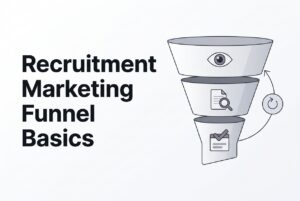
What Is a Recruitment Funnel?
A recruitment funnel is a model for how a broad audience narrows as people discover an employer, consider a role, apply, and move through selection. Recruitment marketers usually focus on awareness, interest, and application. Hiring teams may extend the model further. It is a planning tool, not proof that every person follows the same path.
Why It Matters
The funnel helps a team spot practical problems, such as relevant people visiting a job page but not applying.
Example
A founder sees strong interest in a specialist role but few completed applications, then checks whether the page explains the location and requirements.
Related Terms
Candidate journey, conversion, candidate attraction
Common Misconceptions
More activity at the top of the funnel does not automatically mean better hiring outcomes.
What Are Source Tracking and Attribution?
Source tracking records where a candidate or application came from, such as a career page, job board, referral, or shared campaign link. Attribution is the interpretation of which interactions helped produce the outcome. A final click does not always tell the whole story.
Why It Matters
Teams can compare channels more thoughtfully when they know where interest came from. That helps them avoid blind spots.
Example
A recruiter records that an applicant arrived through a shared job link but also knows the person had attended a company event earlier.
Related Terms
Recruitment campaign, job distribution, candidate journey
Common Misconceptions
The last click is not always the only channel that influenced a decision.
Distinctions Worth Making Explicit
| Often Confused | Clarifying Distinction |
|---|---|
| Recruitment marketing and recruiting | Marketing builds awareness, interest, and relationships, especially before application; recruiting also evaluates applicants and closes hires. |
| Employer brand and EVP | Employer brand includes reputation and perceptions of the organization as an employer; EVP states the substantive offer and expectations behind it. |
| Talent pool and talent pipeline | A pool groups potentially relevant people; a pipeline relates people and their engagement to a hiring need or progression. |
| Talent pool and talent community | The terms can overlap. When differentiated, a pool emphasizes stored contacts and a community emphasizes continuing, relevant interaction. |
| Lead and applicant | A lead may be interested but generally has not applied for a particular job; an applicant has submitted an application. |
| Engagement and conversion | Engagement is interaction; conversion is completion of a specified action. |
| Career site and landing page | A career site is the broader employer-controlled destination; a landing page addresses one audience, proposition, or campaign action. |
| Job distribution and recruitment marketing | Distribution places a vacancy; marketing also explains the employer, attracts relevant people, and sustains relationships. |
| Candidate journey and recruitment funnel | Journey emphasizes the individual’s interactions and experience; funnel is a stage-based model of movement toward application or hire. |
FAQs
Is Recruitment Marketing the Same as Posting Jobs?
No. Posting and distribution increase visibility for an opening, but recruitment marketing also includes the employer proposition, relevant content, candidate relationships, and an appropriate next step. If all you do is publish a vacancy, you are distributing a job. If you are building interest before and around that role, you are doing recruitment marketing.
Does Recruitment Marketing Happen Before or After Someone Applies?
The clearest core use is pre-application attraction and engagement. Some teams also include application-stage communication and other candidate-journey touchpoints. The important part is to say which scope you mean. In practice, the boundary is not universal, so clarity beats argument.
What Is the Difference Between Employer Brand and an EVP?
Employer brand is the reputation and perceived identity of the organization as an employer. The EVP is the underlying offer: what the company stands for, expects, and provides. In short, the brand is the perception, and the EVP is the promise behind it.
What Should a Small Hiring Team Do First?
Start with one priority role and make the work clear on a usable career page. Choose relevant distribution channels, capture where interest comes from, and follow up with people who have expressed interest. That sequence is practical, honest, and much better than spraying job ads everywhere and hoping for the best.