Recruitment marketing is the work of finding, attracting, engaging, and nurturing potential candidates before they apply. In plain terms, it helps people discover an employer, understand a role, and stay in touch until the right opening comes along. If you are asking what is recruitment marketing, that is the clean answer. It is not a replacement for job posting. It is the layer that builds interest before someone is ready to click apply.
That difference matters because candidate attraction is not the same as application volume. A job posting invites people to apply to one opening. Recruitment marketing builds a relationship earlier, answers questions, and keeps qualified people warm for future roles. A strong hiring motion needs both. One gets the application. The other makes sure the right people ever see the opening in the first place.
Recruitment marketing vs. just posting jobs
The short answer is this: posting jobs advertises a vacancy, while recruitment marketing creates ongoing candidate attraction. A posting works when someone is already looking for that role. Recruitment marketing works earlier, and often with people who are not ready to apply today.
Here is the practical split:
| Concept | What it does | When it matters |
|---|---|---|
| Job posting | Describes one open role and invites applications | When a candidate is ready to apply |
| Recruitment marketing | Attracts, informs, engages, and nurtures potential candidates | Before application and between openings |
The two are connected, but they are not interchangeable. A job posting still needs to be clear, accurate, and easy to apply to. At the same time, recruitment marketing gives a candidate a reason to care before the vacancy appears. That might be a useful careers page, a concise role summary, employee perspectives, referrals, or relevant follow-up for people who want future opportunities.
For a lean TA team, this is the useful way to think about it: job posting is the invite. Recruitment marketing is the reason someone stays in the room.
What is recruitment marketing in the candidate journey?
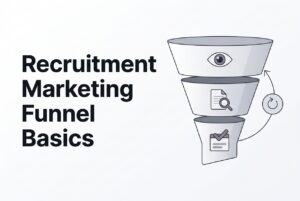
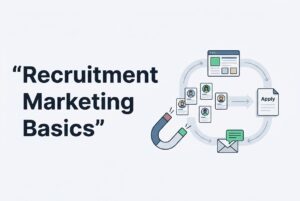
Recruitment marketing supports the full path from first discovery to application. It does not start when a candidate clicks apply. It starts when they first learn the company exists, or when a role catches their attention in a search result, job board, employee referral, or shared team story.
A simple candidate journey looks like this:
- Awareness: A person notices the company or role.
- Consideration: They check the careers page and role details.
- Interest and engagement: They want updates, future roles, or more context.
- Nurture: The team shares relevant openings or updates with permission.
- Application and handoff: The person applies, and recruiting takes over.
That sequence is important because not every interested candidate is ready to apply right away. In fact, many are just trying to answer a few basic questions: What is this team like? What does the role involve? Is it worth my time to dig deeper?
Here is a simple example. A 250-person company expects recurring engineering roles. Instead of pushing each open role and starting from zero, the team makes engineering jobs easy to find, explains the work clearly, invites interested people to receive relevant updates, and reconnects with past applicants when permitted. When a role opens, it still publishes a specific job posting. Recruitment marketing just makes that posting easier to reach the right people.
What a lean TA team can actually do first
A small team does not need a giant program to start. It needs focus. The right first move is to pick one role family or hard-to-fill skill set and build around that. If you try to market every role at once, the message gets fuzzy and the work becomes hard to maintain.
Start here:
- Pick one hiring problem and one audience.
- Fix the careers page so it works on mobile and shows current roles clearly.
- Make the application route obvious.
- Create a few specific answers about the work, location, requirements, and growth opportunity where known.
- Use channels the team can actually maintain.
- Record interests and follow up only where you have a proper basis to do so.
That is the real playbook. More distribution will not save a confusing page. More email will not fix a bad application flow. And a talent pool is only useful if the messages are relevant and the team can manage them.
If you want a practical rule, use this one: fix the destination before driving more traffic to it. Otherwise you are paying to send people into friction.
What channels matter for candidate attraction?
The best channels are the ones your team can keep current and useful. Recruitment marketing is not about being everywhere. It is about being present where your likely candidates already look, and then giving them a next step that makes sense.
The main channels are straightforward:
- the careers page
- job boards
- employee referrals
- relevant organic social content
- a permission-aware talent pool
Job boards help with distribution, but they are not the whole strategy. A careers page gives candidates a home base. Employee referrals add trust. Organic content can show what the work looks like without turning the effort into a full employer-branding project. And a talent pool gives interested people a place to stay connected until the right role opens.
That last piece matters. A person interested in software engineering should not have to subscribe to every job in the company. Good candidate attraction respects relevance. It does not blast the same message to everyone and call that strategy.
How recruitment marketing and recruiting work together
Recruitment marketing and recruiting are connected, but they do different jobs. Recruitment marketing builds awareness, interest, and pre-application engagement. Recruiting and selection take over after the person applies.
Here is the boundary in plain English:
| Function | Primary job | Stage |
|---|---|---|
| Recruitment marketing | Attract, inform, and nurture candidates | Before application |
| Recruiting and selection | Screen, interview, decide, and offer | After application |
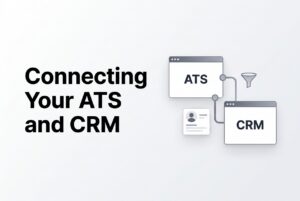
| ATS | Organize jobs, applications, and workflow | Especially after application |
A strong job description can still attract candidates. An ATS can also support some pre-application communication. So the lines are not absolute. But the center of gravity should be candidate attraction and pre-application engagement. That is the point of recruitment marketing.
This matters because teams sometimes try to use one tool or one tactic to do everything. That usually creates confusion. If the goal is to build interest before a candidate applies, focus on what helps them understand the role and stay connected. Once they apply, move them into the hiring workflow cleanly.
How should a team measure recruitment marketing?
Measure the part of the funnel you can actually act on. If you want to know whether recruitment marketing is working, start with completed applications and qualified applicants for one role family. Then look at the visits or sources that produced them.
Useful measures include:
| Measure | What it shows |
|---|---|
| Career-site visitor-to-applicant conversion | Whether visitors actually apply |
| Talent-pool sign-up conversion | Whether the invitation creates interest |
| Application completion rate | Where applicants drop off |
| Qualified-applicant rate | Whether the right people are coming through |
| Source-to-hire view | Which sources produce useful downstream results |
| Nurture engagement | Whether messages lead to replies, clicks, or later applications |
These measures help you diagnose friction. If many people start but do not finish applications, the problem may be the application step. If applications rise but qualified applications do not, the issue may be audience fit, messaging, or job requirements.
One important caution: application volume is not the same as candidate quality. More is not automatically better. The goal is to attract the right people and make it easy for them to move forward.
What numbers can teams use without guessing?
You can use historical and observed context, but you should not turn it into a universal promise. One benchmark report from 2018 listed a 12% visitor-to-applicant conversion rate for 2017, 12.31% of applicants progressing to interviews, and 36 applicants per open requisition. That is useful as a reference point for that dataset, not as a current target.
A more recent job-search report analyzed about 1.7 million applications, 1 million job postings, and a 1,049-person survey, and it reported a 23-day median wait to a first interview in the observed job-search experience. That can help explain why candidate communication matters. It does not prove that any single tactic shortens the wait.
So what should a team do? Establish its own baseline. Then compare like with like: same role family, same time window, same visitor definition, same source-tagging method. That is how you get a useful signal instead of a fake certainty.
Where CVViZ fits in this workflow
CVViZ supports the operational side of recruitment marketing and candidate attraction. It offers mobile-friendly career pages that can be embedded on an employer’s site, job posting to 20-plus free job boards and distribution to 2,000-plus job boards worldwide, and automated candidate sourcing from sites like LinkedIn, GitHub, and StackOverflow.
It also supports multi-step candidate email sequences with open, click, reply, and follow-up tracking, plus a searchable candidate database, talent rediscovery, and recruitment analytics. Those capabilities help a lean team keep candidate interest organized, follow up in a more structured way, and see which channels are producing useful activity.
That said, the tool is only part of the system. A careers page still needs clear content. A talent pool still needs relevant messages. And analytics still need careful interpretation. Good tooling makes the work easier, but it does not replace the need for a clear audience and a sensible process.
Recruitment marketing caveats you should not ignore
A few boundaries matter here.
Privacy is part of the process. If you keep candidate information for future roles, you need a clear purpose, lawful basis, and proper notice. Candidates can object to direct marketing, and that objection must be respected. Also, do not assume passive interest equals consent.
A larger pool is not automatically a better pool. Volume, relevance, completion, and eventual hiring outcomes are different questions. Repeated irrelevant messages can do more harm than good.
Attribution also takes discipline. A candidate may discover the company through one channel and apply through another. So recorded source data is useful, but it is still an attribution convention, not a perfect truth machine.
FAQ
What is recruitment marketing?
It is the use of attraction, engagement, and nurture activities to help potential candidates learn about opportunities and move toward applying, including people who are not ready to apply immediately.
How is recruitment marketing different from posting jobs?
Posting jobs invites applications to a specific vacancy. Recruitment marketing builds awareness and relationships before and between vacancies, so the right people are more likely to notice and consider future openings.
Can a small team do recruitment marketing without a dedicated marketer?
Yes. Start with one role family, a clear careers page, a few useful messages, a manageable follow-up process, and a small set of funnel metrics. Keep it simple enough to maintain.
Is recruitment marketing the same as employer branding?
No. Employer branding shapes how people think about the company. Recruitment marketing puts relevant messages and opportunities in front of potential candidates and measures how they respond.
Does recruitment marketing stop when someone applies?
No, candidate experience continues after application. But the focus of recruitment marketing is before application. Screening, interviews, and offers belong mainly to recruiting.
Do we need a recruitment CRM to begin?
Not necessarily. What matters is having a way to record candidate interests and permissions, send relevant updates, and connect future applications to the hiring workflow.
What metric should we start with?
Start with completed applications and qualified applicants for one role family, then track the visits or sources that produced them. Add application starts and completions if you need to diagnose drop-off.
Can we email everyone who applied before?
Do not assume so. Review the original notice, purpose, lawful basis, retention policy, and objections before reusing applicant data for future outreach.
Final takeaway
If you are new to talent attraction, keep the definition simple. Recruitment marketing is the work of attracting, engaging, and nurturing candidates before they apply. It sits before recruiting, supports candidate attraction, and makes job postings more effective by helping the right people discover them in the first place.
For a lean team, the smartest move is not doing more of everything. It is building a clean path from awareness to application, then measuring where people drop off. That is how recruitment marketing becomes useful instead of noisy.