A small recruiting team does not need a futuristic hiring stack to make AI useful. It needs a process that is structured enough to compare candidates, transparent enough to defend, and simple enough to keep moving when the inbox gets loud.
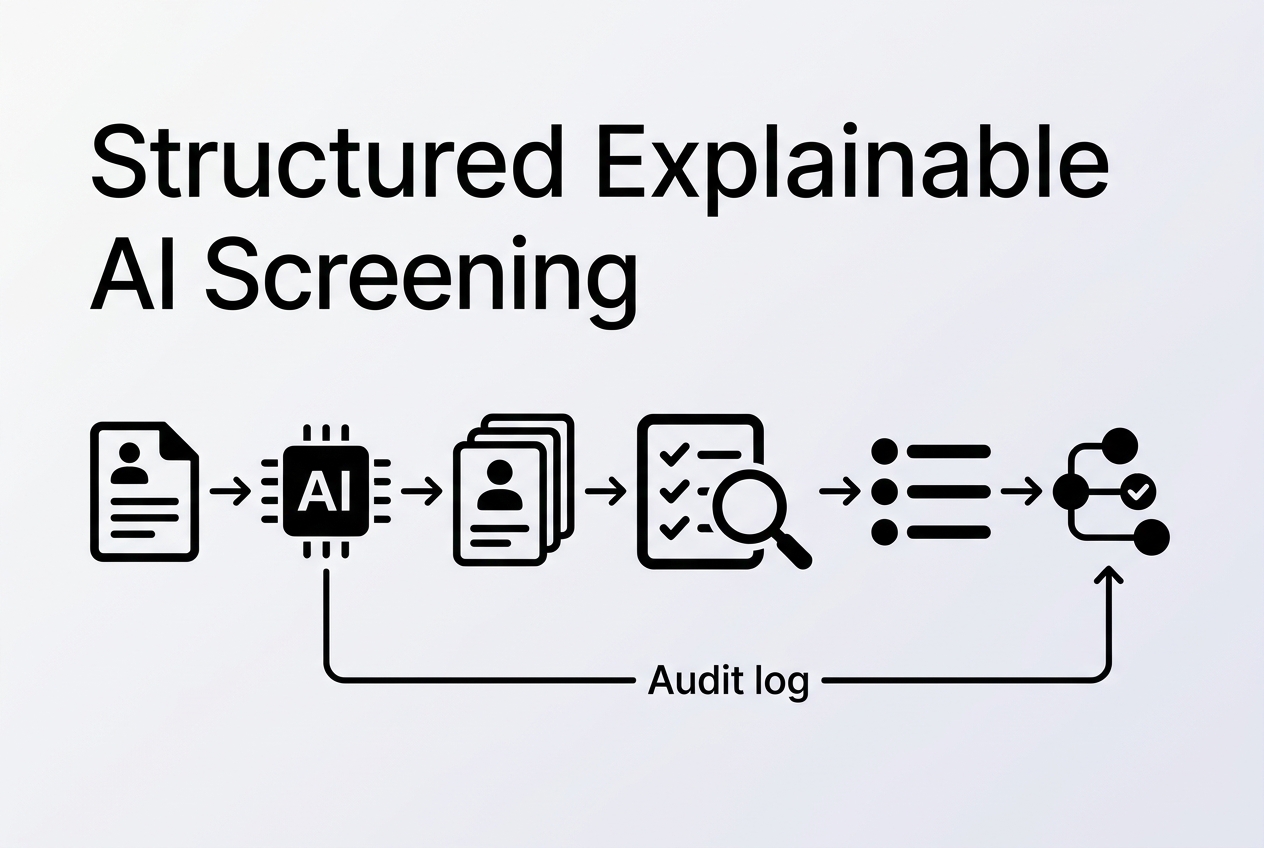
That is the real promise of explainable AI candidate screening: not automatic certainty, but a review flow that hiring managers can understand. The team agrees on the role, uses AI to rank candidates by relevance, asks a few consistent pre-screening questions, and then checks the evidence before anyone advances or rejects a candidate. That combination gives a small recruiting team speed without turning the process into a black box.
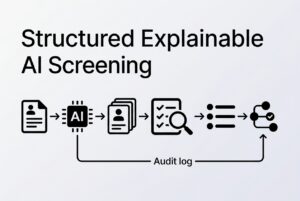
The key idea is straightforward. A ranking is helpful only when the team can connect it to the job, inspect the supporting evidence, resolve uncertainty, and record the human decision. A score alone is not an explanation.
What problem is structured AI screening actually solving?
Most lean hiring teams are not short on resumes. They are short on time, consistency, and shared judgment.
One hiring manager thinks a “must-have” is essential. Another treats it like a nice-to-have. Recruiters end up screening by memory, candidates get different questions, and follow-up slips through the cracks. That is where structured screening matters. It gives the team a repeatable way to decide what counts as evidence, what needs clarification, and what should be reviewed by a human before any consequential decision.
AI helps most when it does not replace the process. It organizes attention. It surfaces likely matches. It reduces keyword-only filtering. But it should not silently decide the outcome.
Key takeaways
- The goal is not autonomous hiring.
- The goal is a review process the team can explain and repeat.
- AI should prioritize review, not own the decision.
- Human ownership stays in the loop for advancement and rejection.
What does explainable AI screening mean in practice?
Explainability has two layers, and teams should not confuse them.
First, there is the understandable hiring process. That means the team can explain the job criteria, the evidence reviewed, the questions asked, and the human decision. Second, there is the model explanation. That means the system’s explanation should faithfully reflect why it produced the output.
Those are not the same thing. A polished summary does not prove the model was right. And a documented process does not prove the model explanation is faithful.
For operational use, the reviewer should be able to inspect a minimum evidence packet:
- the job and criteria version used
- the original resume or application
- the AI output and any supporting information
- pre-screening answers
- what seems met, not met, or unresolved
- the next verification step
- the reviewer and decision date
- the reason for advancing, clarifying, or rejecting
That is what makes explainable AI screening practical. It gives a recruiter something concrete to defend instead of a vague score.
A useful reviewer note sounds like this: the resume shows Python API ownership and SQL optimization, the role requires both, but production incident responsibility is unclear, so the candidate should move forward for clarification. A weak note just says “great fit” and leaves everyone guessing.
Key takeaways
- Explainability is process plus evidence, not a friendly score display.
- Uncertainty should be recorded, not hidden.
- Good explanations separate observation from interpretation.
- The next action should be visible in the review note.
Which criteria should a small recruiting team define before screening?
Before the first application is ranked, the recruiter and hiring manager should agree on the work, not an idealized biography.
That means writing a short screening brief with these fields:
- role and owner
- work outcomes
- essential criteria
- preferred criteria
- acceptable evidence
- equivalent evidence
- clarification rules
- decision authority
- change history
This is where many teams go wrong. They turn every bullet in the job description into a hard requirement. That usually creates false negatives and unnecessary friction. A better approach is to separate what is genuinely required from what is merely familiar.
For example, a backend role might treat API ownership and relational data work as essential, while the team’s exact cloud platform is preferred unless it is truly necessary. Production problem-solving may be essential if the job includes operational ownership. That is a screening decision, not a branding exercise.
The important move is also the simplest one: preserve an uncertainty category. Use labels like met, unclear, and not met. Do not silently convert unclear into not met. That one habit keeps the process honest.
Key takeaways
- Define essential criteria before AI ranking starts.
- Separate required capability from preferred background.
- Use equivalent evidence when the same skill appears in different forms.
- Keep “unclear” as a real category.
How should AI ranking be used without confusing priority with suitability?
AI resume ranking workflow should organize review order, not act as a universal judgment.
The right sequence is to first confirm that the intended job is attached to the candidate, then check that the role information matches the approved criteria, then sample extracted candidate details against the original resume. From there, the recruiter should examine both high-ranked and lower-ranked candidates. That matters because unusual wording, incomplete parsing, or alternative experience can hide good people.
The practical categories are simple:
| Review category | What it means | What to do |
|---|---|---|
| Priority review | Essentials appear supported | Inspect evidence and confirm next step |
| Clarification needed | Key information is missing or contradictory | Ask a targeted question or run a short structured screen |
| Alternative-fit review | Transferable experience may meet the need | Let the hiring manager review equivalent evidence |
| Proposed non-advance | An essential requirement appears unsatisfied | A human verifies the specific reason before negative action |
| Processing exception | Parsing, file, or job association issue | Fix the issue before judging suitability |
The main mistake to avoid is treating a top rank as a final answer. A lower-ranked candidate can still be relevant if the resume uses different language, the answer set is incomplete, or the role changed mid-search. If the hiring manager changes the essentials, the team should record the update and reconsider earlier candidates.
Key takeaways
- Use ranking to prioritize attention.
- Validate the input before trusting the output.
- Sample beyond the top group.
- Reassess candidates when the role changes.
What pre-screening questions should a team ask?
A short question set should collect information the resume does not reliably establish. The point is not to interrogate the candidate. The point is to remove ambiguity.
A practical set usually includes only questions that change the next action. Examples include:
- “Briefly describe a backend API you helped build and your own contribution.”
- “What is your earliest realistic start date?”
- “This role requires the published on-site schedule. Can you meet it, or would you like to discuss an alternative arrangement?”
- “Do you hold the credential listed as essential for this role?”
- “Which relational databases have you used in production, and for what work?”
These are illustrative questions, not defaults that every team should use. The best question is the one that clarifies a decision the resume cannot settle.
Poor questions do the opposite. They repeat already available information, combine multiple requirements into one answer, or collect answers that have no clear impact on the next step. They also create unnecessary risk if they ask for irrelevant personal information. Keep the form short and purposeful.
One useful rule: separate logistics from capability. Start date is not skill. Work arrangement is not performance. Credential verification is not the same as resume text.
Key takeaways
- Ask only questions that change the next action.
- Keep the form short.
- Do not turn every answer into a knockout rule.
- Separate logistics from capability.
Which stage actions should workflow automation handle first?
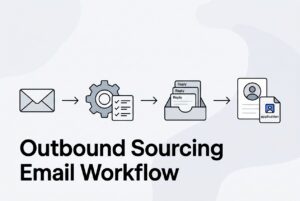
This is where hiring workflow automation earns its keep. Not by making the hiring decision, but by handling the repetitive coordination around it.
Not by making the hiring decision, but by handling the repetitive coordination around it.
The first automations should be the low-ambiguity ones:
- send an acknowledgment when an application arrives
- notify the recruiter when AI assessment completes
- create a task when an answer is unclear
- assign the next owner when a candidate is ready for manager review
- send scheduling information after approval
- send reminders when a review is pending
- send the correct rejection communication only after a human approves it
- route processing errors to a manual queue
That is the right order because it removes friction without handing over judgment. A task without an owner or deadline is just a nicer spreadsheet.
The team should also test workflow automation before it goes live. Normal applications are not enough. Test duplicates, missing information, changed answers, backward-and-forward stage moves, disabled rules, failed messages, and two rules that might fire at the same time. Look for duplicate emails, wrong recipients, status loops, and unintended cross-job effects.
In other words, test the plumbing before trusting the water.
Key takeaways
- Start with acknowledgments, reminders, and ownership.
- Keep score events separate from decisions.
- Test repeated events and rule conflicts.
- Preserve a manual exception path.
How can a recruiter make the shortlist understandable to a hiring manager?
The handoff should be short, specific, and evidence-based.
A good shortlist note includes:
- the role and criteria version
- the recommendation
- two or three concrete observations
- what remains uncertain
- relevant pre-screening answers
- the AI output, labeled as decision support
- the reviewer note
- the next action and owner
That format gives the hiring manager what they actually need. Not a raw grade. Not a wall of resume text. Just enough evidence to make a structured decision.
This is also where structured interviewing should begin. The criteria used in screening should feed the next interview questions. If the shortlist says production ownership is unclear, the interview should verify it. If the role requires a specific work arrangement, the next screen should address that directly.
That keeps the process aligned from screen to interview instead of turning the next conversation into a free-form chat.
Key takeaways
- Send evidence, not just a score.
- Keep the handoff compact.
- Use the screening criteria to shape the interview.
- Assign a next owner every time.
How should a small recruiting team pilot and monitor the process?
A lean team should not flip every switch at once. Start with one well-understood role and run a supervised ai recruiting pilot.
A practical pilot sequence looks like this:
- choose one role
- document the current manual process and time spent
- agree on criteria and evidence labels
- configure only the necessary questions
- review AI outputs without automatic negative decisions
- inspect high, middle, and low-ranked candidates
- resolve recruiter and hiring manager disagreements
- test administrative rules separately from ranking quality
- record errors and revisions
- expand only what works
For a small recruiting team, this is the difference between useful automation and accidental chaos.
Monitoring should be light but consistent. Review exceptions and overdue tasks daily. Inspect disagreements, lower-ranked candidates, rule failures, and candidate questions weekly. When criteria change, revisit affected applications and document the change. When vendor behavior changes, recheck representative examples and workflow tests.
This is not about overengineering the process. It is about keeping it honest.
Key takeaways
- Pilot one role before expanding.
- Review high, middle, and low-ranked candidates.
- Keep a simple cadence for exceptions and disagreements.
- Revisit applications when criteria change.
How does CVViZ support this workflow?
CVViZ provides a documented example of how a team can organize explainable AI screening without turning the process into a black box.
On the job setup side, CVViZ supports required job fields, mandatory skills, and benchmark resumes for contextual screening input. The system uses contextual resume ranking to assess candidates against the job description and screening criteria rather than relying on exact keyword match alone.
On the workflow side, CVViZ supports workflow automation for application acknowledgment, screening follow-up, reminders, and stage changes. It also supports pre-screening questions, including organization-level question setup and job-level question assignment. That gives teams a way to collect missing evidence before a person advances.
CVViZ also gives recruiters access to candidate history, screening answers, grade, skill match rating, and timeline activity inside the workflow. That helps the reviewer connect the recommendation to the underlying evidence.
The important guardrail is simple: use those tools to support a documented process, not to replace it. CVViZ auto-evaluation produces grades and ranking, but it does not automatically decide who to advance or reject. The team still owns the judgment.
Key takeaways
- CVViZ supports contextual ranking, screening questions, and stage automation.
- The product helps organize evidence inside the workflow.
- AI grades are decision support, not automatic decisions.
- Human review remains the operating standard.
What mistakes should teams avoid?
The biggest mistakes are usually the simplest ones:
- screening before the hiring manager agrees on essentials
- using one mandatory rule set for every role
- turning preferred qualifications into knockout rules
- rejecting because a resume does not mention something
- reviewing only the top group and calling it accurate
- assuming human agreement proves objective validity
- treating a polished summary as a faithful explanation
- confusing parsed data with verified ability
- automating rejection before defining who approved it
- changing the role without reconsidering earlier applicants
Those errors are common because they feel efficient. They are not. They usually create more correction work later.
The better pattern is slower at the start and cleaner overall: define the role, inspect the evidence, preserve uncertainty, and automate the administration around the decision instead of the decision itself.
Key takeaways
- Do not confuse speed with control.
- Do not let preferred criteria become hard exclusions by accident.
- Do not treat a score as proof.
- Keep human approval attached to consequential actions.
What should a small recruiting team use as a final decision matrix?
Use this matrix when deciding how much structure and automation to apply.
| If the team’s main problem is… | Focus on… | Do not assume… |
|---|---|---|
| Too many applications | Role-specific prioritization and evidence review | Only top-ranked candidates are suitable |
| Distrust of AI results | Traceable evidence and reviewer reasoning | A score or fluent summary is enough |
| Repeated clarification calls | A short, consistent question set | Every question should be a knockout |
| Slow follow-up | Acknowledgments, reminders, and ownership | Faster messages mean better decisions |
| Different reviewer standards | Shared role brief and structured interview flow | Agreement automatically proves validity |
| Frequent exceptions | Manual review and equivalent-evidence rules | One rigid filter can cover every applicant |
| Unclear product behavior | A scoped pilot with realistic test cases | Marketing language reveals every control |
| Very low application volume | Manual structured screening first | More automation is always better |
For a small recruiting team, the right sequence is usually the same: define criteria, use AI to prioritize, collect missing information consistently, and automate the coordination around the review. That is how explainable AI screening stays understandable enough for hiring managers and useful enough for the team doing the work.