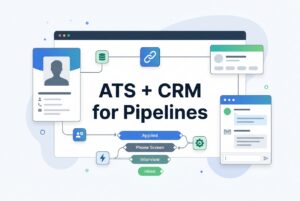
If you are trying to improve talent pipeline management, the real issue is usually not “we need more software.” It is that hiring is split across tools, inboxes, spreadsheets, and memory. An ATS with built-in CRM fixes that by keeping active applicants, passive candidates, silver medalists, and outreach in one system instead of forcing a sync between separate products.
That matters because pipeline problems show up fast: strong candidates go cold, hiring managers lose visibility, and recruiters spend too much time on manual follow-up. A true ATS with built-in CRM gives you one candidate record, one communication timeline, and one set of automation rules. For staffing agencies, the strongest platforms also connect this with Client CRM, so client companies, hiring managers, job requisitions, and communication history live in the same system. That is the core difference between a real recruiting system and a stack of disconnected tools.
What is an ATS with built-in CRM?
An ATS with built-in CRM is a single recruiting platform that handles both applicant tracking and candidate relationship management. In plain English, it manages both the open requisition and the longer-term relationship with people you may want to hire later.
For most employers, the CRM component means Candidate CRM. It helps recruiters build talent pools, nurture passive candidates, re-engage silver medalists, and maintain relationships beyond a single application. For staffing agencies and executive search firms, the CRM often extends further to include Client CRM. This makes it possible to manage companies, client contacts, hiring managers, communication history, business development activity, and job requisitions alongside candidate relationships.
A standard ATS is mostly reactive. It receives applications, routes candidates, schedules interviews, collects feedback, and tracks hires. A recruitment CRM is more proactive. It helps you segment passive candidates, run nurture campaigns, re-engage silver medalists, and keep talent pools warm. In staffing-focused platforms, Client CRM complements this Candidate CRM layer by helping teams manage the companies and decision-makers they serve. When these functions live natively in one product, you get a cleaner workflow and fewer duplicate records.
The important part is the database. A real ATS with built-in CRM uses one shared candidate record, one inbox, and one automation layer. For agencies, it should also connect candidate records with client companies, contacts, job requests, and submissions. That is different from an “ATS + CRM” bundle that depends on middleware or connectors. Those stitched systems often create sync lag, duplicate data, and reporting gaps. For teams trying to improve talent pipeline management, that gets old quickly.
Why talent pipeline management breaks without a CRM layer
Pipeline management usually breaks in five places. First, resumes pile up faster than recruiters can review them, and manual keyword filters miss good candidates. Second, strong past applicants go cold because nobody re-engages them on a schedule. Third, communication gets scattered across Gmail, Outlook, spreadsheets, and Slack. Fourth, hiring managers cannot see progress without asking for a report. Fifth, source data gets fuzzy when jobs are posted across multiple boards.
For staffing agencies, there is a sixth problem: client information gets disconnected from recruiting activity. Sales teams may keep client conversations in one CRM while recruiters manage jobs, candidate submissions, and feedback elsewhere. That makes it harder to understand which clients are active, which hiring managers need follow-up, and how recruiting outcomes connect to account relationships.
A Candidate CRM layer fixes the talent-side problems by adding structure to the ATS. It supports AI-driven ranking, drip campaigns, unified candidate timelines, shared visibility, and source-of-hire analytics tied to each record. A Client CRM layer supports the client side with company records, contacts, account ownership, communication history, job requisitions, and business development visibility. Together, they give staffing teams a clearer view of both the people they place and the customers they serve.
That is why talent pipeline management is not just about storing candidates. It is about keeping the right people warm, reachable, and easy to move forward—while keeping client relationships organized around the work being delivered.
For a growing team, that difference shows up in day-to-day work. Instead of asking, “Where is this candidate?” you can see status, history, and next action in one place. Agency teams can also see the connected client, hiring manager, job, and submission history. That saves time, but it also reduces candidate drop-off and client communication gaps. And yes, candidates notice when the process feels coordinated.
What buyers should look for in an ATS with built-in CRM
A genuine ATS with built-in CRM should clear most of the following requirements. If it fails on several, it is probably just an ATS with a tagging layer.
10-point buyer checklist
| Requirement | What it should do |
|---|---|
| Unified candidate record | Keep application history and passive-pool status in one profile |
| Talent pools with tags and filters | Segment by skill, location, source, or custom attribute |
| Drip and nurture sequences | Trigger outreach by stage change, inactivity, or job match |
| Re-engagement automation | Enroll stale candidates automatically |
| Bulk personalized email | Use merge fields and respect unsubscribe rules |
| Pipeline analytics | Show stage conversion, time in stage, source attribution, and coverage |
| Public and private talent networks | Support referrals, alumni, and silver-medalist pools |
| Built-in workflow automation | Trigger emails, tasks, and status changes without external tools |
| Compliance tooling | Capture consent, retention rules, right to erasure, and audit logs |
| Two-way email and SMS sync | Keep replies in the candidate timeline and recruiter inbox |
For staffing agencies, add Client CRM requirements to that checklist: company and contact records, hiring-manager relationships, communication history, client portals, job requisition tracking, account ownership, and visibility into placements and submissions. The goal is not to redefine Recruitment CRM; Candidate CRM remains the standard meaning of the term. The point is to ensure the platform also supports the commercial and client-management work agencies need to run their business.
A few bonus signals also matter: AI matching against job descriptions, semantic search across the database, interview scheduling, referral portals, and source-of-hire dashboards. For agencies, client activity reporting and connected job, contact, and placement data are equally valuable. These are not nice-to-haves when volume rises. They are what keep recruiting from turning into a full-time game of follow-up tennis.
Best ATS with built-in CRM options
Here is the short version: the best choice depends on your hiring model, budget, and how much structure you need. Some tools are better for SMBs, some for agencies, and some for enterprise teams with heavier reporting and integration needs.
Side-by-side comparison
| Tool | Best for | Pricing model | CRM depth | Notes |
| CVViZ | SMB and mid-market employers, staffing agencies | $99/mo and up, based on active jobs | Built-in Candidate CRM + Client CRM | Native ATS, CRM, sourcing, automation |
| Workable | SMB and mid-market teams | Starts at $169/mo | Built-in Candidate CRM | Talent pools in all plans |
| Recruiterflow | Staffing and recruiting agencies | Starts at $119/user/mo | Strong Candidate CRM + Client CRM | Agency-friendly CRM workflows |
| Ashby | Tech companies scaling fast | $400/mo flat foundation tier | Built-in Candidate CRM | Strong analytics and all-in-one setup |
| Greenhouse | Mid-market and enterprise | Quote-based | Module-based Candidate CRM | Strong structured hiring and reporting |
| Lever | Mid-market companies | Quote-based | Add-on Candidate CRM | ATS plus Talent CRM in one ecosystem |
| SmartRecruiters | Enterprise TA teams | Quote-based | Built-in Candidate CRM | Global TA and advanced analytics |
| iCIMS | Large enterprises | Quote-based | Built-in Candidate CRM | Deep configurability and compliance |
If you want the simplest answer for cost-conscious teams, CVViZ stands out because it combines AI screening, Candidate CRM, Client CRM, job posting, and automation without enterprise pricing. If you need a broader enterprise ecosystem, Greenhouse, SmartRecruiters, and iCIMS belong on the list. For agencies, Recruiterflow is a more direct fit, while CVViZ is also worth considering for teams that want candidate, client, and recruiting workflows in one platform.
CVViZ: strong fit for teams that want one system
CVViZ is positioned as an AI-powered recruiting platform that combines AI ATS, Candidate CRM, Client CRM, candidate sourcing, screening, and hiring workflow automation in one product. It is built for SMB and mid-market teams, plus staffing agencies that want native CRM capabilities without paying enterprise-level contracts.
The Candidate CRM capabilities help recruiters manage talent pools, candidate engagement, outreach, past applicants, silver medalists, and communication history. The Client CRM capabilities help agencies manage companies, leads, client contacts, hiring managers, account managers, communication history, client portals, and job requisitions. That means recruiters and business development teams do not have to work in separate systems to understand the full relationship around a role.
The CRM module is part of the main product, not a separate bolt-on. That means you can manage companies, leads, account managers, communication history, and a client portal in one place, while also managing candidate relationships and talent pools. CVViZ also supports bulk personalized email campaigns, templates, merge fields, workflow automation, and candidate history. For agencies, that combination is especially useful because client communication and candidate communication do not have to live in separate tools.
On the ATS side, CVViZ adds contextual resume screening, relative ranking, job posting to 20+ free boards and 2,000+ paid and free boards, email and calendar sync, recruitment analytics, and a Chrome extension for importing candidates from platforms such as LinkedIn, GitHub, and Stack Overflow. That makes it useful for talent pipeline management when volume is high and the team needs speed more than ceremony.
For staffing agencies, the broader value is that CVViZ brings together the three workflows that are often separated: managing client relationships, managing candidate relationships, and moving candidates through active recruitment processes. This supports a more complete operating model than an ATS alone.
Greenhouse, Lever, Ashby, and SmartRecruiters
These platforms are better known in mid-market and enterprise hiring. They all support CRM-like workflows, but they differ in how native that experience feels and how much you will pay for it.
Greenhouse is a common choice for structured hiring and DEI reporting. It includes talent pools, saved searches, nurture campaigns, source-of-hire analytics, and candidate rediscovery. The tradeoff is pricing opacity and the way costs can rise with add-ons.
Lever combines ATS and Talent CRM in one vendor stack. It is a solid fit for companies already in the Lever ecosystem, but cross-vendor workflows usually need middleware.
Ashby targets scaling tech companies that want ATS, CRM, sourcing, and analytics in one product. It is strong on reporting, but the interface can feel heavier because it leans hard into analytics.
SmartRecruiters is aimed at enterprise TA operations. It offers talent CRM, AI matching, branded career sites, programmatic advertising, and advanced analytics. That is powerful, but it is also more platform than many smaller teams need.
These products primarily focus on internal talent acquisition. Staffing agencies should confirm whether a tool also offers the Client CRM functions they need, including company management, hiring-manager contacts, client communication tracking, and business development workflows.
Workable, Recruiterflow, Manatal, Teamtailor, Breezy HR, Jobvite, and iCIMS
These tools cover a wide range of budgets and use cases, so fit matters more than brand familiarity.
Workable is a practical SMB option with talent pools, AI sourcing, candidate rediscovery, bulk email, referral portals, two-way email sync, and pipeline analytics. It works well when hiring volume changes over time.
Recruiterflow is built for staffing agencies and recruiting teams. It gives you two-way email sync, drip campaigns, talent pools, client and contact management, and job distribution. Its combination of Candidate CRM and Client CRM is important if your work includes client submissions, business development, account tracking, and ongoing client communication.
Manatal offers AI-driven recommendations and scoring, plus talent pools, job posting, and recruitment marketing. Teamtailor is more employer-brand focused, with nurture campaigns and career site tools. Breezy HR is a simpler SMB choice with built-in talent pools, nurture, and structured interviews. Jobvite and iCIMS sit higher in the enterprise lane, with referral, onboarding, analytics, and compliance-heavy workflows.
In other words, do not buy the biggest platform just because it has a big name. Buy the one that matches how your team actually hires—and, for agencies, how your team wins and manages client relationships.
Which ATS with built-in CRM fits which team?
| Team type | Best fit | Why |
| SMB with growing volume | CVViZ, Workable, Breezy HR | Fast setup, broad sourcing, simpler workflows |
| Staffing agency | CVViZ, Recruiterflow | Candidate CRM, Client CRM, submissions, client tracking, communication history |
| Mid-market structured hiring | Greenhouse, Lever, Ashby, CVViZ | Strong process control and analytics |
| Employer-brand-led team | Teamtailor | Nurture and candidate experience emphasis |
| Enterprise TA | SmartRecruiters, iCIMS, Greenhouse | Depth, reporting, compliance, configurability |
This is where recruitment CRM really matters. If you only need to track applicants, almost any ATS will do. If you want to keep candidates warm, segment pools, and re-engage people later, the Candidate CRM layer becomes the part that pays for itself.
For staffing agencies, Client CRM matters alongside it. Agencies need to manage not only who they might place, but also which companies are hiring, who the decision-makers are, what roles are open, and what communication has already taken place. A platform that connects both relationship types with the ATS gives teams a much more complete view of their business.
FAQ
What is the difference between an ATS and a recruitment CRM?
An ATS manages active applicants through the hiring workflow. A recruitment CRM manages relationships with passive candidates, silver medalists, referrals, and alumni. One is mostly reactive. The other is built for ongoing outreach and nurture.
For employers, Recruitment CRM usually means Candidate CRM. For staffing agencies, many recruitment platforms also include Client CRM, enabling recruiters to manage customers, hiring managers, business development, and client communication alongside candidate relationships.
Do small businesses need an ATS with built-in CRM?
Often, yes. Once hiring becomes recurring or competitive, a CRM layer helps keep strong candidates from going cold. That becomes especially useful when teams fill more than a handful of roles each year and want to re-engage past candidates.
Small staffing agencies may benefit even more from a unified system because it can combine Candidate CRM, Client CRM, and ATS workflows without requiring separate sales and recruiting tools.
What features should I prioritize first?
Start with unified candidate records, talent pools, automated nurture, re-engagement triggers, two-way email sync, and source-of-hire analytics. After that, look at compliance tools, workflow automation, and interview scheduling.
If you are a staffing agency, also prioritize company and contact management, job requisition tracking, client communication history, account ownership, and visibility into submissions and placements.
Can AI replace recruiters?
No. AI can screen, rank, and automate repetitive work, but it cannot replace judgment, candidate experience, client relationship management, or stakeholder management. It should reduce admin load, not remove human decision-making.
Final recommendation
If your main goal is talent pipeline management, pick a platform that combines ATS and Candidate CRM natively, not one that depends on a patchwork of integrations. That is the cleanest way to keep sourcing, screening, outreach, and pipeline visibility in one system.
For staffing agencies, look for a platform that also includes Client CRM. Candidate relationships and client relationships are different, but both are essential to agency success. A unified platform should help teams manage clients, hiring managers, candidates, jobs, submissions, placements, and communication history without making recruiters switch between multiple systems.
For SMB and mid-market teams, CVViZ is a strong fit because it blends AI CV screening, sourcing, automation, Candidate CRM, and Client CRM without pushing you into enterprise pricing. For agency workflows, Recruiterflow and CVViZ both deserve a look. For enterprise buyers, Greenhouse, Lever, SmartRecruiters, and iCIMS remain the heavier hitters.
The real test is simple: can the system help you find, warm, move, and re-engage candidates without making recruiters work in five different places? For agencies, it should also help you manage the clients and hiring managers behind those roles. If the answer is no, it is not helping enough.