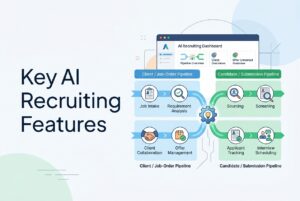
AI recruiting software for agencies should do more than sort resumes. It needs to run two linked workflows at once: the client job-order pipeline and the candidate submission pipeline. That is the real test of a useful recruitment agency ATS. If the platform cannot manage client accounts, candidate ownership, sourcing, screening, submissions, and feedback in one place, it will just move the chaos from spreadsheets into software.
For agencies, the best AI recruiting software for recruitment agencies is the one that shortens the path from job order to client-ready submission without stripping away recruiter judgment. AI should rank, explain, and prioritize. It should not silently decide who gets rejected, because agencies still have to protect candidate data, avoid duplicate submissions, and keep clients in the loop without exposing the whole database.
What should recruitment agencies look for in AI recruiting software?
Start with the operating model, not the feature list. A good agency platform must combine an AI ATS, a Recruitment CRM, searchable candidate data, sourcing, automation, and client collaboration. In plain terms, it should help a team manage client work and candidate work together, not as two disconnected systems.
That matters because agencies do not hire for one employer. They juggle many clients, many open jobs, and many candidates who may fit more than one role. So the software has to support candidate ownership, source history, client-specific visibility, submissions, feedback, and recruiter handoffs. If it cannot do that, the AI layer is just lipstick on a broken workflow.
The practical buyer question is simple: does this tool reduce manual work while preserving control? If the answer is yes, keep going. If the platform only has smarter search but no submission control, client portal, or database reuse, it will not solve the agency problem.
ATS vs Recruitment CRM for agencies
A recruitment agency ATS is not just a corporate ATS with an agency logo on top. It has to connect candidates to clients, contacts, job orders, submissions, and placements. The CRM layer is what keeps the business side connected to delivery. Without both, the agency ends up stitching email, spreadsheets, and separate tools together.
| Requirement | Recruitment agency software | In-house talent software |
|---|---|---|
| Primary customer | Multiple external clients and hiring contacts | One employer and internal hiring managers |
| Core records | Clients, contacts, leads, job orders, candidates, submissions, placements | Requisitions, candidates, interviewers, offers, hires |
| Pipeline design | Two linked pipelines: client/job order and candidate/submission | Usually one requisition-to-hire funnel |
| Candidate relationship | Reuse one candidate across many roles and clients, subject to consent and ownership rules | Reuse is usually within one employer’s talent pool |
| Collaboration | Client portal, submissions, feedback, recruiter and account-manager handoffs | Internal review and approvals |
| Productivity measures | Submissions, interviews, placements, response SLAs, source-to-placement | Time-to-fill, quality of hire, hiring-manager satisfaction |
| Data controls | Client-specific visibility, ownership, duplicate-submission prevention, consent history | Internal role permissions and privacy controls |
| Commercial layer | Job orders, fees, placements, redeployment, account activity | Workforce planning and hiring budget |
The difference is not “more AI.” It is a different data model. That is why an agency should reject any tool that cannot separate the candidate master profile from the client-specific submission record.
Which AI resume-screening features matter?
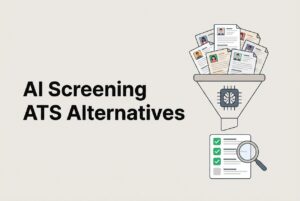
Contextual AI resume screening matters more than keyword matching. The software should rank candidates against the specific job, show why a profile surfaced, and let recruiters adjust the criteria. In agency work, a fixed “good candidate” score is not enough, because the same person may be a strong fit for one client and a weak fit for another.
Look for skills extraction, relative ranking, knockout questions, and visible match explanations. Also look for human override. That is important because a candidate with a nonstandard background, career break, or different job title may still be relevant even if the resume does not read like the template.
CVViZ describes contextual screening beyond keywords, real-time ranking based on job requirements and hiring patterns, and prescreening questions. That is the right direction. Still, agencies should test how the ranking changes across different job orders and whether low-confidence candidates get routed to a recruiter instead of being auto-rejected.
What good screening should show
A useful screening result should answer four questions fast:
- Why did this candidate rank here?
- Which requirements are clearly matched?
- What is missing?
- What can the recruiter change?
That level of transparency matters because agencies need speed without losing judgment.
How does candidate rediscovery work?
Candidate rediscovery is the process of finding people already in your database or sourcing history for a new role. For agencies, this is often one of the highest-value capabilities because the right candidate may already exist in the system from a previous search, submission, or placement.
The best rediscovery workflows combine semantic resume search with Boolean search and filters. They should search resumes, notes, skills, prior client history, source, availability, and ownership. They also need provenance. In other words, the recruiter should see why the profile surfaced, who owns the relationship, and whether the candidate was already submitted to that client.
CVViZ states that it supports semantic search, talent rediscovery, full-text and Boolean search, filters, duplicate detection, and a centralized resume database. That is useful, but agencies still need to validate freshness, consent, and representation rules. A profile found for one role is not automatically free to reuse everywhere.
Why rediscovery beats starting from zero
A stale database is useless. A live, searchable, permission-aware database is an asset. That is the difference.
For agency teams, rediscovery should reduce time spent re-sourcing the same kind of candidate over and over. It should also protect the client relationship by preventing duplicate submissions and surfacing relationship history before outreach starts. If the system cannot do that, it is only a storage box with search on top.
What should an agency client portal do?
A client portal should let clients review only the candidates, documents, and fields intended for them. It should not expose the agency’s whole database, other clients, or internal notes that do not belong in front of a client. That is the basic bar.
Useful portal controls include client-specific logins, job-specific views, submission statuses, feedback, reminders, and audit history. Better systems also allow the agency to control what data the client can see, which matters when candidate privacy and commercial confidentiality are both in play.
CVViZ publicly states that clients can access candidates through a portal and that agencies can control visible data. It also describes client and candidate management, communication history, and collaboration. That is a strong fit for agencies, but buyers should still confirm the exact feedback workflow, redaction behavior, branding options, and field-level permissions in a demo.
The portal test that matters
Ask one question: can a client review a submission without seeing more than they should?
If the answer is yes, the portal is doing its job. If the answer is no, the agency is still relying on email attachments and manual follow-up. And honestly, that is just a fancier way to lose track of who saw what.
How should agencies evaluate sourcing and pipeline sharing?
Agency sourcing needs breadth, lawful capture, deduplication, and source history. It is not about bragging rights on profile counts. A huge number of profiles means little if they are stale, duplicate, inaccessible, or irrelevant to the agency’s markets.
The software should support job-board distribution, web and social sourcing, browser extension imports, email resume import, and one-click capture into a central pool. It should also record the source, capture date, owner, and reuse status. That is what keeps sourcing from becoming a memory game.
CVViZ says it distributes jobs to more than 2,000 paid and free job boards and supports sourcing from web, social, browser, and email channels. It also mentions named channels such as LinkedIn, GitHub, Stack Overflow, Indeed, Glassdoor, and Google Jobs in different contexts. Treat those as vendor claims and confirm coverage for your market and roles.
Shared pipelines need real controls
A candidate can be considered for several roles, submitted to several clients, and still need one master profile. That means the system must keep separate submission records, ownership history, and client-specific visibility.
At a minimum, test whether the platform can:
- prevent duplicate submissions to the same client
- show who last contacted the candidate
- distinguish “in database” from “submitted”
- keep client feedback tied to one submission
- transfer ownership without breaking history
If the platform cannot do those things, the pipeline is not truly shared. It is just shared chaos.
Which workflow and productivity features save recruiter time?
Automation should remove repeat work, not decision-making. In agency recruiting, the most useful triggers are resume received, job added, candidate stage changed, interview scheduled, feedback overdue, and placement closed. The actions can be emails, tasks, reminders, notifications, or status updates.
That matters because recruiters lose time in small fragments: chasing feedback, rescheduling interviews, sending the same update again, and cleaning up status changes. Good automation takes those off the list while leaving exceptions with a human.
CVViZ describes rules and triggers for resumes, jobs, stages, prescreening, email, tasks, reminders, and interview scheduling. It also supports email and calendar sync, video interviews, multi-party interviews, and a live code editor. For technical agencies, that can help a lot. For everyone else, the real value is less typing and fewer missed follow-ups.
Productivity features that actually count
Do not stop at activity metrics. Agencies should care about outcome metrics like time to first qualified submission, client response time, submission-to-interview conversion, interview-to-placement conversion, placements per recruiter, duplicate-submission rate, and source-to-placement yield.
CVViZ’s analytics cover time to fill, sourcing effectiveness, screening, team performance, candidate quality, funnel performance, recruiter productivity, and time to hire. That is useful, but the agency should verify how each metric is defined before comparing teams or reporting to clients.
What does CVViZ offer for agencies?
CVViZ positions itself as AI recruiting software that combines ATS, Recruitment CRM, client access, sourcing, resume screening, automation, and analytics. For agencies, that is the right mix on paper because it maps directly to the dual workflow model.
| Area | CVViZ publicly states | What to verify |
|---|---|---|
| AI screening | Contextual screening beyond keywords; skills, experience, job relevance; relative ranking | How ranking behaves on real agency jobs |
| Candidate rediscovery | Semantic search, talent rediscovery, Boolean/full-text search, filters | Freshness, provenance, consent, ownership |
| Sourcing | More than 800 million global candidate profiles; web/social sourcing; browser extension; email import | Coverage, licensing, market availability |
| Job distribution | More than 2,000 paid and free job boards | Exact board list and regional access |
| CRM | Clients, prospects, contacts, jobs, communications, documents, tasks | Commercial fields and account workflows |
| Client access | Client portal/login and controlled visibility | Feedback forms, redaction, branding, permissions |
| Automation | Rules, triggers, reminders, notifications, scheduling | Failure handling, overrides, consent suppression |
| Analytics | Time to fill, sourcing channels, screening, team performance, candidate quality | Metric definitions and export depth |
The public pricing snapshot lists Starter at $99 per month, Basic at $199, Standard at $349, and Pro at $499, all with unlimited users but different active-job limits. It also lists add-ons for screening and parsing credits. Pricing can change, so buyers should confirm current terms, active-job counting, API access, and any implementation or overage charges.
How should agencies test an AI recruiting platform?
Use real agency scenarios, not a polished demo. That is where weak systems usually fall apart.
Start by creating one client, two contacts, and two similar job orders. Then import the same candidate through an email, a job board, and a browser extension. Check whether the system deduplicates correctly and preserves source history. Next, match that candidate to two different roles and see whether the ranking changes with the role. If it does not, the AI is too generic.
After that, submit the candidate to one client and verify that the submission stays separate from the master profile. Log in as the client and confirm what they can and cannot see. Then trigger an automated follow-up, change the candidate stage, reschedule an interview, and inspect the audit history. Finally, export the candidate, activity, submission, and analytics data so you know the system will not trap your records.
Questions that expose weak implementations
- Can the AI show evidence, or only a score?
- Can a recruiter change criteria without retraining a black box?
- Does the system auto-reject, or route uncertain cases to a human?
- Can one candidate have separate submissions for multiple client jobs?
- Can the platform block duplicate submission to one client while allowing legitimate reuse elsewhere?
- Can the client see only the jobs and fields assigned to them?
- Can feedback be linked to the submission and exported?
- Can the agency export resumes, notes, emails, submissions, and audit records?
If a vendor gets fuzzy on those points, keep digging. The best systems make agency work cleaner. The weak ones just make the mess look organized.
FAQ
What is AI recruiting software for agencies?
It is recruiting software that combines an ATS with a Recruitment CRM, AI screening or matching, sourcing, candidate rediscovery, communication tools, workflow automation, analytics, and controlled client collaboration. The key point is that agencies manage candidates and external clients in connected workflows, so the system has to support both sides.
How is a recruitment agency ATS different from a normal ATS?
A normal ATS tracks candidates through one employer’s hiring process. A recruitment agency ATS has to manage clients, contacts, job orders, candidate ownership, submissions, client feedback, and placements across multiple external customers. It also needs the permissions and history to handle reuse, duplicate prevention, and client-specific visibility.
Does AI recruiting software replace agency recruiters?
No. It reduces repetitive work such as parsing, ranking, sourcing, outreach, scheduling, and reporting. Recruiters still define requirements, review AI output, manage client relationships, protect data, and make the final judgment on candidates.
What is candidate rediscovery?
Candidate rediscovery is finding relevant people already in the agency’s database or sourcing history for a new job. Good rediscovery uses semantic search, Boolean filters, skills extraction, and history such as source, ownership, and prior client submissions, so recruiters do not start from scratch every time.
Why do agencies need both ATS and Recruitment CRM?
The ATS tracks candidate progress. The CRM tracks clients, prospects, contacts, job orders, account activity, and communication history. Agencies need both because a placement depends on a candidate workflow and a client workflow moving together. If one side is missing, delivery gets messy fast.
Should clients get access to the ATS?
Clients should get controlled access to only the jobs, candidates, and fields relevant to them, usually through a portal or restricted view. They should not automatically see the agency’s full database, other clients, commercial terms, or internal notes that do not belong in front of them.
How can an agency prevent duplicate submissions?
Use one master candidate record, duplicate detection, source and ownership history, submission records, and a pre-submission warning. Then test whether the system can block duplicate submission to the same client without blocking legitimate reuse for another client or role.
What integrations matter most to agencies?
The practical set includes job boards, sourcing channels, email and calendar sync, video interviews, browser extension capture, career pages, resume parsing, ATS or CRM APIs, and reporting exports. The real test is field mapping, failure handling, and total cost, not just the number of logos on a website.
Is a large profile database enough to prove sourcing quality?
No. Agencies should ask how many profiles are current, deduplicated, contactable, legally usable, and relevant to their roles and geography. Then they should measure response, submission, interview, and placement outcomes by source. Big numbers are nice, but useful supply is what pays the bills.
How should an agency measure AI recruiting ROI?
Compare a baseline for time to first qualified submission, recruiter review time, rediscovery rate, client response time, conversion through each stage, duplicate rate, candidate response rate, placements per recruiter, and source-to-placement yield. Use the same definitions before and after rollout, or the numbers will lie to you a little.