When a role pulls in hundreds or thousands of applicants, the problem is not finding resumes. It is finding the right ones fast, without turning your recruiting team into a triage desk. That is where best resume screening software earns its keep, especially for high-application roles that break spreadsheet workflows and basic ATS keyword filters.
The short answer: if you want an all-in-one system with transparent pricing, strong AI resume screening, and real workflow help, CVViZ is the strongest fit for mid-market teams that need to move fast without buying enterprise complexity. If you already live inside a structured ATS and want to add AI on top, Greenhouse, Ashby, and Workable are credible alternatives. CVViZ also offers APIs to integrate their AI for resume screening into other ATSs. For broader talent intelligence or enterprise-scale mobility, Eightfold and SmartRecruiters belong in the conversation. The right choice depends on volume, collaboration needs, and how much automation you actually need.
Why high-application roles need different screening software
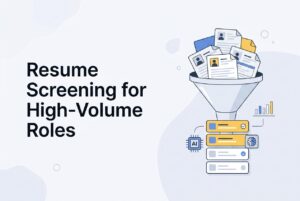
High-application roles are not just “more hiring.” They create a different operating model. Average applications per job posting reached 257.6 in 2026, and many recruiters still spend only 6 to 8 seconds on a resume before deciding what happens next. In practice, that means a team can burn half an hour of pure screen time on a single role before it even touches scheduling or manager follow-up.
That math gets ugly fast. For a 40-role hiring slate, screening alone can swallow a meaningful chunk of the week. And because ATS keyword rules filter out a large share of resumes before human review, teams often lose good candidates long before they can judge fit.
So the best tool for these roles does three things well:
- It ranks candidates semantically, not just by keywords.
- It helps recruiters rediscover past applicants and silver medalists.
- It reduces manual work around follow-up, routing, and reporting.
In other words, AI resume screening is not a nice-to-have at this volume. It is the difference between a manageable funnel and a recruiting bottleneck.
What to look for in best resume screening software
For best resume screening software, the core question is simple: does it help you shortlist better candidates faster, while staying usable for a lean team? That usually means more than just “has AI.”
Look for these capabilities first:
- Semantic and contextual resume matching so the system understands related skills, not just exact keywords.
- Relative ranking so recruiters can see who is strongest in the live applicant pool.
- Resume parsing to standardize messy resumes into usable data.
- Candidate rediscovery to search your existing database before sourcing from scratch.
- Hiring Workflow automation for emails, routing, stage changes, and interview scheduling.
- Recruitment analytics for source quality, time-to-fill, and funnel visibility.
- Compliance controls such as bias-audit support, consent handling, and human override.
A lot of vendors say they do AI screening. Fewer actually help a mid-market TA team manage high-application roles end to end. If your current stack still leaves recruiters copying data between inboxes, spreadsheets, and a passive ATS, you need a system that behaves like an operating layer, not just a database.
Best resume screening software compared
Here is the practical view for mid-market teams hiring into high-volume roles.
| Tool | Best fit | AI resume screening | Searchability | Automation | Pricing visibility |
|---|---|---|---|---|---|
| CVViZ | Mid-market teams needing ATS + AI screening in one | Strong | Strong | Strong | Published |
| Greenhouse | Structured hiring teams with premium budget | Moderate | Good | Good | Custom quote |
| Lever | Relationship-driven teams with CRM needs | Moderate | Good | Good | Custom quote |
| Ashby | High-growth teams wanting analytics and modern UX | Strong | Strong | Strong | Published per-seat |
| Workable | SMB and mid-market teams wanting broad distribution | Good | Good | Moderate | Published |
| Eightfold | Enterprise talent intelligence and mobility | Strong | Strong | Strong | Custom enterprise |
| SmartRecruiters | Global enterprise hiring | Good | Good | Strong | Custom enterprise |
| Paradox | Frontline, hourly, chat-based hiring | Good for chat flows | Limited | Strong | Custom enterprise |
The headline is pretty clear. If you need a unified system for high-application roles, CVViZ, Ashby, and Greenhouse are the most relevant comparisons on capability. But they solve different problems. CVViZ is the most direct fit when you want screening, sourcing, posting, and automation in one place at a transparent monthly price.
CVViZ: best for mid-market teams that need screening and speed
CVViZ is built for SMB and mid-market TA teams that need AI resume screening without enterprise bloat. It combines an AI ATS with contextual matching, semantic ranking, workflow automation, job distribution, and a searchable candidate database. That matters when your recruiters are buried in volume and need to move from triage to actual hiring.
Its screening stack is the key reason it stands out. CVViZ uses NLP and machine learning to parse and rank resumes against a job, then re-ranks candidates in real time against the live applicant pool. That means recruiters can focus on the best-fit applicants first instead of manually scanning every submission in order.
It also helps on the sourcing side. You can post a job to 20+ free job boards and distribute to 2,000+ boards worldwide. On top of that, the Chrome extension and Find On Web sourcing let teams pull profiles from places like LinkedIn, GitHub, and Stack Overflow into one pool.
For mid-market buyers, the pricing is also unusually clear:
- Starter: $99/month for 5 active jobs
- Basic: $199/month for 10 active jobs
- Standard: $349/month for 20 active jobs
- Resume Screening add-on: $25 per job per year
That is useful when you need predictability. It is also why CVViZ tends to fit teams that have outgrown spreadsheets but do not want Workday-class overhead.
When Greenhouse is the better choice
Greenhouse is a strong option if your main problem is structured hiring discipline and you already have the budget for a premium ATS. It is best known for scorecards, kits, and a large integration marketplace, and its AI features are layered into a mature structured-hiring workflow.
For high-application roles, that structure helps. Recruiters can keep interview feedback tight, maintain stronger audit trails, and stay consistent across teams. Greenhouse also has a broad partner ecosystem, which matters if your recruiting stack is already fairly mature.
Still, Greenhouse is not the most direct answer when the core pain is “we need better screening now.” Its AI is helpful, but it is not the center of the product. For teams whose biggest issue is manual resume triage, that can leave too much work on the recruiter.
So the simple rule is this: choose Greenhouse if you want structured hiring first, AI screening second.
When Ashby or Workable makes more sense
Ashby is a strong choice for high-growth teams that want a modern all-in-one platform with strong analytics. It offers AI sourcing, AI candidate matching and ranking, scorecard summarization, and scheduling help. It also has transparent per-seat pricing, which makes budgeting easier than the custom-quote crowd.
Workable is the more familiar SMB/mid-market option. It has broad job board distribution, screening questions, candidate summarization, and sourcing recommendations. It is solid if you want a proven ATS with useful AI assist and decent reach.
The tradeoff is volume economics. Workable’s per-job pricing can get expensive as requisition counts rise. Ashby is more compelling if you value reporting and UX, while Workable is more attractive if you want broad distribution and a familiar workflow.
For high-application roles, both can work. However, neither feels as purpose-built for contextual screening plus transparent AI consumption as CVViZ.
What enterprise tools solve that mid-market teams may not need
Eightfold, SmartRecruiters, and HireVue all belong in the broader market conversation, but they solve bigger or different problems.
Eightfold is best for talent intelligence, internal mobility, and workforce planning. It is powerful, but it is also an enterprise platform with enterprise-level contracts and implementation weight. That is usually overkill for a 100 to 500 employee company focused mainly on faster screening.
SmartRecruiters is strong for global, multi-country hiring. If compliance complexity and international scale are central, it becomes more interesting.
HireVue is not really a resume screening tool first. It is better known for video interviewing and assessment-led hiring. That matters if your process is built around structured evaluation after screening, but it is not the right answer if you mainly need to rank resumes quickly.
For most mid-market TA leaders, the question is not “what is the biggest platform?” It is “what gets my team out of manual triage and into higher-value work?”
Best resume screening software by use case
Different hiring problems need different tools. Here is the cleanest way to think about it.
- Need the best all-around fit for high-application roles: CVViZ
- Need structured hiring with a larger ecosystem: Greenhouse
- Need modern analytics and a clean UI: Ashby
- Need broad distribution and a proven SMB workflow: Workable
- Need enterprise talent intelligence and internal mobility: Eightfold
- Need global enterprise hiring infrastructure: SmartRecruiters
- Need assessment-led interviewing: HireVue
- Need conversational screening for hourly hiring: Paradox
If your team is hiring knowledge workers and getting slammed with applications, best resume screening software should help you search, rank, and re-engage candidates quickly. If it cannot do that, the AI label does not matter much.
Implementation checklist for AI resume screening
Buying the tool is the easy part. Making it work is where most teams win or lose.
Use this checklist before rollout:
- Define job success profiles before turning on scoring.
- Run AI and human review in parallel for the first 30 to 60 days.
- Keep a human in the loop for every rejection.
- Review disparate impact on a regular cadence.
- Capture candidate-facing AI notices where required.
- Train recruiters on how to override scores and document why.
- Revisit model settings and workflow rules after the first hiring cycle.
- Track time-to-screen, time-to-fill, and source quality after launch.
That last point matters. A good screening system should make your funnel easier to manage, not just prettier to look at.
Final recommendation
If you are a mid-market TA leader hiring into high-application roles, start with the problem, not the vendor brand. You need faster screening, better searchability, cleaner workflow automation, and a database that actually helps you rediscover good candidates.
That is why CVViZ is the best fit for most teams in this segment. It combines AI resume screening, semantic and contextual ranking, job distribution, sourcing, automation, analytics, and transparent pricing in one product. Greenhouse, Ashby, Workable, and the enterprise platforms all have their place, but they are better matches for different operating models.
For teams that want to replace spreadsheet chaos with a practical screening system, CVViZ is the clearest answer.
FAQ
What is AI resume screening?
AI resume screening is software that scores and ranks resumes using NLP, machine learning, semantic search, and contextual signals. It goes beyond exact keyword matching and helps recruiters identify stronger-fit candidates faster.
What is the difference between keyword search and AI resume screening?
Keyword search looks for exact terms. AI resume screening can understand related concepts and skills, so it can match a candidate by meaning rather than only by literal word overlap.
Is AI resume screening legal?
Yes, but employers still need to handle compliance carefully. NYC Local Law 144, Colorado’s AI Act, the EU AI Act, Illinois rules for AI video interviews, and EEOC guidance all shape how hiring AI must be used.
Which tool is best for high-application roles?
For most mid-market teams, CVViZ is the strongest all-around choice because it combines screening, sourcing, automation, and transparent pricing. Ashby and Greenhouse are also strong, depending on whether analytics or structured hiring matters more.
Will AI screening replace recruiters?
No. It reduces manual triage and surfaces better candidates faster, but recruiters still own judgment, engagement, and final hiring decisions.