If you want candidate rediscovery to work, do not start with a shiny “AI” label. Start with the workflow. A useful ATS should let your team search the ATS talent pool, find people already in the system for a new role, understand why they surfaced, avoid duplicate outreach, and contact the right person from the candidate record. That is the real test.
For a lean TA team, the question is simple: can you reopen a requisition, find a previous finalist and a less obvious past applicant, review their history, and move to outreach without rebuilding the list somewhere else? If the answer is no, you do not have rediscovery. You have a database with extra marketing on top.
What candidate rediscovery actually means
Candidate rediscovery is the ability to find and reconsider people already stored in your hiring system for a new or changed role. It is not just old resume search. It includes past applicants, interviewees, finalists, and imported candidates, as long as their records are still searchable and useful for a fresh opening.
The key point is this: prior disposition does not decide future fit. A strong silver medalist may be a fit for a different role, a different manager, or a changed scope. However, the ATS has to make that person findable first. That means the system must preserve and expose the fields recruiters actually use, not just show a pretty profile page.
In practice, rediscovery sits on five connected abilities: search quality, duplicate handling, resume matching and ranking, filters, and outreach tied to the record. If one of those breaks, the workflow breaks. For example, a recruiter can find a candidate by name, but if the system cannot surface equivalent skills or prevent duplicate contact, the whole process gets clumsy fast. The best systems make the old talent pool usable again, without making recruiters do manual cleanup every time.
Search quality in the ATS talent pool
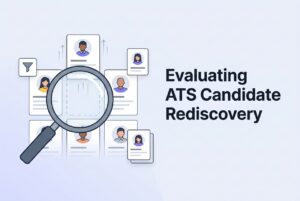
Search is the first gate, but it is not enough to simply “have search.” A strong ATS should retrieve the right candidate records from the ATS talent pool using full-text search, keyword search, Boolean logic, and useful filters. It should also let recruiters inspect the actual record, not just a snippet that looks promising.
Here is the practical test: search a distinctive phrase from an old resume, then check whether the underlying person record appears. Next, try exact qualifications plus alternative titles, and see how AND, OR, NOT, and parentheses behave. After that, test adjacent wording. A candidate might say “customer success” while the role says “account management.” Good search should still help surface that person.
Search quality: what to test in a demo
| Capability | What to test | Red flag |
|---|---|---|
| Full-text search | Find a distinctive phrase inside an old resume | Only names or profile fields are searchable |
| Boolean search | Test AND, OR, NOT, and parentheses in the interface | Vendor explains it but cannot show the query behavior |
| Meaning-aware retrieval | Use an adjacent title or equivalent skill wording | “AI search” behaves like exact keyword search only |
| Index freshness | Update a test record and check when it becomes searchable | Imported or updated resumes stay hard to find |
| Result inspection | Open a hit and confirm the right person, dates, and role history | A good-looking snippet hides parsing errors |
CVViZ supports full-text, keyword, Boolean, and location search backed by Elasticsearch. It also uses contextual analysis in its screening material. That combination is worth testing on your own historical records. Just do not assume that any one search mode proves the entire workflow works end to end.
Duplicate handling is not the same as safe merge
Duplicate resumes create a real mess. They split feedback, duplicate contact history, and make the talent pool look bigger than it really is. They also lead to repeated outreach, which is the fastest way to annoy a candidate and a hiring manager at the same time.
So, when you evaluate an ATS, do not stop at “duplicate detected.” Ask what happens next. Can the system spot likely duplicates during upload, bulk import, and repeat application flows? Can a recruiter compare records side by side? Can they choose the active resume? And most important, does the platform preserve the candidate’s applications, notes, stages, and messages correctly after resolution?
CVViZ documents automatic duplicate checking during parsing for uploads, pasted or dragged resumes, and bulk imports. It compares the uploaded file and parsed content with existing records, and email and phone similarities also factor in. A recruiter can compare the new and old files side by side and choose which resume stays active. CVViZ also documents CSV updating through “Update existing contacts,” so matching emails update records instead of creating new ones.
That said, selecting the active resume is not the same as proving a full-record merge. If you care about historical accuracy, make the vendor show it on a test profile, including a candidate who applied twice under different email addresses.
Resume matching and ranking should be job-specific
Good resume matching does not permanently label people as good or bad. It ranks people against the current requisition. That matters, because the same candidate can be weak for one role and strong for another. A previously rejected applicant may become a fit when the scope changes, the title changes, or the hiring team changes.
In a demo, use real must-have qualifications and real constraints. Then see whether the system surfaces a past finalist, an adjacent-title candidate, and a resume that is keyword-heavy but not truly qualified. A solid ranking layer should help the recruiter understand why someone is near the top, and it should still leave the decision with the human reviewer.
CVViZ matches existing talent against roles and uses contextual AI for resume screening and ranking. That is the right model.
How to evaluate resume matching and ranking
A practical check is precision at 10. Review the first ten results with the hiring manager and ask a simple question: which ones deserve further review for this job? That is not a universal benchmark. It is a clean way to test whether the system ranks candidates in a way your team actually trusts.
Also inspect the misses. A polished top result is easy. A nonstandard title or an older resume with equivalent experience is where weaknesses show up. If the system cannot surface those people, rediscovery is only half working.
Filters and candidate context make rediscovery usable
Search finds candidates. Filters make the list usable. Without good filters, recruiters still end up scrolling through a pile of names and guessing from snippets. That is not rediscovery. That is a nicer spreadsheet.
A good ATS should let recruiters narrow existing records by skills, location or work eligibility where appropriate, previous role, application stage, assessment outcome, last contact, record owner, and data freshness. It should also show context, not just a match. A recruiter should be able to see why a prior finalist was not selected, whether a teammate recently contacted them, whether the resume is stale, and who owns the relationship.
Filters and context: what to verify
- Can filters combine with text search?
- Which fields come from parsed resumes versus structured data?
- Do saved views stay available when the requisition reopens?
- Can the right reviewer see the context without exposing unnecessary notes?
- Does the system preserve the history needed for a fresh review?
One caution matters here. Old rejection reasons can be incomplete or job-specific. They should inform a new decision, not silently exclude someone from another opening. In other words, context should guide review, not shut it down.
Outreach should stay inside the ATS workflow
Rediscovery only pays off if recruiters can act on what they found. That means the system should move from search result to outreach without breaking the record chain. The prior message history, owner, reply, and next step should still live with the same candidate.
A simple outreach flow should do a few things well. It should confirm the candidate’s contact details, check whether they were already approached about the opening, and let the recruiter send a role-specific message. If the person was previously contacted, the message should acknowledge that without sounding robotic. Nothing fancy. Just relevant, respectful, and traceable.
CVViZ supports candidate communication tied to the candidate record, and its feature material includes email campaigns, sequences, reminders, and tracking of opens, clicks, and replies. For rediscovery, treat those as the continuation of a reviewed candidate workflow, not as standalone marketing automation. That keeps the article and the buying decision focused on the ATS use case that matters.
A practical buyer test sequence
If you are evaluating a system, use your own historical candidates. Do not rely on vendor demo data alone. Seed a single requisition with four records: a prior finalist, a suitable candidate with different terminology, an outdated resume, and an intentional duplicate.
Then run this sequence:
- Agree on real requirements with the hiring manager.
- Verify imported records, notes, timestamps, and permissions.
- Run exact search and broader search.
- Review the first ten ranked results.
- Resolve duplicates and check what stays attached.
- Send a permitted test message.
- Review the reply and status on the candidate record.
- Measure the process from role intake to approved shortlist.
That sequence tells you more than a sales deck ever will.
Measures worth asking for in a pilot
| Measure | Working definition | How to read it |
|---|---|---|
| Known-fit retrieval | Suitable historical candidates found divided by the known suitable candidates in the test | Useful for the seeded test set only |
| Precision at 10 | Top ten results judged worth further review divided by ten | Needs agreed job criteria |
| Duplicate escape rate | Duplicate test records still shown as distinct people after resolution divided by duplicate test cases | Different emails may behave differently |
| Time to approved shortlist | Time from opening the role to hiring manager acceptance of the shortlist | Compare similar roles |
| Rediscovery contribution | Hires, interviews, or qualified replies from previously held records | Define the window before comparing |
These measures are not promises. They are the right way to see whether the workflow helps your team mine existing candidates before you spend more on sourcing.
Privacy, fairness, and migration are part of the test too
Historical records do not automatically belong in every future search. You still need the organization’s rules for retention, access, deletion, and future-opportunity contact. You also need to check whether parsed omissions, stale credentials, or nonstandard career paths create avoidable blind spots.
So, treat rediscovery as a human review aid, not a black box. A recruiter should be able to correct records, handle accommodations, and bring in legal or privacy specialists where needed. And if you are leaving spreadsheets or another ATS, insist on a trial import first. Verify candidate identity, multiple applications, notes, attachments, owners, permissions, and contact history before you commit.
What CVViZ supports, and what you should still verify
CVViZ supports contextual AI resume screening, relative ranking, Elasticsearch-backed search, duplicate detection during upload and import, candidate communication, and workflow automation. It also supports GDPR-related rights handling and cloud resume storage.
What you should still verify in a live demo is just as important: which historical fields are indexed, how fresh the index is, what a full-record merge preserves, how different-email duplicates behave, and whether the exact filter set fits your team’s workflow. You should also confirm migration mapping, rollback, plan availability, and any consent or suppression rules required in your jurisdiction.
Quick answer: what should buyers evaluate?
Buyers should evaluate five things in order: search quality, duplicate handling, resume matching and ranking, filters plus context, and outreach tied to the candidate record. If the ATS can do those five things well on your own historical candidates, then it can support real candidate rediscovery. If it cannot, you will still be starting searches from scratch.
FAQ
Is candidate rediscovery just old resume search?
No. Search is only the first step. Real candidate rediscovery also checks current-job relevance, prior context, duplicate identity, contact suitability, and the next action.
Can Boolean search replace resume matching?
No. Boolean search is good for exact terms and hard requirements. Resume matching helps surface adjacent wording and role fit. You should test both.
Should the ATS automatically reject low-ranked past applicants?
No. A rank is a prioritization signal for a specific role, not proof of permanent unsuitability. Review the evidence before excluding anyone.
What if the same candidate applied twice?
Ask the vendor to show duplicate detection and what happens after resolution. You want to see whether applications, notes, and messages stay linked correctly.
Which candidates should we review first?
Start with previous finalists and other candidates who showed strong job-related evidence. Then review why the earlier process ended and whether contact details are still current.
How do we know rediscovery is working?
Track reproducible retrieval tests, shortlist quality, duplicate escapes, qualified replies, interviews, and hires from previously held records. Compare similar requisitions, not random ones.