An ATS with candidate sourcing should do more than publish jobs. It should let recruiters distribute an eligible role, bring applicants and sourced prospects into usable candidate records, rediscover past candidates, control duplicates, search the combined pool, contact people, and track the resulting activity and outcomes without bouncing across spreadsheets or exporting lists into another system.
Posting, proactive discovery, and recruitment CRM are related, but they are not the same thing. A job-board feed alone is not a sourcing workflow, and a database of resumes without usable engagement history is not a complete recruitment CRM. If you want to judge an ATS with candidate sourcing fairly, follow one candidate and one job end to end: publish the job, inspect where the application lands, import a prospect, try a second import of the same person, rediscover an older applicant, send a permitted follow-up, and check the candidate timeline and source report. Then ask what needed an extension, a separate account, a paid ad, a higher plan, or manual cleanup.
What should multi-channel posting actually do?
Multi-channel posting should distribute an approved job to eligible channels and bring applications back into the ATS with usable source data. It should not stop at showing a list of logos. The buyer needs to see where applications arrive, whether the listing is organic or sponsored, and what happens when the job closes.
In CVViZ, job distribution connects eligible roles to supported LinkedIn, Indeed, career-page, and other free or paid channels, then receives applications in a working candidate database. CVViZ offers 20+ free posting sites and 2,000+ free and paid job-board options in current ATS material. At the same time, the sourcing material has older references to 1,500+ boards and 20+ free sites, so treat those as reach claims, not a promise that every role appears everywhere for free.
That qualification matters. Eligibility for LinkedIn, Indeed, and other organic listings depends on the board, geography, employer account, and listing rules. Some postings require sponsorship. So when you evaluate an ATS with candidate sourcing, ask for a live demonstration with your actual roles and budget, not a logo wall.
How should profile import work?
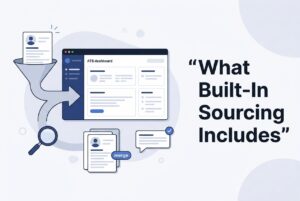
Profile import should add a person to the candidate database or a specific job, parse the record, preserve the source, and make the profile usable right away. If the system forces copy-and-paste work or hides the prospect in a disconnected record, it is not helping sourcing.
CVViZ supports Add Candidates from a job’s candidates tab or the Candidate Database. Recruiters can use resume upload, pasted resumes, inbox import, CSV or XLSX import, Find on web, Find on GitHub, and Discover candidates. The key detail is that the modal can target either the Candidate Database or a particular job, which is what makes the imported record actionable.
For a hard-to-fill developer role, that matters. A recruiter might import a GitHub profile, attach it to the job, and then compare it with a past applicant already in the database. That is the difference between passive storage and usable sourcing. If the vendor’s intake only works through one route, or if the source label disappears after import, the workflow is already leaking value.
Can candidate rediscovery be separate from external sourcing?
Yes, and it should be. Rediscovery means finding relevant people already in your records for a new opening. External sourcing means finding new prospects outside the database. Those are related, but they are not the same motion.
CVViZ supports rediscovery through search and through Discover candidates, which matches the existing database against a target job and requires AI-ranking permission. It also supports searching the organization’s own database before sourcing externally. That is the right pattern for a recruitment CRM and ATS combination: use history first, then expand outward.
A silver medalist is not a guaranteed yes. It is simply a qualified runner-up from a prior process. Availability, interest, and contact preferences still matter. So the practical test is simple: load a past applicant, open a new role, and see whether the recruiter can review old context, reassess fit, and decide whether outreach makes sense. If the system only shows an external profile pool and not the buyer’s own history, rediscovery is not really built in.
What does duplicate control need to handle?
Duplicate control needs to catch repeat people, show the match clearly, and let the recruiter decide what record should remain active. Otherwise, every channel creates another copy, and the pipeline starts lying.
CVViZ documents automatic duplicate checking during resume parsing for uploads, pasted resumes, drag-and-drop, and bulk import. When it detects a duplicate, the recruiter can compare the new file and the existing file side by side and choose the active version. It also uses file and parsed content comparisons, with email and phone similarity factored in after parsing.
That is the right standard. Test the ugly cases, not just the clean ones. Re-import the same person with a newer resume. Then test a CSV row with a matching email. Check whether the warning appears, whether the recruiter can keep the right resume, and whether source and interaction history stay intact after cleanup. For CSV imports, CVViZ also provides an Update existing contacts checkbox that updates matches on email instead of creating another contact.
Is search just keyword lookup?
No. Useful search should retrieve real candidate records, not just accept a query box and hope for the best. Recruiters need Boolean search, filters, and the ability to inspect why a person appeared.
CVViZ uses Elasticsearch-backed full-text, keyword, Boolean, and location search across candidate details such as skills, names, email addresses, phone numbers, job titles, and resume text. It also supports filters, tags, notes, and structured resume data. That is what turns a database into something a recruiter can work from.
For an ATS with candidate sourcing, the real question is whether search can support a repeatable shortlist. Start with skills, title, and location. Add Boolean operators. Then check the actual records returned and see whether parsing gaps or false positives are obvious. Have another recruiter repeat the same query. If the result changes wildly, the search layer is not ready for a lean recruiting team.
How should outreach tracking behave?
Outreach tracking should connect a message, a reply, and the follow-up history to the candidate record. Opens and clicks are useful signals, but they are not proof of interest or qualification.
CVViZ supports email integration and syncing, templates, bulk messages, tracking of opens and clicks, and, in current ATS materials, email sequences plus SMS or WhatsApp conversations with responses in the candidate record. That gives recruiters a single place to see who was contacted and what happened next, which is the real point of a recruitment CRM. It is also why outreach must sit beside the candidate record, not in a separate tool with no history.
In practice, send one permitted message and then inspect the reply in the candidate timeline. If another recruiter can see the handoff, the record is doing real work. If the system only shows campaign setup and open rates, then it is reporting activity, not managing relationships.
Built-in versus add-on: what should buyers verify?
Built-in sourcing does not mean the ATS vendor owns every service involved. It means the buyer can execute and audit the workflow in the contracted setup. That distinction saves a lot of headaches.
Use this simple test:
| What to verify | What “built in” should look like | Red flag |
|---|---|---|
| Job distribution | Eligible roles post to the right channels with source data returned | A logo list without proof the role qualified |
| Profile import | Resume, inbox, CSV, extension, or web intake lands in a usable record | Copy-and-paste work or inaccessible records |
| Rediscovery | Past candidates are found inside the buyer’s own database | Only an external profile pool is shown |
| Duplicate control | The system flags matches and lets the recruiter choose the active record | Every channel creates a new record |
| Search | Real records appear for Boolean and filtered queries | Query terms return weak or meaningless results |
| Outreach tracking | Replies and follow-up history live in the candidate record | Opens and clicks are treated like a hire signal |
That is also the right way to think about sourcing automation. It should describe a repeatable action, like importing an inbox resume or matching existing records to a role. It should not pretend the system can source or hire autonomously.
A practical demonstration checklist for buyers
If you only do one demo, make it an end-to-end test with one real job and one real candidate. That is where most sourcing claims either hold up or fall apart.
- Publish one approved role to a career page and a few eligible channels.
- Confirm where the applicant lands and how source attribution is recorded.
- Import one prospect through a second route, such as CSV, inbox, or Find on web.
- Import the same person again and inspect the duplicate warning.
- Search the historical database for an older applicant who fits the new role.
- Send a compliant follow-up and check the reply in the candidate timeline.
- Review reports for source, progress, and downstream outcomes.
- Ask what required an extension, paid ad, extra account, API work, or manual transfer.
For a mid-market team with limited recruiting capacity, this checklist matters more than a feature brochure. It tells you whether the system reduces friction or simply relocates it.
How does CVViZ fit this use case?
CVViZ gives buyers the pieces they need to evaluate an ATS with candidate sourcing seriously. It offers job posting to 20+ free boards and 2,000+ free and paid boards worldwide. It supports AI resume screening, relative ranking, automated sourcing from the web and social platforms, search across the resume database, email sync, workflow automation, recruitment analytics, and a recruitment CRM for agency workflows.
It also supports GDPR tooling, cloud resume storage, duplicate detection, and API-based access. CVViZ can act as an intelligent layer on top of an existing ATS as well. For product fit, the important part is not the label. It is whether the buyer can move from job distribution to sourcing, rediscovery, duplicate control, search, and outreach in one working flow.
FAQ
Is job posting the same as candidate sourcing?
No. Posting attracts applicants to a role. Candidate sourcing also includes finding prospects, importing them into a usable pool, rediscovering past candidates, and tracking engagement history.
Can an ATS have built-in sourcing if it uses job-board integrations?
Yes, if the integration supports an actual workflow and the buyer can verify eligibility, source attribution, record continuity, and follow-up history. A feed alone is not enough.
What is the quickest way to judge candidate rediscovery?
Load a known past applicant into a new open role, inspect their earlier context, and see whether the recruiter can decide if renewed outreach is appropriate. Load a known past applicant into a new open role, inspect their earlier context, and see whether the recruiter can decide if renewed outreach is appropriate.
What should leadership ask for in a source report?
Ask for applications and downstream progress by source for a defined period, plus the attribution rules used for people with multiple source events.
Does an open or click prove interest?
No. It only shows engagement with a message. Interest, fit, and consent still need recruiter review.