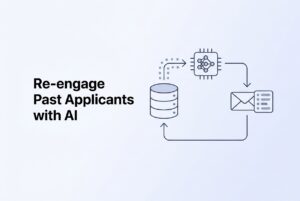
Lean recruiting teams do not need to start every search from zero. They need a better way to reuse the candidates they already have. That is the core idea behind talent rediscovery: treat your ATS as a searchable talent inventory, then use AI matching and email campaigns to surface the best-fit past applicants for a new role.
The practical move is simple. Define the role, search the internal database, rank candidates by fit, review the results with human judgment, segment the right people, and send a short message that explains why they are being contacted now. That is faster, cleaner, and much more defensible than blasting generic outreach to a cold list.
Why past applicants get overlooked
Most teams have the data, but not the system. An ATS may store resumes and application history, yet still behave like a filing cabinet. If records are fragmented across inboxes, spreadsheets, referrals, and job boards, recruiters cannot reliably find people who already showed interest in the company.
Keyword search adds another problem. A resume may describe the right experience without repeating the exact job title or skill string. On the flip side, a resume can repeat keywords and still be a poor fit. That is why old-school search often misses the best candidates and over-ranks noisy ones.
There is also a human issue: recruiters tend to review the newest applications first. Older profiles get buried, even when they were strong finalists or were only rejected because another person was a better fit for that specific opening.
And then there is outreach. Generic batch mail feels lazy fast. If a candidate does not understand why they are being contacted, the message reads like spam with better grammar. Talent rediscovery only works when the search is structured and the follow-up is relevant.
The Talent Rediscovery Loop
The best way to reuse an AI ATS is to run the same operating pattern every time a role opens. We call that The Talent Rediscovery Loop.
1. Define the role
       ↓
2. Rebuild the searchable talent inventory
       ↓
3. Match and rank past applicants
       ↓
4. Review, segment, and exclude unsuitable records
       ↓
5. Re-engage with personalized email campaigns
       ↓
6. Route replies into the hiring workflow
       ↓
7. Measure outcomes and improve the next search
       ↺
The point of the loop is not to automate hiring decisions. It is to make the database useful again. AI handles retrieval, parsing, matching, ranking, and workflow support. Recruiters still own the criteria, judgment, communication, fairness, and decisions.
If you want a simple rule to remember, use this one: rediscover first, source second.
How do you define the role for AI matching?
AI ranking is only as good as the role brief you feed it. Before you search the database, translate the requisition into explicit criteria. Separate must-haves from preferences so you do not turn every nice-to-have into an automatic rejection rule.
A strong role brief should cover:
- Job title and close alternatives
- Required skills and acceptable synonyms
- Minimum relevant experience
- Certifications, licenses, work authorization, or location constraints where appropriate
- Work arrangement and travel requirements
- Seniority and scope
- Nice-to-have skills that improve prioritization
- Evidence that should trigger human review
- True disqualifiers that are job-related and consistently applied
This matters because a past applicant was evaluated under old constraints. They may fit now for a different reason: the role changed, the person gained experience, the location moved, or the earlier hiring decision was simply relative to another finalist.
For CVViZ, relative resume ranking uses job requirements and hiring pattern signals to prioritize candidates in real time. The practical takeaway is the same either way: define the job first, then let the system compare candidates to that definition.
How do you search an ATS for past applicants?
Use two searches, not one. Start broad, then tighten.
The first pass should use contextual AI matching and full-text retrieval to surface people who look relevant even if the resume wording is different. The second pass should use Boolean logic and structured filters to control the result set.
| Search approach | Strength | Weakness | Best use |
|---|---|---|---|
| Exact keyword search | Transparent and easy to audit | Misses synonyms and context | Precision follow-up queries |
| Full-text search | Broad retrieval across parsed resumes | Relevance is not the same as fit | First-pass database search |
| Boolean search | Good control over inclusion and exclusion | Still depends on the words you choose | Narrowing the candidate pool |
| Contextual AI matching | Compares skills, experience, and role relevance | Must be reviewed by humans | Prioritizing the best-fit candidates |
| Human review | Brings judgment and nuance | Slow and inconsistent on its own | Final validation and exceptions |
CVViZ supports Elastic search across the resume database with full-text, keyword, Boolean, and location search, plus filters such as years of experience, qualification, location, and resume freshness. It also supports contextual matching that goes beyond exact keyword frequency.
A good workflow is: search the internal pool, review the top-ranked candidates, inspect a few lower-ranked or overlooked profiles, and then decide who is worth contacting. That keeps past applicants from disappearing just because they were not the first page of a queue.
How should recruiters rank and segment prior applicants?
Use AI to prioritize review, then segment with human judgment. Do not send the same message to every candidate just because they all applied at some point.
A practical segmentation model looks like this:
| Segment | Meaning | Action |
|---|---|---|
| High-fit prior applicant | Strong match and contactable | Personal outreach first |
| Silver medalist | Strong finalist who was not hired | Reference the prior process and reopen the conversation |
| Adjacent-fit candidate | Credible fit through a different path or title | Human review before outreach |
| Revisit candidate | Previously overlooked or screened out under different criteria | Audit the old decision first |
| Nurture candidate | Relevant but not ready or not available | Permission-aware nurture |
| Do-not-contact / excluded | Opted out, deleted, stale, or restricted | Suppress completely |
The key discipline is to review the resume, stage history, feedback, location, availability, and prior communications before you reach out. A rejection from last year is context, not a permanent label.
This is where talent rediscovery becomes operational instead of theoretical. You are not just storing records. You are deciding which records still deserve attention.
How do email campaigns re-engage past applicants?
Effective outreach is short, specific, and honest. The email should remind the candidate who you are, why you are contacting them now, and what is different about the role.
A strong message usually includes:
- Subject line tied to the candidate’s background or prior interaction
- Brief context about the earlier relationship
- Why this role is relevant now
- One or two concrete skills or projects that matter
- A simple next step
- A clear opt-out path
Here is the shape of the message:
Hi [Name],
We spoke earlier about [previous role/team]. We now have a new opening for [current role], focused on [specific responsibility]. Your experience with [specific skill or project] stood out, so I wanted to see whether this is relevant to your plans now. If it is, would you be open to a short conversation? If not, feel free to opt out of future role updates.
Best,
[Recruiter]
Notice what this does not do. It does not oversell. It does not expose internal scorecards. It does not pretend the person was “basically hired.” It simply gives the candidate a reason to care.
CVViZ’s email tools support templates, bulk emails, campaigns, reminders, open and click tracking, and candidate history. That makes it easier to keep email campaigns tied to actual candidate context instead of generic blasts.
Which recruiting tasks should be automated?
Automation should handle repetitive logistics, not final judgment. That is the right line.
Use automation for:
- Resume received notifications
- Candidate stage changes
- Interview scheduling
- Hiring manager reminders
- Follow-up emails
- Candidate instructions
- Campaign sequencing
- Reply routing
- Status updates
Keep a recruiter in the loop for:
- Exclusions
- Nontraditional profiles
- Edge cases
- Reply interpretation
- Final decisions
- Accommodation requests
- Any record with unclear status
CVViZ workflow automation supports email and notification triggers when a resume is received, a job is added, or a candidate stage changes. It also supports reminders, scheduling, assessments, and moving candidates through the hiring workflow. That is the right kind of automation for a lean team: predictable, repeatable, and easy to monitor.
The rule is simple. Let the system do the routing. Let the recruiter do the thinking.
How do you measure talent rediscovery?
Do not measure this with opens alone. That is vanity data. Measure the funnel.
| Metric | What it tells you |
|---|---|
| Rediscovery coverage | How much of the eligible pool you reviewed |
| Match-to-review rate | How many surfaced candidates were worth human review |
| Review-to-contact rate | How selective the team was before outreach |
| Deliverability rate | Whether the message actually landed |
| Reply rate | Whether the outreach was relevant |
| Positive-reply rate | Whether the role matched candidate interest |
| Screen conversion | Whether contact turned into real conversation |
| Interview conversion | Whether the rediscovered pool produced interviews |
| Offer conversion | Whether the pool produced viable finalists |
| Hire conversion | Whether the workflow created hires |
| Time to first qualified slate | How fast the team produced a credible shortlist |
| Time to hire | How long the process took end to end |
| Cost per rediscovered hire | What the pipeline actually cost to use |
| Hiring-manager satisfaction | Whether the process created trust |
| Ranking quality | Whether the AI surfaced the right people |
The best comparison is before and after. Measure a baseline period, then compare rediscovered candidates against new applicants on shortlist speed, recruiter time, interview conversion, and hire outcomes.
The best comparison is before and after. Measure a baseline period, then compare rediscovered candidates against new applicants on shortlist speed, recruiter time, interview conversion, and hire outcomes.
The best comparison is before and after. Measure a baseline period, then compare rediscovered candidates against new applicants on shortlist speed, recruiter time, interview conversion, and hire outcomes.
If the rediscovery process is working, you should see faster qualified slates and less dependence on external sourcing.
CVViZ’s reporting focuses on time-to-hire, source performance, recruiter productivity, and related funnel signals. That gives teams a way to track the effect of reuse instead of guessing.
Privacy and fairness still matter
Past applicants are not a free-for-all contact list. Before re-engaging them, confirm lawful basis, original notice, retention policy, and opt-out status. Suppress deleted, opted-out, restricted, or clearly unsuitable records across every system you use.
Human review also matters for fairness. AI ranking should support prioritization, not automatic rejection. Recruiters should review false negatives, check for accessibility issues, and keep a route open to correct bad data or challenge a ranking outcome.
That is not just good practice. It is how you keep the process defensible.
CVViZ supports GDPR rights such as access, rectification, erasure, and portability, and it acts as a data processor. But the employer still owns the policy decisions around reuse, retention, and communication.
What does CVViZ support, and what should buyers verify?
CVViZ supports the core pieces of this workflow: AI resume screening, relative ranking, Elastic search, resume parsing, workflow automation, email campaigns, and recruitment analytics. It also supports adding AI capabilities to an existing ATS.
| Need | CVViZ supports | What to verify |
|---|---|---|
| Central candidate inventory | Searchable resume database | Your record schema and retention rules |
| Resume parsing | Structured extraction and export | Exact fields and import behavior |
| Database search | Full-text, Boolean, filters, relevance ranking | Query setup and field coverage |
| AI matching | Contextual screening and ranking | How rankings are reviewed and governed |
| Segmentation | Tags for roles, pipelines, and experience | Your internal segment rules |
| Outreach | Templates, bulk campaigns, reminders | Your cadence, opt-out flow, and approvals |
| Workflow | Notifications, stage changes, scheduling | Which triggers you will actually use |
| Analytics | Time-to-hire and source reporting | Your baseline definitions and dashboards |
The important point is not whether the tool “does recruiting.” It is whether it supports a repeatable rediscovery process that your team can actually run every week.
Practical examples
Example 1: High-volume operations role
A team receives hundreds of applications for a remote operations role. Instead of rereading every resume, the recruiter defines the role, searches the internal pool, ranks prior applicants, and separates strong finalists from adjacent-fit candidates and nurture records. The first outreach wave goes to the strongest prior applicants. The second wave goes to people with credible adjacent experience. The third wave stays in nurture until timing changes.
Example 2: Technical role with different requirements
A developer was not selected for a prior role because the stack and seniority were different. A new opening uses a different product domain and a slightly different technical mix. The recruiter searches skills, adjacent terminology, and experience filters instead of relying on the old title alone. In this case, past applicants are useful because the role changed, not because the person magically changed.
Example 3: Previously interviewed candidate
A candidate reached interview stage last year but was not hired. If the old issue was role-specific and no longer relevant, a new conversation makes sense. If the record shows a material concern that still applies, the candidate should be suppressed or routed through policy review.
That is the real value of email campaigns tied to candidate history. The message reflects the actual relationship, not a mass mailing fantasy.
FAQ
Is talent rediscovery the same as sourcing?
No. Talent rediscovery works from people already in your ATS or talent database. Sourcing looks for new people in external channels. Rediscovery reduces how often you need to start from scratch.
How far back should recruiters search?
There is no universal cutoff. Use your retention policy, lawful basis, data freshness, role relevance, and local law.
Should every past applicant be contacted?
No. Contact only candidates whose current fit is credible and whose record is eligible for reuse. Suppress deleted, opted-out, restricted, or clearly unsuitable profiles.
Can AI rank candidates without rejecting them automatically?
Yes, and that is the safer setup. Use AI to prioritize review and keep humans in the decision loop.
What should the first email say?
Say who you are, why you are reaching out, what changed, why the candidate may fit, and what the next step is. Keep it short.
How many follow-ups should be sent?
Use a small, documented sequence. Stop when the candidate replies or opts out.
Does CVViZ publish its ranking formula?
No public formula is documented in the available material. CVViZ describes contextual matching and ranking, but not the underlying weights or score scale.
What is the most important success metric?
Time to a qualified slate is usually the best primary measure. After that, look at interview conversion, hire conversion, recruiter time, and hiring-manager satisfaction.
The bottom line
The teams that win with existing candidate data do one thing differently: they treat every past interaction as reusable evidence. That is what talent rediscovery is really for.
When you define the role clearly, search the ATS intelligently, rank prior applicants with human review, and send relevant email campaigns, you stop wasting time on cold starts. You get back to a live talent pool that already knows your company, already showed interest, and may be closer to “yes” than your next outbound list ever will be.