If your team only needs to process applicants for open roles, an Applicant Tracking System (ATS) may be enough. But if you also need to build and maintain relationships with people who may apply later, then you need recruitment CRM capability too. That is the real question behind recruitment CRM versus ATS: are you tracking a live hiring process, or are you also nurturing a future talent pipeline?
In practice, many teams need both workflows in one place. That is especially true when hiring is proactive, recurring, or agency-led. An ATS handles requisitions, applications, interviews, feedback, offers, and hire decisions. A recruitment CRM handles sourcing, talent pools, candidate engagement, rediscovery, and long-term relationship history. The cleanest setup is often an ATS with built-in CRM when the same candidate records, communication history, search, and permissions should carry across both modes.
Recruitment CRM vs ATS: what is the difference?
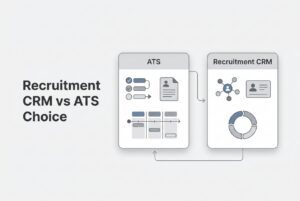
The short version is simple. An ATS manages people through an active hiring process, while a recruitment CRM manages relationships before, between, and after open requisitions. They overlap, but they optimize different jobs.
An ATS answers: “Where is this applicant in the process for this open role?” A recruitment CRM answers: “Who should we stay in touch with for current or future roles, and what do we know about them?” That difference matters because the same person can move between both states without becoming a duplicate or losing context.
Here is the practical split. Use ATS logic when the trigger is a requisition, application, screening step, interview, or offer. Use CRM logic when the trigger is sourcing, a referral, an event contact, a past finalist, or a future hiring plan. In other words, one system manages the current hiring cycle, while the other manages the relationship that outlives it.
That is why talent pipeline management is broader than applicant tracking. It includes people who have not applied yet, people who may apply later, and people who should remain visible after one job closes. If you only need one thing, track the live process. If you need both, track the live process and the relationship.
What does an ATS manage?
An ATS manages the requisition-to-hire workflow. It keeps the open job, the application, the candidate stage, interviewer feedback, offer steps, and hire outcome tied together in one process.
A typical ATS flow starts with planning and approving the requisition. Then the job is posted, applications are collected, candidates are screened, interviews are coordinated, feedback is stored, and the requisition is closed. That structure gives recruiters and hiring managers visibility into where each applicant stands.
ATS tools are optimized for control and reporting around open jobs. They are built for things like posting jobs, collecting applications, applying knockout questions, scheduling interviews, routing approvals, sending updates, and reporting funnel movement. They are not primarily built to maintain a relationship with someone who is not in an active process.
For example, a software company may get 600 applications for one engineer role. The ATS collects the applications, removes obvious duplicates, asks prescreening questions, ranks or filters profiles, assigns tasks, schedules interviews, stores feedback, and reports funnel performance. That is an ATS-first workflow because the trigger is an open role and the goal is a hiring decision.
So yes, an ATS can hold a talent pool. But a talent pool alone does not make it a full recruitment CRM. The real test is whether the system supports proactive sourcing, durable prospect records, long-term segmentation, nurture history, and a clean move from prospect to applicant.
What does a recruitment CRM manage?
recruitment CRM manages candidate relationships. It is built for proactive sourcing, talent pooling, engagement, rediscovery, and future opportunities.
The core workflow is different from an ATS. First, you capture people from sourcing, referrals, events, old applications, or talent-pool sign-ups. Then you create a durable profile with skills, source, preferences, activity history, notes, and ownership. After that, you segment the pool, build a relationship, rediscover matches when a role opens, and hand the person into the formal hiring workflow when needed.
That is where recruitment CRM matters. It lets you keep qualified people visible even when no job is open yet. It also helps you find silver medalists and past applicants when a similar role appears later. The goal is not just to store names. It is to keep the relationship usable.
A simple example makes this obvious. A recruiter sources a cybersecurity engineer six months before hiring begins. The recruiter records the person’s background and preferences, keeps contact within the allowed policy, places the person in a relevant pool, and sends limited updates. When the role opens, the recruiter searches the pool and invites the person into the formal ATS process. The relationship started before the application.
That is also why talent pipeline management is not just a nice-to-have phrase. It is the operating model for staying ready before a requisition exists, not only after it does.
ATS vs recruitment CRM: comparison table
| Dimension | ATS | Recruitment CRM / Candidate Relationship Management |
|---|---|---|
| Primary question | Where is this candidate in an active hiring process? | How do we build and maintain a relationship for current or future roles? |
| Main trigger | Requisition, application, referral, formal submission | Proactive sourcing, referral, event, past application, talent-pool sign-up, future hiring plan |
| Time horizon | Current hiring cycle | Before, between, and after hiring cycles |
| Core record | Requisition plus application or stage | Person plus relationship, pool, segment, activity, and future-fit context |
| Typical people | Applicants being evaluated | Prospects, passive candidates, past applicants, silver medalists, referrals, alumni |
| Main actions | Post, screen, shortlist, interview, collect feedback, offer, hire, reject | Source, enrich, tag, search, segment, contact, nurture, rediscover, re-engage |
| Success measures | Time-to-fill, stage conversion, interview throughput, offer acceptance | Response rate, pool quality, rediscovery, prospect-to-applicant conversion, reuse |
| Failure if used alone | Future candidates get buried after a requisition closes | Relationship activity exists without formal stage control or hiring auditability |
The table is functional, not universal. Many products blur the line, which is why workflow matters more than labels.
The key distinction is this: an ATS moves a person through a defined hiring process, while a recruitment CRM preserves and develops a relationship even when there is no open job. A single candidate can move between those states many times.
When do agencies need both?
Agencies often need both capabilities because their work spans reusable candidate pools and active submissions to open jobs. They may identify a person before a matching job exists, submit that person to different roles over time, and keep communication history across multiple placements.
That is a classic case for ATS with built-in CRM. The ATS side handles the live submission, interview stages, and outcome for a specific job. The CRM side keeps the broader relationship intact, so the recruiter does not start from zero each time a new role appears.
Here is the reality of agency work. One candidate may be suitable for several clients, may receive feedback from more than one hiring team, and may be redeployed after a placement ends. That means the recruiter needs a durable profile, searchable skills, availability, consent or contact status, ownership, submission history, interview notes, and communication history. A one-job view is not enough.
The agency also has client context, but this article is not about sales CRM. The important point is that candidate and job context should stay connected. Otherwise, recruiters end up re-entering data, chasing notes across tools, and losing visibility when a job closes.
A good agency setup keeps one candidate record and lets that person move from prospect to submission to future candidate without a messy reset. That is where a combined system earns its keep.
When do proactive hiring teams need both?
Proactive hiring teams need both workflows when they source before a requisition exists, hire repeatedly for similar skills, engage passive candidates, or reuse past finalists. If hiring is mostly inbound and occasional, ATS-only may be enough for now.
The strongest signs are easy to spot. Recruiting starts before the job is approved. The same skill families keep coming up. Qualified people often decline, pause, or lose to another employer but still matter later. Recruiters source from professional networks, technical communities, referrals, and events. Hiring managers want future talent visibility, not just current applicants.
That is exactly where talent pipeline management becomes useful. It gives the team a way to organize people before the opening exists, then move the right people into the formal process when the role becomes real.
There is also a practical reason to care. In a 2025 recruiting benchmark, sourced outbound applicants were reported as five times more likely to be hired than inbound applicants. The same benchmark also showed that the share of sourced hires rediscovered within a company’s CRM or ATS rose from 29.1% in 2021 to 44.0% in 2024. That does not prove a tool caused the result, but it does show why rediscovery and candidate reuse matter.
So if your team is still treating every closed requisition as the end of the story, you are leaving useful candidates on the table.
Do you need separate tools or an ATS with built-in CRM?
Most teams should start by asking whether one system can hold one candidate identity across sourced, applied, interviewed, hired, and past-candidate states. If yes, an ATS with built-in CRM is usually the simpler operating model. If not, separate tools can still work, but only with strong integration and governance.
Built-in is not automatically better. A shallow talent-pool feature that cannot segment, search, nurture, or preserve history is not very useful. On the other hand, two strong tools can still create a bad process if they produce duplicate candidates, delayed status updates, or broken communication history.
Use this decision filter:
- Choose built-in CRM when recruiters need one sequence from sourcing through hire and re-engagement.
- Choose separate tools when a specialist workflow already exists and integration is reliable.
- Choose built-in CRM when shared search, communication history, permissions, and reporting matter.
- Choose separate tools when the organization can manage master data, deduplication, and source-of-truth rules cleanly.
Before buying recruitment software, ask a few blunt questions. Can a prospect become an applicant without a second profile? Is sync one-way or two-way? Who owns each field? How are duplicates merged and audited? Do opt-outs, consent records, notes, and preferences show up everywhere they need to?
If those answers are fuzzy, the architecture is probably fuzzy too. And fuzzy recruiting systems tend to become expensive inboxes.
How should ATS and CRM work together?
A good combined system uses one person record with multiple contexts. The person record stores identity, profile, source, skills, notes, contact preferences, lawful-basis or permission status, ownership, and activity history. Then a separate association links that person to each requisition or submission.
That gives you a clean lifecycle: prospect, engaged prospect, matched to role, invited or applied, screened, interviewed, offered or rejected, hired, withdrawn, silver medalist, and future match. Those are example states, not a universal setup. Teams should adapt stage names to their process and jurisdiction.
The important rule is simple. Do not delete the relationship just because one requisition closes. Instead, record the outcome, apply the retention rule, segment the person properly, and make the next action clear. A candidate who was not right for one role may still be right for another. A candidate who must be removed under policy should not stay in a pool just because it is convenient.
This is where recruitment CRM and ATS stop being separate arguments and become one operational model. The ATS controls the live process. The CRM preserves the future relationship. When both are working together, recruiters can move fast without losing context.
How CVViZ maps to the workflow
CVViZ is positioned as AI recruiting software that combines ATS and recruitment CRM capabilities. On the ATS side, it supports AI resume screening, candidate ranking, job posting to 2,000+ boards, workflow automation, video interviews, recruitment analytics, and resume parsing.
On the CRM side, its agency-oriented materials describe prospect management, future talent pipeline building, candidate history, email tools, bulk email, open and reply tracking, notes, document management, company and contact records, leads, account-manager assignment, client portals, and permission settings. That makes it a fit for teams that need both candidate tracking and relationship management in one environment.
CVViZ, with its AI resume-screening APIs, can also add an AI layer to an existing ATS or recruitment software. So, depending on the setup, it can be used as a combined system or as an intelligence layer alongside another ATS. That matters for teams that already have an ATS but want screening, sourcing, or analytics support without replacing everything at once.
One note of caution: the reviewed materials do not establish exact two-way sync behavior, field mapping, duplicate handling, or every integration detail. So those parts still need product validation.
Privacy and automation safeguards
Recruitment CRM work involves more than applications. Passive prospects are still personal data, and recruitment records can include sensitive information. That means access control, retention rules, and a deletion process are not optional extras.
At minimum, people should be told what data is collected, why it is used, how long it is kept, and how they can exercise rights. The system should also record source, purpose, permission or lawful-basis status, contact preference, owner, and retention or deletion date. If a person opts out or asks for deletion, the workflow should respect that across every connected process.
Automation helps, but it should not make decisions on its own. It is useful for acknowledgements, reminders, routing, status updates, and task creation. It is not a substitute for human judgment on suitability, exceptions, or sensitive decisions. AI resume screening can reduce repetitive review, but a score is not a hiring decision.
A practical rule works well here: automate the admin, not the accountability. That keeps the process moving without turning recruiting into a black box.
Key statistics that shape the answer
A few benchmark numbers explain why this topic matters.
A 2025 recruiting benchmark, based on data from January 2021 through December 2024, covered more than 140 million applicants and 1.3 million hires. In that dataset, hiring teams conducted 42% more interviews per hire than in 2021, with 20 interviews rather than 14. The same comparison reported a 24% increase in average time to hire, from 33 days to 41 days.
The same benchmark also showed that job boards and social sites produced 49.0% of applications but less than one quarter of hires, at 24.6%. That gap helps explain why sourcing and rediscovery matter more than simply collecting applications.
A 2025 candidate-experience benchmark, based on more than 2.5 million hiring experiences and nearly 70,000 candidate comments, reported global candidate Net Promoter Score averages of +81 for hired candidates, +40 for withdrawn candidates, and -7 for rejected candidates. It also found that withdrawal comments most often pointed to communication gaps, slow timelines, and compensation misalignment discovered late.
Taken together, the message is clear. Speed, communication, and candidate rediscovery matter. A process that only tracks applicants is usually too narrow once hiring gets serious.
FAQs
Is a recruitment CRM the same as an ATS?
No. An ATS manages candidates through an active hiring process. A recruitment CRM manages candidate relationships before, between, and after active requisitions. They overlap in search, communication, and notes, but they solve different problems.
Can an ATS include a recruitment CRM?
Yes. Some platforms combine both. The key is to verify that the CRM side supports real prospect records, talent-pool segmentation, proactive sourcing, nurture communication, relationship history, and a clean handoff to application stages.
Do staffing agencies need both an ATS and recruitment CRM?
Often, yes. Agencies reuse candidates across clients and roles, recruit proactively, and preserve history after a placement closes. They do not automatically need two separate products, though.
Does a recruitment CRM replace an ATS?
Usually not. A CRM can maintain relationships and future pools, but teams still need requisition control, application tracking, interview feedback, offer management, and hiring reporting for live roles.
When is an ATS alone enough?
An ATS may be enough for mostly inbound hiring tied to a small number of open requisitions, with little proactive sourcing, little candidate reuse, and no ongoing talent-community program. Reassess when hiring gets more frequent or harder to fill.
How should a prospect become an applicant?
Use one identity and add an application or requisition association. Carry forward source, notes, activity, communication preferences, and permission status. Do not create a second profile or overwrite the long-term relationship.