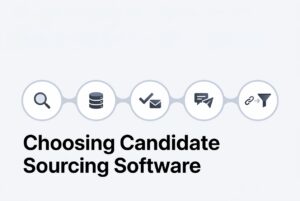
Technical recruiting for scarce talent works best when sourcing and screening are part of one evidence-led workflow, not separate motions. Start by defining the actual engineering work, then source likely matches from GitHub, Stack Overflow, and your existing records, then use contextual matching to decide what deserves review, and finally assess interested candidates with the same job-related coding exercise and rubric. That is the core move. It keeps technical recruiting focused on evidence, not noise.
For teams under pressure, this matters because a strong public profile is not a hiring decision. A GitHub repo may show relevant work, and a Stack Overflow answer may show technical depth, but neither proves current interest or production performance. Likewise, a live code editor helps you observe how a candidate solves a problem, but it still only measures one sample of work. The workflow only works when each step answers a different question and the team records source, evidence, outreach, assessment, and decision together.
The workflow in one view
The best workflow is simple to describe and disciplined to run. First, calibrate the role with the hiring manager. Next, source from public developer signals and internal candidate history. Then, use contextual matching to prioritize review, not to make the technical judgment for you. After that, contact people deliberately, confirm interest, and evaluate them on the same task and rubric.
Here is the practical split:
| Stage | What it answers | What it does not answer |
|---|---|---|
| Role calibration | What problem must this hire solve? | Who can already do it |
| GitHub sourcing and Stack Overflow review | Who has visible, relevant technical signals? | Who is ready to interview |
| Contextual matching | Which records deserve human review first? | Who is technically capable |
| Coding exercise and interview | How does the candidate reason on a real task? | Whether a repo alone is enough |
AI resume screening supports this flow with AI resume screening, relative ranking, candidate sourcing from GitHub and Stack Overflow, and a video interview with a live code editor. Used together, those parts help a lean team keep the process evidence-based instead of reactive.
1. Calibrate the role before you search
Start here, or the rest of the workflow gets sloppy fast. Technical recruiting only works when the recruiter and hiring manager agree on the real work, the must-have skills, the learnable skills, and the fair constraints before sourcing begins. That means defining the first-quarter task, the production environment, and what counts as acceptable evidence in a resume, a public repository, a conversation, and a coding exercise.
A good calibration separates essential from preferred. For example, a backend hire may need experience operating a service, while experience with one specific framework may be preferred. That distinction keeps you from over-filtering too early. It also helps when a strong candidate has adjacent experience but not the exact title or stack you expected.
contextual resume screening supports this approach with contextual resume screening and job-linked ranking, but the discipline still starts with the role definition. For sparse talent markets, that is the guardrail that stops the team from rejecting unconventional people just because they do not match a rigid keyword list.
What to document before sourcing
- The first-quarter engineering task
- Non-negotiable skills and constraints
- Learnable or preferred skills
- Observable evidence for each criterion
- Location and working-arrangement requirements
- Who can advance an unconventional but promising profile
That is the foundation. Without it, GitHub sourcing turns into a scavenger hunt and screening turns into guesswork.

2. Source from GitHub and Stack Overflow, plus your own records
GitHub sourcing and Stack Overflow are useful because they show public technical signals. They do not replace resumes, and they do not prove someone is open to a job. Treat them as discovery channels that help you find people worth a closer look.
CVViZ provides sourcing paths through Find on web and Find on GitHub. The documented source tabs include Resume Files, LinkedIn, GitHub, Behance, and Stack Overflow, and the job-specific GitHub path supports search by query, location, language, repositories, and followers. Those are discovery controls, not hiring cutoffs. In other words, few repositories or followers do not mean low ability.
Use your existing database too. Past applicants, silver medalists, and previously sourced people often deserve a second look when a new role opens. CVViZ supports candidate rediscovery and searchable records, which makes it easier to re-engage known talent instead of starting from zero every time.
What each source is good for
| Source | Best use | Caution |
|---|---|---|
| GitHub | Public work on a relevant language, system, or problem | Public work may be old, collaborative, or limited by employer rules |
| Stack Overflow | Public explanations or solutions to technical problems | Participation is uneven and does not show job interest |
| Existing candidate records | Reuse of prior evidence and prior conversations | Past interest does not guarantee current availability |
One small rule matters here: inspect actual evidence before importing. A profile card is not enough. Check whether the repository, contribution, or answer is relevant to the role, and confirm that two records belong to the same person before merging them. Technical recruiting gets messy when lookalike names get treated like one candidate.
3. Use contextual matching to prioritize review, not to decide
Contextual matching is the bridge between sourcing and evaluation. It helps you decide which records look relevant to this job, based on the meaning of the role, not just raw keyword overlap. That is the right use of AI in technical recruiting: prioritize review, then let a human examine the evidence.
This is where lean teams save time without giving up judgment. A candidate who has operated reliable services in a different framework may deserve review over someone who only lists the exact framework in the job post. On the other hand, a repository using the right language does not prove the person designed or maintained the system.
A practical ranking rule
Use contextual matching to answer one question: “Which profiles deserve a human look first?” Then stop there.
That keeps the workflow honest. It also protects unconventional candidates, especially those with sparse public portfolios or nonstandard titles. If the evidence is thin, review the underlying record, sample a few lower-ranked profiles, and let the conversation do its job.
4. Contact people deliberately and avoid duplicate outreach
Good sourcing is wasted if outreach is generic. For scarce talent, a strong public profile does not mean the owner is job hunting, so the first message should be short, specific, and tied to observed work. Ask whether the person wants to explore the role. Then record the contact attempt and the response.
This is not a small detail. CVViZ’s sourcing guidance warns that imported people may not show a distinct sourced tag in the interface, so teams should tag campaigns themselves, check for existing candidate records before importing, and send tailored outreach instead of relying on a generic automated stage-entry email. It also notes that stage automation can fire after addition, and the same candidate can appear in multiple jobs.
That means you need a deliberate process before outreach starts. Check candidate history. Check job automation. Check whether the person already exists in the database. If you skip that work, you can easily send duplicate messages or send the wrong message at the wrong time.
Outreach checklist for scarce technical talent
- Tie the message to a specific piece of work
- Mention the actual engineering problem
- Ask whether they want to talk
- Record the source and response
- Check for duplicate candidate records
- Review job automations before importing
- Respect applicable platform and privacy rules
This part sounds operational because it is operational. For hard-to-fill roles, outreach quality is part of the workflow, not a side task.
5. Use the live code editor only after interest is confirmed
Once a candidate has shown interest and basic fit, move to a consistent technical evaluation. Do not start with the coding exercise. First establish constraints, motivation, and role fit. Then use a relevant task to observe how the candidate reasons, communicates, tests, and improves code.
CVViZ supports video interviews with an inbuilt live code editor. The reviewed product details confirm that candidates can execute code live, receive syntax support, and join without a CVViZ login. That makes it useful for interviewer-observed coding discussions, especially for developer roles where you want to see how someone thinks in real time.
A good exercise is small and specific. For example, present a service function with a failing edge case, ask the candidate to clarify the requirement, make a change, discuss or run a test, and explain a trade-off. Keep the task, permitted resources, time window, and rubric fixed across candidates. That gives you a fair comparison.
Suggested scoring rubric
Use a simple 0 to 2 scale for each dimension:
- Problem clarification
- Correctness and tests
- Design trade-offs
- Communication and iteration
This is a recommendation, not a CVViZ default. But it is a useful way to keep interview feedback concrete. Record what the candidate actually did, not just whether the interviewer felt impressed. Also, provide an alternative when the format creates an accessibility barrier.
The live code editor is a sample of work, not a final verdict. That distinction matters.
6. Debrief with evidence and measure the funnel
The last step is where a lot of teams get lazy. They debrief from memory, discuss impressions, and forget to connect the sourcing signal to the interview result. Don’t do that. Have interviewers record judgments against the agreed criteria before the group discussion, then compare the original source, contextual match, outreach, and assessment.
That comparison shows where qualified candidates are lost. Maybe GitHub sourcing found good profiles but outreach was weak. Maybe contextual matching was too narrow. Maybe the coding task was too hard or the rubric was inconsistent. If you do not separate the stages, you cannot fix the funnel.
recruitment analytics supports recruitment analytics, so you can track time to fill and effective sourcing channels, along with searchable candidate history and reports. For a lean team, useful measures include qualified replies per outreach, interviewer hours per qualified candidate, stage-to-stage conversion, time from first contact to technical evaluation, time-to-fill, and reasons for rejection. Define the numerator, denominator, and observation period locally.
Track the funnel separately by source
- Source
- Contacted
- Replied
- Screened
- Technically assessed
- Advanced
- Hired
Do this for GitHub, Stack Overflow, rediscovery, and inbound applicants. Compare sources by qualified outcomes, not by raw profile volume. A big source pool is not the same thing as a good hiring funnel.
What this workflow looks like in practice
Here is the simplest way to think about it. GitHub sourcing and Stack Overflow help you discover possible candidates. Contextual matching helps you decide which records deserve attention. The live code editor helps you evaluate candidates who actually want the role. None of those steps should try to do the job of the others.
That is why this workflow works for sparse talent. It respects how technical hiring actually happens. People reveal different kinds of evidence in different places, and a lean team needs a clean way to connect those signals without pretending any single signal is enough.
CVViZ supports that structure with contextual AI resume screening, candidate sourcing from GitHub and Stack Overflow, job-linked import, searchable records, sourcing paths, recruitment analytics, and live coding inside video interviews. Used well, those parts create one continuous process from discovery to decision.
FAQ
How should technical recruiters combine sourcing and screening?
Calibrate the role, source likely matches from GitHub, Stack Overflow, and existing records, import them into the right job, use contextual matching to prioritize review, then run the same job-related technical evaluation for interested candidates.
Can GitHub replace a resume?
No. GitHub adds useful evidence about public work, but it does not show full career context, private work, or current interest in the role. Use it as one signal, not the whole profile.
Does contextual matching prove someone can code?
No. Contextual matching ranks records by relevance to a job. It helps recruiters review the right people first, but it does not replace a technical interview or work sample.
Does the live code editor automatically grade candidates?
No. CVViZ supports live coding during video interviews, but the reviewed product details do not confirm automated grading. Use interviewer scoring and consistent criteria.
What if a strong engineer has no public GitHub work?
Do not reject them for that reason. Review resumes, prior candidate records, and other evidence, then give them the same job-related evaluation path.
What should a small TA team measure first?
Start with qualified replies by source, progression from contact to technical evaluation, interviewer effort, and time-to-fill. Then compare those numbers by stage, not just by raw source volume.