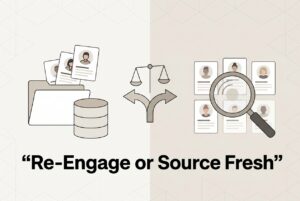
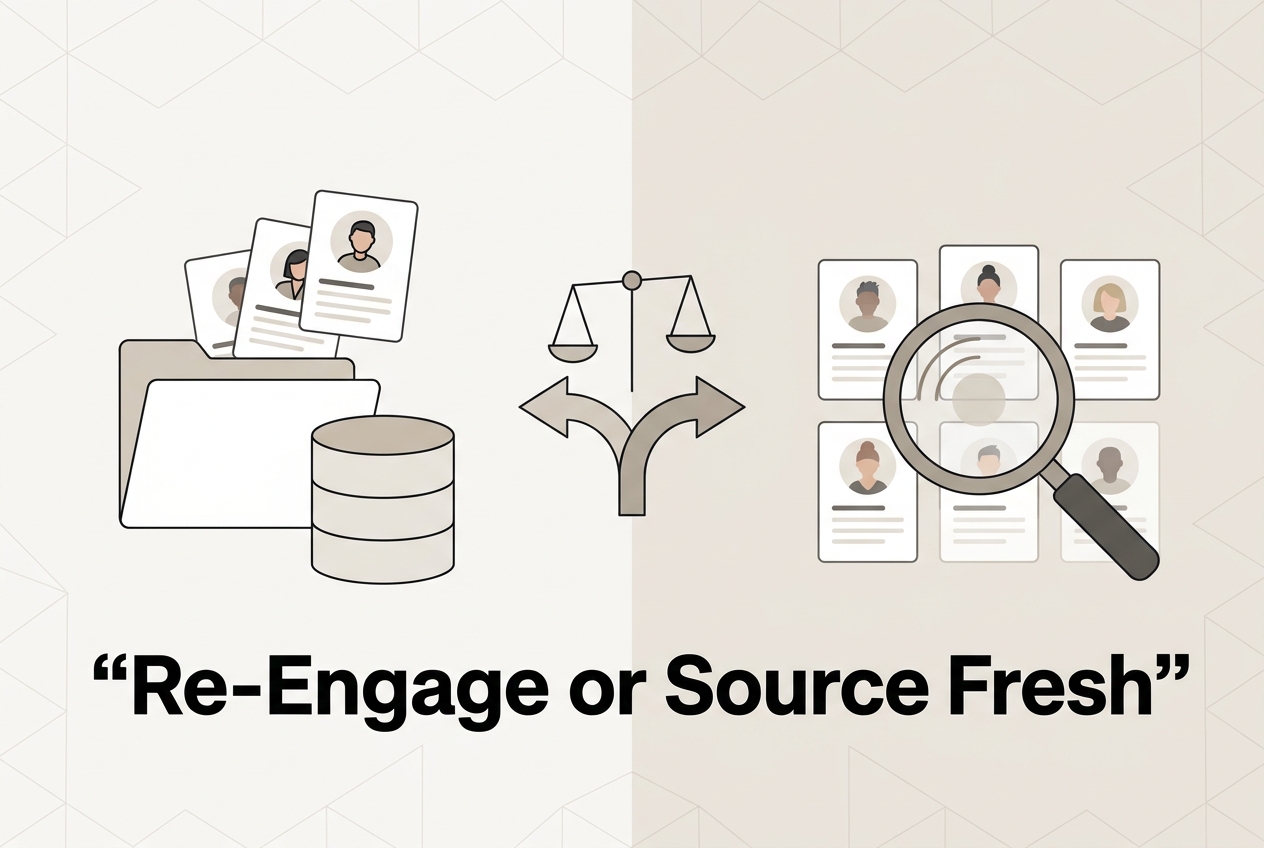
For lean TA teams, the right move is usually database-first, not database-only. If your talent pools already contain people who still fit the role, can be contacted appropriately, and can realistically move inside your deadline, re-engaging candidates should come first. That is especially true when you already have strong previous finalists for a similar role.
But database size alone is not proof that the pool is ready. Old contact details, unresolved rejection reasons, changed pay expectations, and weak candidate relationships can make a big database a weak hiring pipeline. In those cases, fresh sourcing should start right away, not after the database is exhausted.
What is the real difference between talent pools and fresh sourcing?
A talent pool is an organized group of potential candidates you can return to. Fresh sourcing is the search for net-new prospects who are not already represented in your usable records. Those are related, but they are not the same thing.
That distinction matters because a stored candidate record does not prove current interest, current suitability, or even contact eligibility. A past applicant may be warm, cold, or somewhere in between. Also, a person can be rediscovered in your database and still need cold outreach.
Here is the clean way to think about it: past candidates reduce research work, while fresh sourcing expands coverage. If you treat every old record as ready-to-go, you will waste recruiter time. If you ignore the database entirely, you will miss an obvious source of qualified people.
The practical test is simple. Start with the existing pool when it can credibly produce enough qualified, interested, available candidates within the hiring window. Start fresh when the role requires skills, seniority, geography, or market reach your pool does not cover.
When should you start with past candidates?
Start with past candidates when the role is similar to work you have already hired for and your records contain real evidence of fit. Previous finalists are especially worth reviewing because you already have assessment history and they already know something about your company.
That said, do not collapse “previously known” into “ready now.” A finalist who was ghosted may be less receptive than a newer prospect with a stronger trust connection. A candidate who once declined because of pay or timing may still be a good target, but only if that barrier has actually changed.
This is where a clean segment matters. Strong previous finalists, candidates affected by canceled hiring, and people who declined for potentially resolved reasons belong in the first wave. Unreviewed applicants and old records with no recent interaction need more caution.
If you are using CVViZ, the workflow stays practical: search the resume database, review communication history and prior evidence, then re-engage only the people who still make sense for the role. The point is not to automate judgment. It is to make the usable pool visible fast.
When does fresh sourcing need to lead?
Fresh sourcing should lead when your database cannot cover the role’s actual requirements. That happens a lot more often than teams expect.
A first hire in a new function, a new geography, a new technical specialty, a bigger leadership scope, or a compensation model that no longer fits most known candidates are all clear triggers. So is a poor historic record base. If the pool was never built for the role you need now, rediscovery will be slow and incomplete.
This is also true for urgent roles. For a business-critical vacancy, do not wait for every past candidate to respond before starting external work. Review the database immediately and launch targeted fresh sourcing in parallel. Then shift effort toward whichever channel produces qualified, available people first.
One useful rule: if the database lacks evidence for the role, fresh sourcing should not be treated as a backup plan. It is the lead channel.
How do role type and urgency change the decision?
Different roles favor different starting points. Repeat hiring for an established role is usually the best case for re-engagement. So is high-volume support or operations, where location, shifts, pay, and start-date needs are predictable and previous candidates may still match.
By contrast, a new technical specialty or first-of-kind role usually needs fresh sourcing first. A large engineering database does not automatically cover a specific stack or specialty. Sales roles can look similar on paper and still differ in segment, territory, deal size, and compensation model, so the title alone is not enough.
Urgency changes the math even more. If the deadline is tight, the question is not “Can the database eventually produce someone?” The question is “Can it produce enough qualified people soon enough?” If the answer is uncertain, fresh sourcing starts immediately.
A simple working rule helps: parallel sourcing for urgent or hard-to-fill roles; database-first for familiar, covered roles; fresh-first for new, poorly covered, or structurally different roles.
A simple working rule helps: database-first for familiar, covered roles; parallel sourcing for urgent or hard-to-fill roles; fresh-first for new, poorly covered, or structurally different roles.
How do you know if your talent pool is actually enough?
The pool is enough only when five conditions hold: coverage, usability, relevance, capacity, and timing. In plain English, you need people who plausibly fit, can be reached, are still relevant, can cover the hiring need, and can move in time.
This is where many teams get fooled by volume. A large database can still be weak if most records are stale, unreachable, or no longer fit the role. Three suitable people is not enough for a campaign hiring ten. And positive replies do not matter if candidates fail the updated screen or cannot meet the start date.
Use a conditional funnel, not a headcount guess. Think in terms of distinct eligible records, reach rate, interest rate, qualification rate, and practical availability. That gives you a rough expected yield from the pool instead of a false sense of abundance.
A quick example makes the point. Forty plausible records can still produce fewer usable candidates than the hiring manager needs once you apply reach, interest, qualification, and timing filters. The stored count is not the usable count. The usable count is what matters.
How should you re-engage candidates without wasting recruiter time?
Keep the process short, specific, and reason-driven. Start by recalibrating the role, then clean the records, then segment by prior outcome, and finally clear reason to reconnect.
First, confirm the essentials: skills, seniority, location, work arrangement, compensation, and deadline. Then remove duplicates, check contact validity, and review the last substantive interaction. A last upload date is not the same thing as a last verified information date.
Next, segment the list. Strong finalists, people blocked by a freeze, people who declined for a fixable reason, and early-stage applicants all need different treatment. Do not turn a historic rejection into a permanent label. Check whether the original reason still matters.
When you contact them, explain what changed. Maybe the scope changed. Maybe the location changed. Maybe the pay changed. Maybe the timing changed. That message works better than a generic nurture email because it gives the candidate a real reason to respond.
What evidence suggests past candidates will respond now?
Response likelihood depends more on relationship quality and the reason for contact than on database age. Previous finalists often respond well because there was already meaningful interaction and some proof of fit. Candidates whose earlier process ended for a business reason may also be receptive if the role is now active again.
On the other hand, a past applicant who never had real contact is not automatically warm. A former finalist who felt ghosted may need trust repaired before they will engage. And someone who declined over pay or work arrangement will only be interested if that issue is actually different now.
There is no reliable universal benchmark that says past candidates always respond more often than net-new prospects. Treat that as a local question, not a universal truth. Measure your own cohorts by role family, level, and prior stage.
One practical takeaway: a new prospect with a credible referral can be more receptive than an old applicant with a weak relationship. So do not confuse familiarity with warmth.
How should you measure whether the approach is working?
Measure qualified interest, not just replies. A reply rate can look healthy while the actual pipeline stays thin. A person saying “not interested” still counts as a reply, but it does not help your shortlist.
Track delivery rate, reply rate, positive-interest rate, qualified-interest yield, time to first approved shortlist, cost per qualified interested candidate, offer acceptance, and hire yield. Use the same denominator every time. Otherwise, the dashboard will look precise and tell you nothing useful.
Also keep original source and re-engagement source separate. Someone may have entered through a job board and later become active through rediscovery. If you collapse those into one number, you lose visibility into what actually worked.
For small teams, even a simple local comparison is valuable. Compare rediscovered and net-new candidates for similar roles and similar observation windows. Do not assume rediscovery caused better results just because previous finalists were already more qualified.
When does CVViZ fit into this workflow?
CVViZ fits when you want to make the existing database searchable, usable, and measurable without turning the process into manual cleanup work. CVViZ provides a searchable resume database, talent rediscovery, contextual resume screening, duplicate detection, source tracking, communication history, email sequences, and recruitment analytics.
That makes it useful for a database-first workflow. A recruiter can search known candidates, review prior stage history and communication history, confirm current fit, and then launch a targeted re-engagement sequence. At the same time, fresh profiles can enter the same role-based workflow.
One important boundary: a match percentage is not a guarantee of success. It is a ranking aid, not a final hiring decision. Current fit, current availability, and the hiring deadline still decide whether the database is enough.
So the product role is straightforward. CVViZ helps you find the right past candidates faster, but your sourcing strategy still has to decide when to stop mining the pool and start expanding it.
What is the simplest decision rule recruiters can use?
Use this rule: database-first, not database-only.
Start with the pool when it covers the role, the records are usable, and enough qualified people can move in time. Add fresh sourcing immediately when coverage is weak, the role is new or materially different, or the hiring deadline is too tight to wait.
If you need a plain-language version for hiring managers, use this: “We checked the database first because it may save time, but we are also sourcing new candidates because the role needs more coverage than the current pool can provide.” That is honest, practical, and easy to defend.
FAQ
Should recruiters always search their database before sourcing externally?
Usually, yes. A quick database check is worth it. But it should not delay fresh sourcing for urgent, first-of-kind, or poorly covered roles.
Are all past applicants warm candidates?
No. Warmth comes from the relationship, not just from a stored record. Some past applicants barely interacted with the company at all.
How many candidates make a talent pool sufficient?
There is no universal number. Sufficiency depends on fit, contactability, interest, qualification, practical constraints, hiring volume, and timing.
Do past candidates respond more often than new prospects?
Sometimes they do, especially when the earlier interaction was positive. But there is no universal benchmark that applies to every team and every role.
Should previous finalists repeat the whole interview process?
Not automatically. Reuse relevant evidence where appropriate, but reassess changed requirements and stale information before advancing them.