Outbound sourcing breaks the moment teams treat it like a send button. The real problem is not whether you can draft an email. It is whether candidate outreach has a clean owner, a reliable reply path, duplicate checks, a stop rule, and a clear way to tell whether a prospect became an applicant. If those pieces live in different places, recruiters end up automating noise in their recruitment process.
The fix is a closed-loop workflow: approved audience, assigned owner, short sequence, reply handling, handoff, and tracked conversion. Done well, email sourcing becomes an operating system, not a pile of follow-up reminders.
The workflow in one line
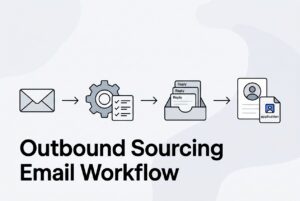
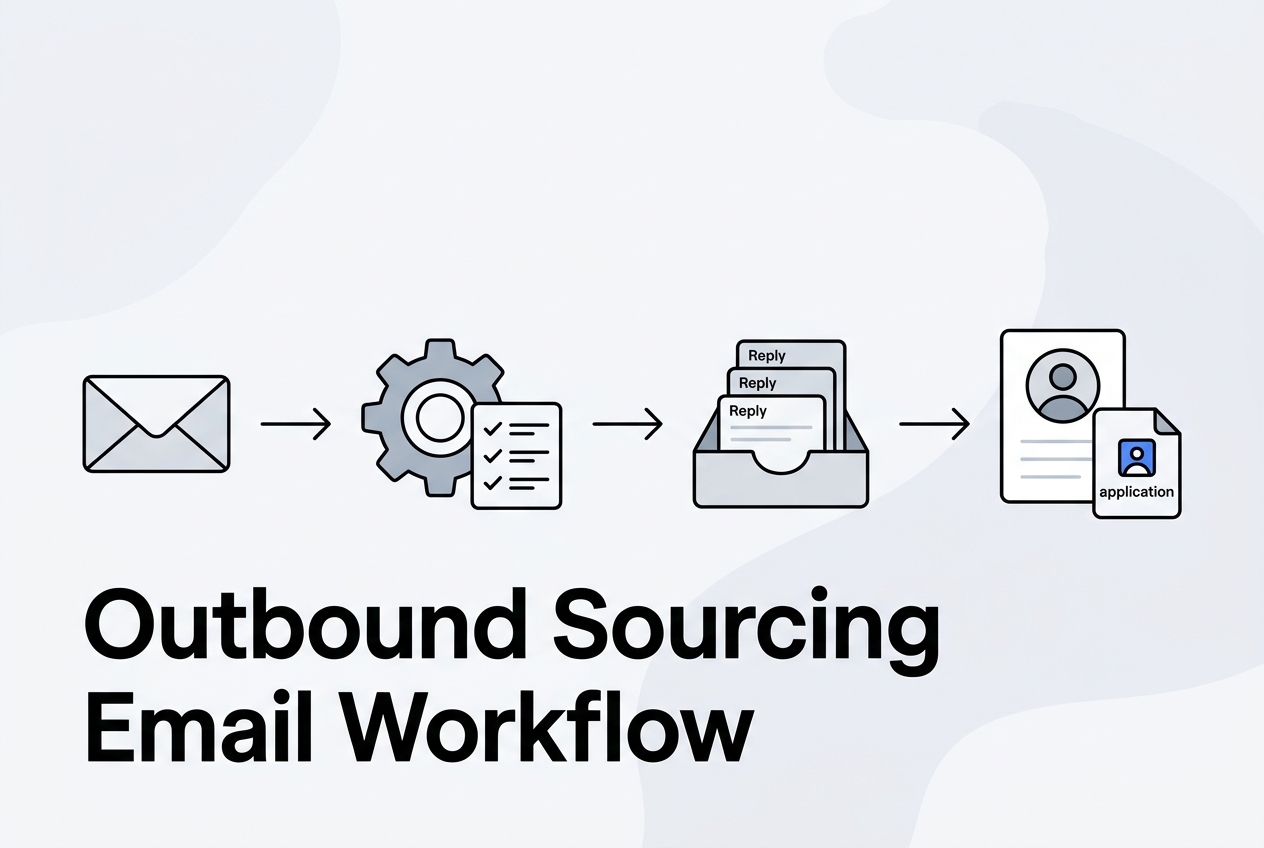
Role intake → database rediscovery and external sourcing → eligibility and duplicate checks → sequence enrollment → scheduled outreach → reply classification → recruiter handoff → applicant conversion → funnel review
That is the sequence that matters. Everything else is support work.
Start with the role, the audience, and the conversion event
Before any prospect enters a sequence, the recruiter and hiring manager need alignment on a few basics:
- Is the requisition approved and actively moving?
- What skills are essential, and what is only preferred?
- What location, level, compensation, and eligibility constraints are real?
- Who owns replies, and who covers that owner if they are out?
- What is the next step for an interested person?
- What counts as an applicant in this process?
- When will the hiring manager review qualified prospects?
That last question matters more than people think. If the team cannot describe the next step, the sequence will drift into “just checking in” territory. That is where candidate outreach gets sloppy.
A short role-specific sourcing brief is the right starting artifact. A job title alone is not enough.
Build the audience from rediscovery first
Good outbound sourcing starts with the database you already have. Past applicants, silver medalists, prior conversations, and people who asked to reconnect later are usually the cheapest place to begin.
CVViZ supports searchable candidate records with full text search, Boolean operators, filters, tags, notes, structured resume data, duplicate detection, source tracking, job pipelines, ownership, and communication history. That is the foundation you want before you start expanding outward.
There is a reason to begin there. In a large recruiting dataset, nearly half of sourced hires came from rediscovered candidates. That does not mean every employer will see the same result. It does mean the practical workflow should inspect existing relationships before paying the time and contact-data cost of starting from zero.
For external sourcing, keep the review human. Check whether the profile is current, whether the source channel makes sense, whether the contact detail is usable, and whether the person already exists in the database or another active process.
A sourced profile is not an applicant. An imported record is not consent. Keep those concepts separate.
Use one source of truth before enrollment
A maintainable workflow needs clean records. At minimum, keep these separate:
- Identity
- Provenance
- Role association
- Ownership
- Enrollment
- Scheduling
- Engagement
- Preferences
- Conversion
- Operational exceptions
The point is simple: one person may be relevant to multiple roles without requiring duplicate records or simultaneous campaigns.
Recommended collision rules:
- Search the shared database before creating a new record.
- Do not merge people just because names match.
- Allow only one accountable owner at a time.
- Check for existing applications, interviews, offers, and prior declines before enrollment.
- Carry preferences and suppression decisions into every relevant workflow.
CVViZ documents checks for eligibility, duplicate email addresses, and suppression when adding sequence recipients. That helps, but the broader person-level collision policy still needs to be owned and tested by the team.
Configure the sender and prove the reply path
This part gets skipped too often, and it causes most of the mess later.
The documented CVViZ email connection path is:
Settings → Integrations & Tools → Integrations → Email
There, workspaces may show Microsoft 365 Outlook and, for eligible workspaces, Gmail. Gmail requires an eligible workspace. Google Calendar access alone does not enable Gmail.
After connection, confirm that the intended address appears as connected. Then inspect the composer From address, the Outreach sending address, and the sequence reply settings. Those are not the same thing.
Before launch, verify:
- The visible sender is authorized
- The From and reply destination are correct
- Someone monitors the reply destination
- Reply capture is enabled where automatic stopping is expected
- A test response appears in the right place
- Remaining follow-ups actually stop
- A disconnected mailbox is visible to an owner
That last one sounds boring. It is not. A broken reply path turns a sequence into a machine for sending messages nobody is watching.
A short sequence beats a bloated one
For most teams, the right starting point is a three-email sequence:
| Touch | Example timing | Purpose | Exit check |
|---|---|---|---|
| First touch | Business day 0 | Explain why the role may fit and offer one next step | Eligibility, ownership, sender, preferences, audience approved |
| Follow-up one | Four business days later | Add useful role detail or answer a likely objection | No opt-out, active-process collision, or delivery issue |
| Final follow-up | Five business days later | Close the loop and make it easy to reply or decline | Recheck the same stop conditions |
That is a recommended operating policy, not a universal law. It does, however, fit CVViZ’s documented Outreach scope of a first email plus up to two follow-ups where enabled.
Use business days carefully. A generic “four days later” is not the same thing as a Monday-to-Friday delay. That distinction matters when someone is staring at the inbox on a Monday morning.
Each email should have a distinct job:
- The first message explains relevance and asks one clear question
- The follow-up adds something useful, not just repetition
- The final touch closes the loop and makes declining easy
Do not write as if there is already a relationship if there is not one.
Make reply handling the center of the process
This is where most outbound sourcing workflows either work or collapse.
When reply capture is enabled in CVViZ, matched replies appear in Replies and on candidate or contact records. With follow-ups enabled, a matched reply stops the remaining follow-ups for that enrollment.
That is the behavior you want. But it is conditional. If reply capture is unavailable, responses go to the selected From mailbox and cannot automatically stop follow-ups. In that case, the recruiter has to manage the mailbox and future sending manually.
Recommended reply taxonomy:
- Interested and relevant: stop follow-ups, answer questions, and set the next step
- Interested, fit unclear: clarify the missing pieces
- Requests information: answer personally
- Not interested in this role: stop this role’s sequence
- Not now: stop the active sequence and record a future task only if appropriate
- Stop contacting me: suppress promptly
- Out of office: review manually, do not count as interest
- Referral: review the referred person separately
- Wrong person or wrong address: correct the record
- Hard bounce: suppress the address
- Complaint: stop and escalate
- No reply after completion: close the enrollment
A clean queue matters here. The team should triage replies at least once every working day and respond to interested candidates within one business day where feasible.
Also, assign a backup owner. An automated sequence should never keep sending while the only recruiter who monitors it is out of office.
Treat interest as a handoff, not the finish line
That is one of the biggest reporting mistakes in outbound sourcing. A person can be interested, can be qualified, and still never become an applicant if the handoff breaks. Common causes are easy to spot once you name them:
- No owner after the reply
- A broken application destination
- A delayed hiring-manager decision
- Continuing prospecting after the candidate has already moved forward
The fix is a deliberate queue of interested prospects awaiting the next step, with an owner and due date.
Track these as separate events:
- Prospect imported
- First outreach sent
- Human reply received
- Interest confirmed
- Basic fit confirmed
- Application invited or process-entry agreed
- Application completed
- Screen scheduled
Do not collapse all of that into a single “engaged” stage. That is how teams lose visibility into where the funnel is actually leaking.
Control stopping, pausing, and recovery
A maintainable workflow has explicit stop states. The sequence should stop or be reviewed when any of the following happens:
- A relevant human reply
- An opt-out or do-not-contact request
- A hard bounce or complaint
- Entry into an active application or interview process
- An ownership collision
- A closed or changed requisition
- A sender or compliance issue
CVViZ supports pause, resume, archive, and restore behavior for sequences. Pending emails may still arrive after a pause or reply, so do not assume instant recall. If status is uncertain, check it before retrying.
One important guardrail: creating another sequence does not remove suppression. That means the team needs a real suppression policy, not a workaround habit.
Deliverability is a launch prerequisite
This is not a growth hack section. It is the part that keeps your emails from becoming a reputation problem.
Before sending, verify:
- SPF is in place for authorized senders
- DKIM is enabled
- DMARC is configured and monitored
- Any third-party sender is authorized
- From and Reply-To identity are accurate
Also keep sending behavior sane. Increase volume gradually, keep patterns consistent, and investigate delivery issues before expanding.
Do not treat authentication as permission to contact anyone you want. It helps deliverability. It does not fix relevance.
Opens are not the metric to optimize
Open activity is noisy because privacy protection and automated scanning distort it. Clicks can be noisy too. So do not build the workflow around open rate, and do not decide someone is interested because they opened the email.
Use these instead:
- Human replies
- Qualified interest
- Completed applications
- Screening progression
That is the difference between a mailbox metric and a hiring metric.
Keep privacy and suppression in the workflow
Outbound sourcing also needs guardrails.
For UK recruiting, privacy information should be provided as soon as possible and no later than one month after obtaining the information. Manual searching of appropriate public social media is allowed in some cases, but recruitment-based platforms are a safer context than personal social profiles. Direct contact still has to comply with applicable direct marketing rules.
Suppression should be minimal and durable. If someone objects to contact, keep only enough information to respect that preference and prevent re-contact. Do not delete the only record of a stop request and then rediscover the same person next month.
For US outreach, CAN-SPAM can apply to recruiting email depending on the message’s primary purpose. Where it applies, the basics include accurate headers, nondeceptive subject lines, a physical postal address, and a working opt-out path that is honored promptly.
The operational point is simple: a good workflow respects stop requests immediately.
What to measure
A useful dashboard should show the funnel by role, sequence version, audience segment, sender, and cohort.
Track:
- Reviewed prospects
- Enrolled prospects
- Sent messages
- Delivered prospects
- Human reply rate
- Qualified-interest rate
- Applicant conversion
- Interest-to-applicant conversion
- First-response SLA
- Prospect-to-applicant time
- Downstream quality
- Operational health
The key is denominator discipline. A reply rate is not the same as an interested rate, and a delivered prospect is not the same as an applicant.
Use cohort reviews after a consistent observation window. A sequence launched yesterday should not be judged the same way as one that has had time to mature.
A maintainable rhythm for a small team
A lean recruiting team does not need more noise. It needs a steady maintenance routine.
Daily
- Triage human replies and automatic responses
- Act on opt-outs, complaints, and bounces
- Resolve unowned or overdue next actions
- Check disconnected senders and sending failures
- Verify interested candidates moved forward
Weekly
- Review cohorts by role and audience
- Inspect reply-to-applicant drop-off
- Discuss qualified prospects with hiring managers
- Check duplicate or overlapping outreach
- Adjust enrollment volume to response-handling capacity
Monthly
- Audit suppression propagation and access permissions
- Review stale records and retention rules
- Check sender authentication and connection ownership
- Retire obsolete sequences
- Confirm workflows still match recruiter behavior
That rhythm is boring in the best possible way.
What CVViZ supports in practice
CVViZ gives teams the pieces needed for this workflow: searchable candidate records, duplicate detection, source tracking, job association, ownership, communication history, outreach sequencing, reply capture, pause and archive controls, and recruitment analytics.
The documented Outreach flow is straightforward:
- Open Outreach and create a sequence
- Choose Candidates for in-house recruiting
- Name the sequence clearly
- Build the emails and follow-ups
- Add recipients and review eligibility
- Choose a sending address
- Set sending days, time zone, and time window
- Review reply-handling settings
- Check recipients, exclusions, messages, and credits before starting
Where credits are enabled, sequence emails, follow-ups, and recruiter replies each use a credit. Daily sending limits are separate from the credit balance.
CVViZ supports a practical sourcing engine, but the workflow still needs human governance. The product can help you move faster. It cannot decide whether a response is actually qualified, whether a stop request should be honored, or whether the candidate truly applied. That part belongs to the process.
The rule to keep in mind
A maintainable sourcing engine is not the one that sends the most emails. It is the one where every prospect has an owner, every follow-up has a reason, every reply produces a next action, and every applicant can be traced back to the outreach that engaged them.