Yes, keyword ATS screening routinely screens out qualified candidates, and the problem gets worse when a lean team is buried in 250-plus applications per role. In practice, a mid-market ATS that only counts exact terms will miss people who describe the same work in different language. That is why a senior Oracle specialist can disappear while a junior Java developer with one stray Oracle mention moves up.
Here is the blunt version: a keyword-based resume screening system rewards wording, not fit. By contrast, contextual AI looks at meaning, skills in context, and relative rank. That matters a lot when recruiters scan each resume in about 7.4 seconds on average, average postings attract around 250 applications, and 88% of employers report that qualified candidates are excluded because of ATS configuration. In other words, the stack is already too shallow to waste good candidates on word choice.
For mid-market teams, this is not an abstract debate. A 100 to 500 employee company hiring 20 to 300 people a year can end up with corporate-level volume and startup-level staffing. Meanwhile, the pressure is real: time-to-fill has stretched to 44 days in 2025, cost-per-hire sits around $4,700, and recruiters are often spending 15 to 20 hours a week on screening. If your current system is just a filing cabinet with search, the miss rate is not a bug. It is the design.
What does a keyword-based ATS actually do?
A keyword-based ATS scores resumes by counting exact or near-exact terms from the job description. If the resume does not contain the configured phrase, the candidate drops down or out, even when the underlying experience is solid. That is why a resume that says “11g to 12c cloud migration across four business units” can miss a search for “Oracle developer.”
This approach is simple, but it is also brittle. It can overvalue boilerplate like skills lists and certification blocks, and it can underweight real hands-on work if the wording is different. For example, “backend engineer” can be treated as a separate bucket from “Java developer,” even when the work overlaps heavily. Likewise, “program management” can be screened differently from “project management,” even though hiring teams often treat them as neighboring disciplines.
The result is predictable. Strong candidates get buried because they described their work honestly, not in recruiter shorthand. That is why keyword search is useful for exact gates, but weak for judging fit. It is fast, however, it is narrow.
What does contextual AI resume screening do differently?
Contextual AI resume screening reads the resume as a whole document, then matches skills and experience to the role by meaning, not just by exact wording. In practice, it does five things in sequence: read, extract, match, rank, and learn. First, it parses the resume. Next, it pulls out skills in context. Then it compares those skills to the job. After that, it ranks candidates relatively. Finally, it learns from recruiter feedback.
That changes the outcome in a real way. A system can recognize that “Oracle DBA,” “Oracle developer,” and “11g/12c administrator” sit in the same domain. It can also tell the difference between a single passing mention of Oracle and repeated recent work on Oracle internals. As a result, the ranking reflects relevance, not just string overlap.
This is where a tool like CVViZ fits, because its AI Resume Screening and Relative Resume Ranking are built to do exactly that kind of contextual matching. The point is not magic. The point is that the system can surface the right person even when the resume does not mirror the job description word for word.
Keyword Search vs. Contextual AI: side-by-side
| Dimension | Keyword-based ATS | Contextual AI System |
|---|---|---|
| Matching logic | Counts exact or near-exact text matches | Compares meaning, skill relationships, and context |
| Recognizes synonyms | Limited unless manually configured | Yes, by understanding related phrases |
| Handles related roles | No, treats buckets as separate | Yes, treats overlapping roles as adjacent |
| Weighs recency and depth | Usually no | Yes, it scores skills in context |
| Filters boilerplate | Often over-matches | Better at separating core experience from noise |
| Learns from recruiter feedback | No | Yes |
| Candidate experience | Higher false rejection risk | Lower false rejection risk |
| Best for | Exact title or credential checks | Non-standard phrasing and broader skill inference |
| Weakness | Cannot bridge vocabulary gaps | Needs tuning and human review |
The short version is simple. Keyword search is good at matching words. Contextual AI is better at matching people to work.
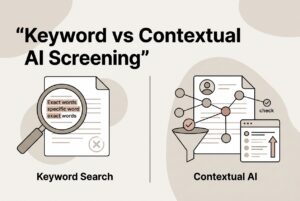
Walkthrough: same resume pool, two systems
A mid-market SaaS company posts an “Oracle Database Developer” role and gets 310 applicants in 14 days. Two recruiters handle the search. The same resume pool goes through two paths: the existing keyword module and CVViZ’s contextual AI screening.
The keyword system is set to look for Oracle, PL/SQL, 11g, 12c, DBA, and SQL tuning. It advances candidates who hit enough of those tokens early in the resume. In that pass, 87 candidates clear the gate. However, Maria, a strong Oracle DBA with 11g to 12c cloud migration work, gets buried because she writes “database” and “migration” more than the exact phrase “Oracle developer.” Meanwhile, Dev, a junior Java developer with one old Oracle freelance project, gets pushed up because he matches the token pattern. Four of the top 20 keyword-ranked candidates are not actually Oracle specialists.
The contextual pass changes the picture. Maria ranks #2 overall because the system sees her recent Oracle internals work, her migration ownership, and her skills in context. Dev falls to #68 because the Oracle mention is peripheral and his core experience is Java. The recruiter now reviews the top 25 in about 10 minutes instead of spending roughly 12 hours manually digging through the pile. That is the practical difference. One system rewards keyword density. The other surfaces fit.
The numbers mid-market TA Leaders track
Mid-market TA leaders feel this problem in their metrics, not just their inboxes. Time-to-fill reached 44 days in 2025, and cost-per-hire sits around $4,700 in US corporate hiring. Meanwhile, recruiters often spend 15 to 20 hours a week on screening work, and average recruiter workload has climbed to 14 open requisitions per recruiter. That is a bad combination when every hiring manager wants speed and every candidate expects a quick answer.
The math also gets ugly at scale. A company with 20 to 300 hires a year can easily process 5,000 to 75,000 resumes annually if it sees around 250 applications per requisition. As a result, the old model of “just review more resumes” breaks down fast. You do not need more noise. You need a better first pass.
Contextual AI helps because it cuts resume review time from hours to minutes on the shortlist. It also gives recruiters room to spend time on outreach, manager alignment, and candidate engagement instead of manual triage. For a lean team, that is not a nice-to-have. It is the difference between running a process and being run by it.
Where keyword search still has a place
Keyword search is not obsolete. It still works well for hard credential gates, proactive sourcing, and duplicate cleanup. If a role legally requires a specific license, clearance, or certification, a keyword or Boolean filter is still the right first cut. Likewise, if a recruiter knows the exact title pattern they want from an existing resume database, keyword search is fast and useful.
It also has a practical place in early cleanup. For example, if you need to remove near-identical agency duplicates or filter obvious format noise, a boolean pass can do that quickly. The key is to treat keyword search as a tool, not the whole system.
In practice, the strongest setup is layered. Use keyword filtering where the requirement is hard and literal. Then use contextual AI where the requirement is broader, messier, or hidden in different language. That way, you keep the speed of Boolean search without throwing away qualified candidates who wrote their experience in plain English.
What contextual AI screening should NOT be used for
Contextual AI should not replace human judgment. It can rank candidates, but it should not be the final hiring authority. That matters because AI screening can reproduce bias if it is used carelessly, and some studies have found uneven recommendation patterns by race in certain job postings. For that reason, the safest operating model is human-in-the-loop decisioning.
That is also how most employers already use these tools. Roughly 80% of US employers using AI hiring tools say they do not reject any applicant without a human reviewer in the loop. That is the right default. AI should narrow the stack, not make the final call in a black box.
So the job is simple: use the system to surface relevance, then use recruiters to judge fit. CVViZ supports that model with contextual screening, relative ranking, and workflow controls, but the recruiter still owns the decision. That is exactly how it should be.
What mid-market buyers are paying for AI screening
Mid-market buyers usually have three options: pay for an enterprise ATS, stay on a first-generation ATS with weak screening, or use a tier-priced platform that includes AI without a huge contract. The third option is often the least painful one.
| Platform | Mid-market positioning | Pricing reference | Mid-market note |
|---|---|---|---|
| Greenhouse | Mid-market / enterprise | Around $12,000 to $15,000 per year for mid-market | Strong, but pricey |
| iCIMS | Enterprise-leaning | Around $20,000 to $21,000 per year in mid-market | Often heavy to implement |
| Workday Recruiting | Enterprise HCM-suite native | $150,000 to $300,000 implementation for 200 to 500 employees | Usually best in a broader Workday stack |
| Lever | Enterprise-leaning | Quote-only | Often too much commitment for lean teams |
| CVViZ | Mid-market / startup / enterprise | Starter $99/month, Basic $199/month, Standard $349/month, Pro $499/month | AI screening available as a $25/job add-on |
CVViZ also includes AI Resume Screening, Relative Resume Ranking, semantic Search, and a Resume Parser API. In other words, it gives mid-market teams enterprise-ready recruiting software depth without forcing an enterprise contract. That combination is why buyers keep comparing it against much larger platforms.
FAQ
What is the difference between keyword search and contextual AI in resume screening?
Keyword search counts exact or near-exact matches of configured words. Contextual AI compares the meaning of resume phrases against the meaning of the job, so it can catch candidates who describe the same work in different language.
Why do qualified candidates get screened out by keyword ATS?
Because their resumes do not contain the exact phrases the recruiter configured. A senior Oracle specialist can write “11g/12c database administration with ERP integrations” and still miss a rigid “Oracle developer” screen.
Is contextual AI screening biased?
It can be if it is not governed well. The best approach is human-in-the-loop review, structured scoring, and auditable decisioning.
How much faster is contextual AI screening than manual review?
Industry benchmarks suggest AI screening can reduce a 100-resume review from 12 to 18 hours of manual work to about 10 to 15 minutes of human decisioning on a shortlist.
What does CVViZ’s contextual AI actually do?
It parses resumes, extracts skills in context, semantically matches candidates to the job, ranks them relatively, and learns from recruiter feedback.
Is keyword search obsolete?
No. It still works for hard-credential gates, proactive Boolean sourcing, and duplicate elimination.
How do mid-market companies usually handle screening today?
Most rely on a legacy ATS plus manual shortlisting. Limited synonym recognition means recruiters often maintain synonym lists by hand.
What does contextual AI screening cost?
Pricing varies. In CVViZ, AI Resume Screening is available as a $ 25-per-job. If you buy an ATS subscription, it is already included.
Will contextual AI replace recruiters?
No. It removes the first-pass review burden so recruiters can spend time on engagement, interviews, and hiring manager partnership.
What measurable improvements do mid-market teams see after adopting contextual AI screening?
The category reports faster shortlist review, better candidate recovery, and less manual screening. Specific results vary by role, volume, and process maturity.
Closing
If your team is choosing between the three usual paths, the answer is pretty clear. You can pay enterprise prices, stay stuck with keyword-only screening, or use a system that actually understands what the resume means. For a mid-market ATS buyer, that third path is usually the one that makes sense.
The real win is not that AI screens faster. It is that it stops qualified people from disappearing because they used different words. That is how contextual AI helps recruiters recover hidden talent, reduce false rejects, and spend more time on the work that actually moves hiring forward.
If your hiring volume is rising and your current process still depends on literal keyword matches, the gap will only get more expensive. A better screen does not replace your team. It gives your team a chance to see the candidates they should have seen in the first place.