An affordable ATS is not the cheapest one on the quote sheet. It is the one that lowers your total cost of ownership while increasing hires, recruiter throughput, and quality of hire. In practice, that means you judge ATS total cost against the work it removes: manual screening, scheduling, follow-up, job distribution, reporting, and the drag of switching tools later.
That matters because the hidden math is brutal. Recruiters commonly spend 60–80% of their time on admin work, while a typical role can attract 300+ applications. So if an ATS does not save time, widen sourcing reach, and improve shortlist quality, it is not really affordable. It is just inexpensive at the start.
What “affordable” actually means in ATS buying
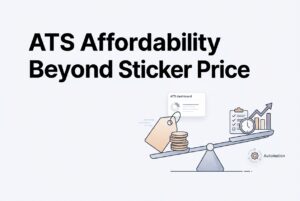
Affordability is a ratio, not a sticker price. The formula is simple: total cost of ownership divided by value delivered. That value comes from hires made, hours saved, and cost-per-hire reduced.
Three buckets drive the real number:
- Sticker price: license, seats, implementation, add-ons, and support
- Operating cost: recruiter hours saved, faster time-to-fill, less agency dependency
- Strategic ceiling: whether the ATS keeps working as hiring volume grows
A low monthly fee can still prove expensive if the team spends hours on manual data entry or pays for implementation, integrations, and training on top of that. On the other hand, an ATS can cost more per month and still be cheaper in the real world if it removes agency spend or saves enough recruiter time. That is the core test.
For awareness-stage buyers, the right question is not “What costs less?” It is “What costs less per hire, per hour saved, and per req handled?” That framing works for both in-house teams and agencies.
Why sticker price misses the real ATS total cost
Sticker price is the easy part. ATS total cost is what shows up after setup, training, add-ons, and ongoing support enter the picture.
Common pricing models include per-user pricing, per-employee pricing, flat monthly tiers, quote-based enterprise contracts, and free plans with limits. But none of those tell the full story. Implementation can run from a few thousand dollars into much higher ranges for mid-market and enterprise deployments. Training also adds up fast, with roughly 23 hours per new recruiter or hiring manager to reach proficiency.
Then there are the quiet extras:
- ATS integrations
- data migration
- job board credits
- SMS or email credits
- premium support
- AI module add-ons
- seat expansion
- archive export when switching vendors
The research dossier also notes that companies typically spend 40–60% more than the initial quote once those costs are included. That is why a “cheap” ATS often stops being cheap after the first renewal cycle.
So if you are comparing tools, ask one question first: what will this system cost over a full contract cycle, not just month one? That is the number finance actually cares about.
The admin-effort tax is where affordability is won or lost
An ATS becomes affordable when it cuts recruiter admin time in a visible way. Otherwise, it just moves work around.
Recruiters are usually buried in scheduling, follow-up emails, manual data entry, and reporting. That leaves less time for sourcing and actual candidate engagement. The dossier puts the admin share at 60–80% of recruiter time in many teams. That is the tax.
The best systems reduce that tax through ATS workflow automation, self-scheduling, resume parsing, bulk communication, and stage-based triggers. Even small gains matter. Self-scheduling can recover about 5–8 recruiter hours per week, and workflow automation can remove routine status updates and follow-ups.
Here is the practical test: if your team still lives in spreadsheets and inboxes after buying an ATS, then the system did not lower operating cost. It may have formalized chaos, which is not the same thing. Slightly more organized chaos, maybe. Still chaos.
For both agencies and in-house teams, admin reduction is one of the clearest signs that an ATS is truly affordable.
How AI recruiting software changes the economics
AI recruiting software changes affordability by compressing the most expensive part of early hiring: resume review and shortlisting.
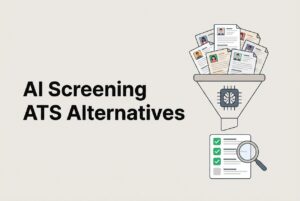
Manual screening does not scale well. Recruiters may have only seconds per resume in practice, yet each role can attract hundreds of applicants. AI Resume Screening helps by using contextual matching, skills extraction, and relative ranking instead of pure keyword search. That means recruiters can focus on the most relevant candidates first.
The dossier’s directional findings are strong:
- AI screening can reduce resume review time by up to 75%
- AI-augmented hiring is associated with a 27% reduction in cost-per-hire
- AI screening is associated with a 36% improvement in quality-of-hire metrics
- AI-driven workflows often produce 30–50% faster time-to-hire
That is why AI matters to affordability. Every minute saved in screening becomes a minute spent on candidate engagement, hiring manager service, or pipeline development. Over a quarter, those minutes compound into real capacity.
For buyers, the key is not “Does it have AI?” It is “Does the AI actually reduce review time, improve ranking, and help the recruiter act faster?” If the answer is no, the AI is just decoration.
Manual screening vs AI screening
A useful way to judge affordability is to compare manual screening with AI screening side by side.
| Factor | Manual screening | AI Resume Screening |
|---|---|---|
| Time on resumes | High | Much lower |
| Candidate ranking | Keyword-driven and inconsistent | Contextual and real-time |
| Recruiter focus | Broad, scattered | Top candidates first |
| Admin effort | Heavy | Reduced |
| Cost impact | Slower hiring, more labor | Lower cost-per-hire potential |
| Scalability | Breaks under volume | Handles larger applicant pools better |
The reason this matters is simple. Applications per hire have risen above 300 and stayed there. At that volume, manual review becomes a bottleneck, not a process. AI recruiting software does not replace the recruiter. It gives the recruiter back enough time to do the work that actually moves hiring forward.
If your hiring motion is high-volume, junior-heavy, or time-sensitive, AI resume screening has an outsized effect on affordability. For executive searches, the volume is lower, so the absolute savings are smaller. Still useful, just less dramatic.
Sourcing reach can lower cost per hire fast
A narrow sourcing strategy makes an ATS look cheaper than it is. If the system only posts to one or two boards, you usually pay for that limitation somewhere else, often in more expensive channels or slower hiring.
Posting a single role to multiple boards can lift application volume by 25–35%. The dossier also notes that 79% of organizations use multi-board distribution as a core part of their recruitment strategy. That is not a nice-to-have. It is table stakes for many teams.
This is where affordable ATS logic gets practical:
- more reach can mean more applicants
- more applicants can mean better shortlist quality
- better shortlist quality can mean faster hiring and less agency dependence
An ATS that posts broadly across free and paid boards can be structurally cheaper per hire, even if the license looks higher. CVViZ’s multi-board posting feature follows that pattern with 20+ free boards and 2,000+ paid distribution options.
The buyer takeaway is blunt: distribution is part of cost. If your ATS shrinks reach, it inflates your effective cost-per-hire.
Agency vs in-house: affordability is not the same math
Agency and in-house teams should not judge affordability the same way. The economics are different.
| Factor | Agency | In-house + ATS |
|---|---|---|
| Main cost | Placement fees per hire | Recruiter salary plus ATS |
| Cost pattern | Variable | Mostly fixed and predictable |
| Best strength | Surge capacity and niche roles | Steady-state hiring and pipeline ownership |
| Pressure point | Recruiter throughput | Time-to-fill and admin efficiency |
| Affordability wins when | Placements per recruiter stay high | Volume is steady enough to amortize the system |
Agency fees commonly run 15–25% of first-year salary for contingency recruiting and 25–33% or more for retained search. That means agencies can be cost-effective for seasonal, specialized, or executive work. But for steady hiring, those fees add up fast.
In-house economics work better when hiring is repeatable. The dossier’s crossover point is usually around 8–12 hires per quarter. Below that, agencies often stay cheaper. Above that, in-house plus ATS usually wins decisively.
So the question is not “Which model is better?” It is “Which model fits the hiring pattern right now?” That answer changes with volume, role type, and urgency.
What to compare before you call an ATS affordable
Buyers usually compare monthly price and stop there. That misses the point. Instead, compare the whole system.
Use this checklist:
- List every fee line, not just the base license
- Estimate recruiter hours recovered from automation and scheduling
- Measure expected impact on cost-per-hire
- Estimate time-to-fill improvement
- Check how broad job distribution is
- Verify scalability as recruiter or job volume grows
- Confirm integrations with your existing stack
- Review compliance and audit controls
- Test whether the AI learns from recruiter feedback
- Compare 3-year total cost, not annual price
That last point matters a lot. ATS refresh cycles are typically every 3 to 5 years, which means the real buying window is longer than most teams think. Once you include implementation, support, training, and migration, the true cost can diverge sharply from the quote.
If you want one simple rule, use this: an ATS is affordable only if it lowers the cost and friction of hiring at the pace your team actually runs.
When an ATS becomes a good buy for each model
For in-house teams, an ATS becomes affordable when hiring is steady, cost-per-hire matters, and the team wants to reduce dependence on agencies. It should improve recruiter throughput, cut time-to-fill, and centralize the process.
For agencies, affordability depends on placements per recruiter and workflow across multiple clients. A system that supports client hierarchy, collaboration, and candidate communication is more valuable because it helps the team manage volume without adding admin drag.
That is also why Recruitment CRM features matter for agencies. If the team is juggling companies, contacts, leads, and client portals, a basic ATS may not be enough. The platform needs to support the actual operating model.
In-house teams, by contrast, usually care more about sourcing reach, automated screening, scheduling, analytics, and candidate reactivation. They want cleaner handoffs and faster shortlists, not a pile of extra screens.
The model matters. So does the work. Affordable means the system fits both.
The bottom line on affordable ATS buying
An affordable ATS is one that creates more hiring output per dollar, per recruiter hour, and per open role. That usually comes from four things: lower admin load, broader sourcing reach, stronger automation, and better recruiter throughput.
If your current process is slow, manual, and fragmented, a low sticker price will not save you. If your hiring volume is steady and the system reduces agency use, screening time, and scheduling churn, then a higher-priced ATS can be the cheaper choice.
That is the cleanest way to think about ATS total cost. Judge the system by what it removes, not just what it charges.
FAQ
What makes an ATS truly affordable?
An ATS is truly affordable when total cost of ownership is lower than the value it creates. That means license, setup, support, and add-ons must be outweighed by saved recruiter time, faster time-to-fill, lower cost-per-hire, and reduced agency dependence.
Is the cheapest ATS always the best option?
No. A cheap system can become expensive if it needs heavy manual work, paid integrations, or major implementation help. If it does not reduce admin time or improve hiring output, it is not affordable in practice.
How does AI recruiting software affect affordability?
AI recruiting software can lower resume review time, reduce cost-per-hire, and improve quality of hire. It is most valuable when the team handles large applicant volumes and needs to shortlist faster without adding headcount.
Should agencies and in-house teams define affordability the same way?
No. Agencies should focus on placements per recruiter and multi-client workflow efficiency. In-house teams should focus on recruiter throughput, cost-per-hire, and reduced reliance on external agencies.