Manual interview scheduling isn’t just a 10-minute admin task. It’s a compounding coordination bottleneck that drains founder hours, adds weeks to your time-to-hire, and quietly pushes great candidates toward companies that move faster.
If this sounds familiar, you’re already paying the price:
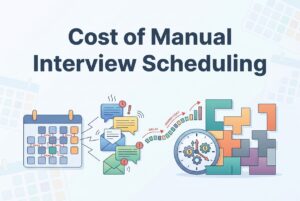
You know the drill. Endless back-and-forth interview scheduling emails to find one slot everyone can make. Time zone mix-ups that cost you a full business day. Panel interviews that feel like a game of calendar Tetris. Reschedules that force you to start the whole hunt over again. And the worst one: no clear owner, so the ball just sits there.
Let’s quantify what manual scheduling is actually costing your startup in hours, hiring days, and lost candidates. Then I’ll walk you through the fastest fixes, from zero-tool process changes to smart automation.
What is the real cost of manually scheduling interviews (in startup terms)?
Manual scheduling costs more than most founders realize. When I look at the damage it does, I see it in four categories: time, opportunity, delay, and candidate loss.
- Time cost: Coordinating a single interview takes 30 minutes to 2+ hours when you factor in email threads, calendar checks, and rescheduling. That’s not an outlier; it’s the baseline.
- Opportunity cost: When a founder or your lead engineer is handling scheduling, they’re not sourcing, closing deals, or building product. Every scheduling email is a context switch away from higher-leverage work.
- Delay cost: The longer a role stays open, the longer your team is understaffed. Projects slip. Your existing people get burnt out covering gaps. Timelines move.
- Candidate cost: Friction and lag in the hiring process make candidates drop out. The longer it takes to get someone in front of an interviewer, the higher the chance they take another offer.
At most startups, scheduling lands on whoever is closest to the role, usually the founder or team lead. That’s not an admin problem. That’s a coordination problem in disguise.
Here’s the bottom line: Scheduling is a coordination problem. You have to treat it like one.
How much time do you actually waste per interview when scheduling is manual?
Don’t underestimate this. Even conservative estimates add up fast. A single screening call might take 30–45 minutes to coordinate. A panel interview with three busy people in different time zones can easily eat 90–120 minutes by the time you’ve wrangled availability and handled a last-minute reschedule.
Here’s what that looks like in practice:
| Interview Type | Coordination Steps | Typical Time Spent |
|---|---|---|
| 1:1 Screening Call | Email offer, back-and-forth, confirm invite | 30–45 min |
| Panel Interview (2–3 people) | Align availability, send invites, follow up | 60–90 min |
| Multi-round Virtual Loop (3–4 stages) | Repeat above per stage + internal handoffs | 3–5 hours total |
Now apply that to a real week. If you’re scheduling 8 interviews, you’re spending 6–10 hours on coordination alone. For a lean startup, that’s a full day of someone’s time gone to calendar logistics.
And it gets worse when you add in common complications:
- Multiple time zones, which shrink your availability windows.
- Buffer time requirements, which kill off even more viable slots.
- Rescheduling loops, where one person’s conflict restarts the entire chain.
- Interview prep time, which adds another constraint for everyone involved.
This isn’t an abstract math problem. Ten hours a week of scheduling at a founder’s or senior engineer’s value translates directly to delayed product decisions and slower growth. That’s the real cost.
Why do scheduling delays compound across interview stages (and add weeks to time-to-hire)?
A two-day delay to schedule the first call feels like no big deal. A three-day delay for the second? Annoying, but fine. But these delays multiply. Across three or four stages, they can become a multi-week gap that has nothing to do with how good your candidates are.
Here’s a realistic example for a 4-stage process:
- Stage 1 (Recruiter screen): Candidate replies after 1 day. Your interviewer is free in 3 days. That’s 4 days gone before the first call even happens.
- Stage 2 (Hiring manager screen): Internal handoff takes a day. Scheduling takes another 3–4 days. Throw in one reschedule, and you’ve added another 2 days. Total: 6–7 days.
- Stage 3 (Technical or panel): Aligning 3 calendars across time zones can easily add 4–5 days minimum.
- Stage 4 (Final loop): Tack on another 4–5 days for scheduling, plus time for the debrief before you can move to an offer.
Total coordination delay across 4 stages: 18–22 days. That’s almost three weeks spent just waiting, not evaluating; that pushes time-to-fill even further.
Watch out for what I call “silent stalls.” This is when nobody owns moving the candidate to the next stage. The hiring manager thinks the recruiter is on it. The recruiter is waiting for the manager’s availability. The candidate hears radio silence and mentally checks out. (I’ve seen this kill so many promising candidate pipelines).
The longer the gap, the higher the risk they churn. Research from LinkedIn shows slow hiring processes are a top reason candidates drop out. The delay itself becomes a negative signal about your company.
What does scheduling friction do to candidate experience and employer brand?
Your scheduling process is the first real product demo a candidate gets. If it’s full of friction, it tells them a story you don’t want them to hear.
What they see:
- Three or more emails just to book a 30-minute call.
- Vague questions about time zones that force them to do the math.
- Last-minute reschedules with no real explanation.
- No confirmation email, no reminder, no prep instructions.
- Wrong calendar links or getting double-booked.
What they think:
Each of those friction points makes them ask the same question: “If they can’t even organize a calendar invite, what’s it like to work there?”
Good candidates, especially technical ones with options, treat your hiring process as a preview of how you operate. Slow, disorganized scheduling looks like broader dysfunction.
A Greenhouse candidate experience survey found that candidates often share negative hiring stories publicly, and slow processes are always a top complaint. On the flip side, something as simple as automated reminder emails can dramatically reduce no-show rates.
Candidate expectations have changed. They can book a doctor’s appointment in a few clicks. A three-day email chain to confirm a 45-minute call feels broken. It creates doubt right when you want them leaning in.
How do you calculate your startup’s scheduling cost in 10 minutes?
You don’t need a fancy spreadsheet. Let’s do a back-of-the-napkin calculation right now.
Step 1 — Grab your numbers
- Interviews per week: How many screens, panels, and loops are you running?
- Average coordination time: Be honest. Use 45 minutes as a conservative guess, or 90 minutes if you do a lot of panels.
- Stages per role: Typically 3–4 for most startups.
- Average days between stages: How long does it sit in someone’s inbox?
- Who schedules: A founder? An engineering manager? A recruiter? What’s their rough hourly value?
- Candidate drop-off estimate: Assume 10–20% churn for every stage as a working number.
Step 2 — Do the math
- Hours/month lost: (Interviews/week × avg. coordination time) × 4
- Days added to time-to-hire: Avg. days between stages × number of stages
- Cost of vacancy: What does one extra day with this role unfilled cost you in team output or delayed revenue?
A quick example: 10-person startup, 2 open roles
- 10 interviews/week × 60 min avg. coordination = 10 hours/week
- 10 hours × 4 weeks = 40 hours/month just on scheduling
- 4 stages × 5-day avg. gap = 20 days of coordination delay per role
- At a founder’s hourly value, that is a real dollar figure, not a rounding error.
Once you see that number, the question isn’t “Should we fix this?” It’s *”Why haven’t we fixed this yet?”
What fixes reduce scheduling cost immediately (before you buy anything)?
Most of the waste I see comes from unclear ownership, no process, and too much back-and-forth. You can fix all three this week without buying a single tool.
Assign clear ownership
- One person owns scheduling for each role, period. No ambiguity.
- Define who is responsible for triggering the next step after an interview.
Standardize interview blocks
- Set 2–3 fixed windows for interviews each week (like Tuesday and Thursday afternoons).
- Pre-hold this time on your interviewers’ calendars before you even post the job.
Reduce unnecessary stages
- Combine back-to-back 1:1s into a single structured panel.
- Cut any stage that doesn’t give you new, decisive information.
Improve your invite messages
Every scheduling email should include:
- 2–3 specific time slot options. Never ask “When are you free?”
- The time zone, stated clearly (e.g., “3:00 PM PST”).
- The interview’s duration and format.
- What the candidate should prepare, if anything.
Set internal SLAs
- Agree to respond to candidates within 24 hours of each stage.
- Define your rules for rescheduling. Who needs to approve it?
- Create a simple “reschedule policy” so everyone knows the protocol.
These process changes alone can cut 30–50% of your scheduling churn. Start here.
When does automation become worth it, and what should startups look for?
So when is it time to stop patching the process and get a tool? Here are the signs I look for.
You need automation if…
- You’re scheduling more than 8–10 interviews a week.
- You’re regularly hiring across multiple time zones.
- Reschedules are happening more than once a week for any given role.
- Your hiring managers are complaining about the chaos.
- You’re losing candidates mid-process and aren’t sure why.
What to prioritize in a tool
- Automated reminders and follow-ups: Confirmations get to candidates and interviewers without any manual work.
- Stage-change automation: When a candidate moves to the next stage, the right emails go out automatically.
- Workflow triggers: Simple rules that fire when a resume is received, a stage changes, or a deadline passes.
- Pipeline visibility and analytics: You need to see exactly where your delays are.
This is where tools like CVViZ come in. They support workflow automation through rules and triggers, email templates, and analytics that track your time to fill. That visibility helps you spot bottlenecks before they get worse and measure if your fixes are working.
What to avoid
- Overly complex workflows that someone has to constantly maintain.
- Disconnected tools that just create more handoffs instead of fewer.
Remember, sometimes the biggest win isn’t faster scheduling; it’s scheduling fewer interviews in the first place. Better screening means fewer low-quality calls to coordinate. That’s the real leverage.
How can AI hiring automation reduce scheduling load by shrinking the number of interviews you run?
The cheapest interview to schedule is the one you don’t need.
If you run 10 unnecessary screening calls because your initial filter wasn’t good enough, you just created 10 cycles of avoidable scheduling work. Better screening upstream directly reduces your scheduling volume downstream.
Here’s the flow I teach early-stage teams:
- Post broadly: Get the role on multiple job boards to maximize your applicant pool.
- Let AI screen and rank: Use contextual resume screening to prioritize who to engage first, instead of manually reading every single resume.
- Use video interviewing for early evaluation: A pre-recorded video can help you evaluate candidates without the pain of live scheduling on both sides.
- Schedule live interviews only for shortlisted candidates: This means fewer calls with better-qualified people, which equals less calendar chaos.
CVViZ supports this flow through AI resume screening that helps prioritize top-fit candidates, plus video interviewing for those initial rounds. Their AI hiring automation and communication tools can also keep candidates warm between stages, reducing drop-off without anyone on your team having to send manual follow-ups.
The payoff
- You get to a shortlist faster.
- You run fewer live interviews, which means fewer scheduling cycles.
- Your pipeline is filled with better candidates, leading to faster decisions and offers.
The goal isn’t to automate hiring itself. It’s to remove the coordination tax that slows down the parts of hiring that need your human judgment.
FAQs
How many interviews per week is “too many” to schedule manually?
My rule of thumb is that once you’re coordinating more than 6–8 interviews a week, the overhead is too much for a lean team to handle manually.
- Under 5/week: Manual is fine, as long as one person owns it.
- 5–10/week: You need standardized blocks and templates to survive.
- 10+/week: Automation will pay for itself almost immediately.
How do scheduling delays affect offer acceptance rates?
Slow scheduling gives candidates time to get and consider competing offers. Longer processes directly correlate with lower offer acceptance rates, especially for in-demand roles. Every extra week you take is another week a competitor can use to close your candidate.
What’s the simplest way to reduce candidate no-shows?
Send a confirmation email right after scheduling, then a reminder 24 hours before the interview. That’s it. Those two touchpoints will eliminate most no-shows. Make sure both emails include the video link, time zone, and a simple “reply here if you need to reschedule.”
Should founders be scheduling interviews at all?
Let me be clear: founders should interview. They should not be chasing calendars. In the very early days (pre-10 employees), founders have to be involved. But they should not own the coordination. Delegate it, create standardized blocks, or use a basic tool to get the logistics off their plate.
What’s the fastest change that improves hiring momentum this month?
Do these two things today: assign a single scheduling owner for each open role, and create 2–3 fixed interview windows per week. These changes cost nothing, take less than an hour to set up, and will eliminate most of the “who’s handling this?” stalls that add days between stages.