Staffing teams do not usually have a talent problem. They have a memory problem.
The resumes are somewhere in the ATS. The notes are in email. The “good but not hired” candidates live in someone’s inbox, a spreadsheet, or a half-remembered Slack thread. So when a new role opens, the team starts from scratch and acts surprised when the same people show up again. That is a slow way to hire. It is also the exact problem that ATS CRM for staffing is supposed to solve.
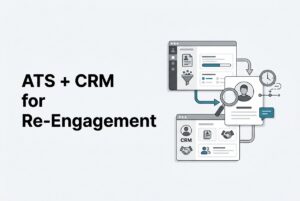
Here is the practical split: an ATS runs the active requisition. A CRM preserves the relationship with the person over time. When staffing teams connect those two functions, they can search their own pool first, understand why someone was previously considered, send a relevant message, track who owns the relationship, and move a responsive candidate back into the ATS without rebuilding the record.
That is the real value of talent pipeline management. Not bigger lists. Better reuse.
ATS vs. CRM: the difference that actually matters
If you are hiring out of job boards, referrals, agencies, and spreadsheets, the distinction is simple:
- ATS: organizes candidates around an open role
- CRM: keeps the longer-term relationship with the candidate useful
An ATS is built for the process of this job, right now. A CRM is built for the person, between openings and after the first decision is made. The ATS tracks application stages, interviews, offers, and hires. The CRM keeps the profile, history, engagement, and context that make future outreach possible.
That boundary matters because staffing teams rarely need one more place to store resumes. They need one place where the same person can be found later with the old notes still attached.
A good ATS CRM for staffing workflow preserves:
- one candidate identity
- one activity history
- one owner
- one clean status change from passive to active
That last part is where most teams lose the thread. A person can be in a warm pool and also re-enter the ATS workflow. The point is not to duplicate them. The point is to keep the record alive.
What a warm talent pool really is
A warm pool is not “every resume we have ever seen.” That is just clutter with better branding.
A useful pool contains people the team can justify contacting again because there is real context behind the record. The best categories are usually the obvious ones:
- recent active applicants
- silver medalists
- strong candidates who were not ready yet
- role-mismatch candidates who may fit a different opening
- past screened candidates with meaningful feedback
- passive prospects from sourcing
- former interns, alumni, or former employees when the fit still makes sense
One category should be treated carefully: stale, opted-out, or unverified records. Those are not warm by default. They are control records. Refresh them, suppress them, or delete them as needed.
The key is not just tagging someone as “qualified.” That is too vague to be useful later. A better note sounds like this: strong backend engineer, not yet ready for senior level, likely relevant again in a few months. That is searchable. It is also something a recruiter can act on without guessing.
This is where talent pipeline management gets practical. A pool is only valuable if it tells you why the person belongs there and what kind of job would make sense next.
The workflow staffing teams should use
If you want candidate re-engagement to work, the process has to be repeatable. Not fancy. Repeatable.
1. Capture the record properly from the start
The first rule is basic: if the candidate data is incomplete, the future search will be weak.
At minimum, the record should capture:
- name and reliable contact details
- current and target titles
- normalized skills and technologies
- work history and experience level
- location, remote or onsite preference, and availability
- source
- original requisition or pool reason
- stage reached and last stage change
- rejection or withdrawal reason
- interview feedback and scorecard summary
- last contact date and contact owner
- email status, bounce status, and opt-out status
- consent or legal basis status where applicable
- duplicate or merged-record identifier
That list is not about stuffing fields for the sake of it. It is about making the record usable later. If a recruiter cannot tell why the person was retained, who last contacted them, or whether they can be contacted again, the CRM is not doing its job.
Data hygiene matters too. Merge duplicates. Keep the original source. Standardize titles and skills. Assign one owner. Suppress bounced or opted-out contacts. And do not create five overlapping pools that all contain the same person. That is how teams turn a system into a maze.
2. Close each requisition by harvesting future-fit candidates
Before a role is closed, the recruiter and hiring manager should decide who is worth keeping warm.
Usually that means:
- the selected candidate
- finalists who were credible but not selected
- people who passed early screens but missed the level, timing, or scope
- applicants who may fit recurring work
- records that should be closed or removed
For every retained candidate, save a short factual note about why they are worth preserving and what kind of role might fit later. Then send the normal outcome message first. A future-opportunity invite should be separate, transparent, and permission-appropriate.
This is where many teams get lazy. They reject someone for one role and then assume that becomes indefinite permission to market to them forever. It does not.
The silver medalist pattern is worth paying attention to because it explains why this process matters. A team can screen a large number of resumes, speak with many people, and still end up with several strong finalists who do not get the offer. If you do not keep those records alive, you are throwing away workable future talent.
3. Build rediscovery into intake
The best time to search the internal pool is before a new job goes live.
That means intake should include a short check with the hiring manager:
- have we interviewed people like this before?
- which recent roles had similar skills?
- did any finalists get close but not make it?
A useful operating rule is simple: internal rediscovery first, external sourcing second, as long as the existing records are relevant and contactable.
For recurring roles, set a reminder or a review step so the team checks the past-applicant pool before launching a fresh search. You do not need a magical button for this. You need a habit.
4. Organize pools around skills and hiring patterns
A good pool structure should reflect how your team actually hires. Common ways to organize include:
- discipline
- level
- role family
- location or time zone
- availability window
- source
- engagement stage
- candidate type such as silver medalist or referral
The research is clear on the general principle: use one well-structured pool and filter it by attributes instead of creating too many overlapping pools. That keeps ownership cleaner and search faster.
It also helps if one person is responsible for curating the pool. Without an owner, warm talent turns stale quickly.
5. Search the existing pool before sourcing cold
This is the step where ATS CRM for staffing becomes very real.
CVViZ’s public product pages describe Elasticsearch-based search, full-text and Boolean search, filters for experience, qualification, location, and resume freshness, plus AI contextual matching and automatic ranking of best-fit profiles for a new job posting. In plain English, that means the team can search by skill family, then narrow by history, recency, and fit instead of hunting through old PDFs.
For a rediscovery search, combine the new role requirements with the old context:
- prior stage reached
- rejection reason
- interview feedback
- source
- last contact date
- owner
- location
- availability
- communication status
Do not assume a prior finalist is still available. Do not assume a strong profile is still interested. Review the actual record before contacting anyone. Ranking should help the recruiter review faster, not replace judgment.
That matters because candidate re-engagement is not keyword matching with a friendlier name. It is a search problem plus a relationship problem.
6. Send outreach that remembers the candidate
The first message should do three things:
- acknowledge the earlier interaction
- explain what is newly relevant now
- offer one clear next step
A message that says “Are you still looking?” is weak. It sounds like the sender forgot the person existed. Staffing teams can do better than that.
A stronger message names the role, the reason it might fit now, and the next action. It should also respect the earlier outcome. If the person was rejected before, the note should not pretend that never happened.
CVViZ’s communication tools, as described on public pages, support personalized email, templates, bulk email, email campaigns, reminders, follow-ups, email and mailbox sync, candidate history, and open/click tracking. That is useful because re-engagement only works when the recruiter can see the history and the response in one place.
One practical rule keeps campaigns sane: assign one owner, stop the sequence when the candidate replies, and suppress bounced or opted-out records. A smart sequence is better than a loud one. Loud is how teams end up annoying good candidates.
7. Move the positive response into the ATS without losing history
Once a candidate responds positively, the system should not create a second disconnected record. That is how history gets lost.
The recruiter should:
- link the person to the new requisition
- preserve the prior profile, source, and communication history
- update current title, skills, location, availability, and interest
- record why the person was re-engaged
- assign the current recruiter or hiring owner
- send current job details and collect any needed application info
- run the current screening and interview process
CVViZ public pages describe a combined ATS and recruitment CRM workflow, candidate histories, talent pipeline management, automated interview scheduling, calendar sync, and video interviewing. Those are useful once the person is back in the active process, but they do not replace current assessment.
A negative reply, a changed preference, or no response should also be logged. If the person is no longer relevant or contact is no longer permitted, the record should be suppressed or removed according to policy.
How CVViZ supports this workflow
The best way to think about CVViZ is not as a magic shortcut. It is a set of building blocks that support the workflow above.
Here is how the pieces map:
| Workflow need | CVViZ capability described on public pages | What it helps a staffing team do |
|---|---|---|
| Find past applicants | Internal candidate pool search and ranking | Start with the existing database before sourcing from scratch |
| Search accurately | Elasticsearch, Boolean search, filters, relevance ordering | Find candidates by skill, title, location, and recency |
| Match beyond keywords | AI contextual matching and ranking | Surface adjacent candidates who may still fit |
| Preserve context | Candidate history, notes, emails, past actions | See why a candidate was retained or rejected |
| Run outreach | Templates, campaigns, reminders, follow-ups, engagement tracking | Send targeted candidate re-engagement messages |
| Trigger routine actions | Rules and triggers for resumes, jobs, and stage changes | Automate acknowledgements and status updates |
| Coordinate interviews | Calendar sync, video interviewing, stage-based workflows | Reduce back-and-forth after re-entry into the ATS |
| Measure results | Recruitment analytics and report exports | Compare rediscovered candidates with external sourcing |
The key phrase there is “support the workflow.” That is different from promising a miracle. The platform helps teams act on existing talent faster and with more context. It does not remove the need for a recruiter to judge fit, confirm availability, or handle the conversation well.
What to measure
A warm pool should be judged by quality, not by how many records it contains.
Useful measures include:
- eligible-pool size
- pool freshness
- rediscovery rate
- re-engagement coverage
- response rate
- engagement rate
- re-engagement-to-screen rate
- screen-to-interview conversion
- interview-to-offer conversion
- re-engagement-to-hire rate
- time to rediscovery
- time to fill or time to hire, using one definition consistently
- source effectiveness
- pool quality, including duplicates, bounces, opt-outs, and stale records
- candidate experience
The important part is to compare like with like. Silver medalists should be compared with other past applicants, not with every external sourced candidate in a different role family. Similar roles, similar seniority, same time window. Otherwise the numbers will lie to you politely.
There is no single universal benchmark for candidate re-engagement rate. So define it clearly inside your team, track the denominator, and use the number to learn, not to decorate a dashboard.
Privacy and retention are not optional
A warm talent pool is only useful if the organization is allowed to use it.
The research is clear on the guardrails:
- show a privacy notice when collecting or importing a profile
- state the future-recruitment purpose
- record consent or the documented legal basis and date
- keep do-not-contact and opt-out flags
- provide a simple way to withdraw consent or request deletion
- set a review, deletion, or anonymization process
- limit access by role
- keep an activity history
- stop automated outreach after a bounce, objection, or clear request not to be contacted
Also, do not store candidate data forever. That is not a gray area. It is a bad habit.
A platform can help with consent tracking, retention controls, audit logs, and access permissions, but the recruiting organization still owns the legal and ethical decision-making. Software is the tool. Not the excuse.
What good and bad re-engagement look like
Good re-engagement looks like this: the recruiter searches internally first, the profile is deduplicated, the prior stage and feedback are visible, the current role is actually relevant, one owner sends a specific message, the system records the response, and the positive reply moves into the ATS with the history intact.
Bad re-engagement looks like this: a spreadsheet gets exported with no owner, a generic bulk email goes to every historical applicant, one person gets contacted twice because records are duplicated, an old title is treated as current truth, opt-out requests are ignored, and sensitive comments are copied into a campaign like that is normal. It is not.
A simple starting point for staffing teams
If you want to improve candidate re-engagement without rebuilding your hiring process, start here:
- Pick one recurring role.
- Identify the silver medalists and strong non-hires from the last few openings.
- Clean up their records.
- Assign one owner.
- Check whether they are still relevant and contactable.
- Search that pool before sourcing externally.
- Send one specific outreach message.
- Track responses, screens, and hires.
That is the playbook. Not glamorous, but it works when the data is clean and the follow-up is real.
FAQs
Is an ATS the same as a recruiting CRM?
No. An ATS manages the active hiring process for a role. A recruiting CRM manages the longer relationship with the candidate before, between, and after requisitions.
Why not just search the ATS?
You can, but a CRM layer adds the context that makes old records useful: prior conversations, ownership, interests, source, and communication history.
When should a candidate move from the CRM to the ATS?
When the person is being considered for a live role and has the current job information or has been invited to apply. Keep the history intact. Do not create a second identity.
Who should be re-engaged first?
Start with recent finalists and silver medalists, then strong candidates who missed only timing, level, location, or scope, then other screened prospects that still make sense.
How often should a staffing team email a talent pool?
There is no universal cadence. The right rhythm depends on consent, candidate preference, role frequency, and whether the message is actually relevant.
What should the first re-engagement message say?
Reference the prior interaction, explain why the current role may fit better now, and offer one clear next step.
How do teams know whether re-engagement works?
Track pool freshness, candidates surfaced, messages delivered, responses, screens, interviews, hires, time to rediscovery, and source quality. Compare rediscovered candidates with external candidates using the same definitions.
Does AI ranking replace recruiter judgment?
No. AI matching helps prioritize review. Current availability, interest, consent, and human judgment still matter.
What does CVViZ specifically contribute?
Its public pages describe a combined ATS and recruitment CRM, searchable candidate pool, AI matching and ranking, Elasticsearch search, candidate history, email campaigns and tracking, workflow triggers, interview scheduling, and analytics.
Can a staffing agency keep every past applicant forever?
No. The research says candidate data should be kept only as long as necessary for the stated purpose, then deleted or anonymized according to policy and jurisdiction.