If your hiring process still works at 500 applicants a month, that does not mean it will survive at 5,000. As scaling hiring ramps up, the real change is not just “more resumes.” It is a different operating model: more automation, tighter compliance, deeper integrations, and a much more structured candidate pipeline.
The short version is simple. Around 500 applicants a month, a basic ATS with manual review and light automation can still hold up. Around 1,500, manual screening starts to break down. By 5,000+, the system has to do more of the heavy lifting, or recruiter workload and response times get out of control. That is where recruiter efficiency stops being a nice metric and becomes the whole game.
The volume threshold that changes everything
The biggest mistake mid-market teams make is buying for today’s mess instead of next year’s volume. A process that feels manageable at 500 applicants can become chaos once jobs start pulling in several times that number. At that point, the ATS is no longer just a tracking tool. It becomes the operating system for the hiring process.
The practical inflection point is between 800 and 1,500 applicants per month. Below that, spreadsheets and entry-level tools can survive if the team is disciplined. Above that, manual first-pass review, scheduling, and follow-up become too slow to scale cleanly. Once you hit 1,500+ applicants per month, automation and structured workflows stop being optional.
Volume tiers at a glance
| Volume tier | Monthly applicants | What still works | What starts breaking |
|---|---|---|---|
| Tier 1 | Under 500 | Manual review, basic ATS, email templates | Duplicate detection, pipeline visibility, consistent screening |
| Tier 2 | 500 to 1,500 | Structured scorecards, Boolean search, basic workflow rules | Manual resume reading at consistent quality, scheduling overhead |
| Tier 3 | 1,500 to 5,000 | AI-assisted ranking, automated workflows, multi-board distribution | Recruiter burnout, inconsistent evaluation, ad spend waste |
| Tier 4 | 5,000+ | Programmatic advertising, structured interviews, full automation stack | Manual anything, ad hoc hiring, no-ops recruiting |
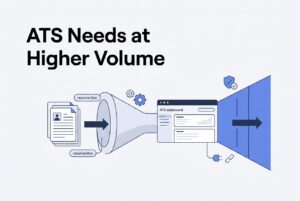
The big shift happens between Tier 2 and Tier 3. That is when AI screening moves from “helpful” to operationally required.
What changes first: resume intake and screening
At lower volume, a simple parser and manual review can work. At mid-market scale, though, resume parsing accuracy starts to matter a lot more because one bad intake step creates work everywhere else. In practical terms, the ATS needs to handle clean parsing, bulk import, duplicate detection, and source tagging without dropping candidates into a black hole.
How resume parsing requirements evolve
| Tier | What you need |
|---|---|
| Under 500 | Basic parser that extracts name, email, and work history |
| 500 to 1,500 | Higher parsing accuracy, especially on standard formats |
| 1,500 to 5,000 | Bulk import, duplicate detection, automatic source tagging, and resilient parsing across formats |
| 5,000+ | Parsing plus candidate rediscovery across historical applicants |
The reason is simple. Recruiters cannot spend the same time on every resume once the volume gets large. The dossier notes that leading AI resume parsers reach about 95%+ accuracy on standard formats, while unusual layouts still create failures. It also notes that skills extraction is weaker than name or date extraction, so manual review still matters for borderline cases.
That is why the best mid-market setup is not “AI only.” It is AI ranking first, then human judgment on the shortlist. That hybrid model protects recruiter efficiency without turning hiring into a blind machine process.
Why candidate search becomes a strategic function
At low volume, keyword search is enough. At scale, that becomes too shallow. Once the candidate pipeline grows, recruiters need Boolean search, saved searches, filters, and then semantic matching and candidate rediscovery.
Search capability by scale
| Tier | Search approach |
|---|---|
| Under 500 | Simple keyword search |
| 500 to 1,500 | Boolean search, saved searches, filters |
| 1,500 to 5,000 | Semantic search and vector-based matching |
| 5,000+ | Rediscovery as a strategic function |
This matters because a mature ATS should not only help you fill new roles. It should also help you find past applicants for new openings. At the highest volume tier, rediscovery becomes a real source of hires, especially when teams can re-engage silver medalists instead of starting every search from scratch.
For mid-market buyers, this is one of the clearest signs that the hiring stack is maturing. You are no longer just tracking applicants. You are building a reusable talent database.
Workflow automation becomes non-negotiable
This is where a lot of hiring teams feel the pain first. When applications spike, the bottleneck is not just screening. It is the workaround screening. Notifications, follow-ups, status updates, interview prompts, and escalation rules all pile up fast.
Common automations that matter at scale
- New application → confirmation email + recruiter notification
- Stage change → hiring manager notification + calendar invite
- Interview complete → scorecard prompt
- Rejection → templated email + talent pool tagging
- Offer signed → onboarding handoff + HRIS sync
- Candidate inactive for several days → nudge email
- SLA breach → escalation alert
- Background check clear → move to hired + notify Payroll or IT
At 1,500+ applicants per month, organizations without rule-based automation typically lose qualified candidates because response times lag. That is a direct hit to the hiring process, and it usually shows up as candidates dropping off before a recruiter can engage them.
This is also where structured workflows help hiring managers. Instead of asking recruiters for constant status updates, managers can see progress in the system. That keeps the process moving and cuts down on status-chasing.
Interview scheduling is usually the hidden bottleneck
Many teams think screening is the big issue. In practice, scheduling often eats just as much time. At lower volume, email back-and-forth is fine. At mid-market scale, it becomes a tax on everyone.
A single loop of scheduling can create 5 to 10 emails per candidate. Once you are handling 100+ interviews a month, that can consume a full-time coordinator. In Tier 3 and above, self-scheduling and calendar integration for video interviews are no longer convenience features. At Tier 3 and above, self-scheduling and calendar integration are no longer convenience features. At Tier 3 and above, self-scheduling and calendar integration are no longer convenience features.
Scheduling needs by tier
| Tier | Scheduling requirement |
|---|---|
| Under 500 | Email back-and-forth works |
| 500 to 1,500 | Calendar integration with self-serve links |
| 1,500 to 5,000 | Automated panel scheduling |
| 5,000+ | Dedicated recruiting coordinators and self-scheduling |
The dossier also notes that self-scheduling tools have reduced time-to-interview from about 5.9 days to 3.9 days, with candidate satisfaction averaging 4.63 out of 5. That makes scheduling one of the most practical levers in scaling hiring.
Job distribution and sourcing need broader reach
At smaller volume, posting to one or two boards may be enough. As volume rises, that approach becomes too narrow. Mid-market teams typically need 5 to 10 boards by Tier 2, then multi-board posting and budget allocation across channels by Tier 3.
Distribution by scale
| Tier | Sourcing and distribution |
|---|---|
| Under 500 | 1 to 2 boards |
| 500 to 1,500 | 5 to 10 boards plus aggregator feeds |
| 1,500 to 5,000 | Multi-board posting through one workflow |
| 5,000+ | Programmatic job advertising across 20+ networks |
The cost structure also changes. Indeed Sponsored Jobs run at $0.10 to $5.00+ per click, with a $5 daily minimum and $25 per post minimum since July 2025. Once volume justifies it, programmatic advertising can lower cost per apply by 20% to 40%.
That is why job distribution is not just a sourcing task. It is part of recruiter operating efficiency. If your postings cannot move fast enough across channels, the rest of the funnel gets choked.
Compliance gets heavier as volume rises
Compliance is easy to underestimate when the team is small. At scale, it becomes part of the ATS requirement itself.
What changes by scale
- EEOC recordkeeping: personnel and employment records must be retained for 1 year
- OFCCP federal contractor rules: applicant records for 2 years, outreach and recruitment activity records for 3 years, annual data-collection analyses for 3 years
- GDPR: retention, access, rectification, erasure, and portability controls matter when EU candidates are involved
- State AI laws: bias audit and disclosure requirements become relevant once automated tools are used in hiring
The most operationally significant U.S. rule in the dossier is New York City Local Law 144. It requires an annual independent bias audit, public posting of results, candidate notice at least 10 business days before tool use, and an alternative process on request. Other jurisdictions, including Illinois, Colorado, California, and Texas, add related requirements around consent, disclosures, impact assessments, and high-risk AI controls.
For mid-market teams, this means the ATS must support audit trails, retention controls, and compliance workflows. At 5,000+ applicants per month, that is not a legal checkbox. It is part of the system design.
Integrations become mandatory, not nice-to-have
At low volume, a few disconnected tools can still limp along. At scale, they create manual handoffs that break the process.
Integrations that matter most
| Integration | Why it matters |
|---|---|
| HRIS | Employee record creation and post-hire handoff |
| Calendar | Interview scheduling and self-serve booking |
| SSO/SCIM | Identity and role provisioning |
| Assessments | Skills validation |
| Background checks | Post-offer workflow |
The dossier also points to the need for native or well-supported integrations with HRIS, calendar, SSO, assessments, and background checks. Without them, teams end up re-entering data, copying candidate status by hand, and losing visibility across the candidate pipeline.
For scaling hiring, this is one of the biggest inflection points. A mid-market ATS should not just store candidates. It should connect recruiting to the rest of the company’s systems.
What mid-market buyers should prioritize
If you are hiring between 500 and 5,000+ applicants per month, the right ATS is not the one with the most features. It is the one that matches your current tier and the one you are moving into next.
Priority checklist by scale
At 500 applicants/month
- Structured ATS with pipeline visibility
- Standardized job templates and scorecards
- Basic workflow automation
- Centralized candidate communication
At 1,500 applicants/month
- AI-assisted resume screening and ranking
- Multi-board posting
- Self-serve interview scheduling
- Source-of-hire and funnel tracking
- Structured interview kits
At 5,000+ applicants/month
- Programmatic job advertising
- AI with explainable scoring and bias audit support
- Advanced analytics dashboards
- HRIS, background check, and assessment integrations
- SSO/SCIM and role-based access controls
- Data retention and deletion policies
- Dedicated coordinator function
That checklist is the practical answer to recruiter efficiency. The more applicants you get, the less room you have for manual work, disconnected tools, and fuzzy ownership.
Where CVViZ fits in this picture
CVViZ is one way to address these scale problems because it is built as AI recruiting software, not just a resume inbox. It supports contextual AI resume screening, relative ranking, job posting to multiple sites, workflow automation, resume parsing, search across the resume database, email tools, video interviewing, and recruitment analytics.
For mid-market buyers, that matters because the core problem is usually not one isolated feature. It is the combination of screening, routing, scheduling, communication, and reporting that falls apart together. A system like CVViZ helps bring those pieces into one place so the candidate pipeline is easier to manage.
FAQ
At what applicant volume does a spreadsheet break down?
Around 100 to 200 applicants per month per role. After that, duplicate detection, status tracking, and collaboration start to fall apart.
Do we need AI screening at 500 applicants per month?
Not necessarily. At that level, manual review with structured rubrics is still feasible. AI screening becomes much more valuable around 1,500+ applicants per month.
What is the single most important ATS feature at scale?
Workflow automation with triggers. Without it, recruiters spend too much time on coordination instead of hiring.
What integrations matter most as we grow?
HRIS, calendar, SSO/SCIM, assessments, and background checks are the most important core integrations.
How long does ATS implementation take for a mid-market company?
Tradtional ATS used to take typically 4 to 8 weeks for a standard mid-market rollout, assuming common integrations. However, modern ATSs come with plug and play like strcuture. The data transfer and data mapping from the old ATS or old system to the new ATS may take a few days.
How do we measure ATS ROI?
Track time-to-fill, time-to-hire, cost-per-hire, recruiter hours per hire, candidate NPS, and source-of-hire quality before and after implementation.