It’s Monday morning. You open the applicant queue and see 200 resumes for one role. By Wednesday, you’ve somehow shortlisted twenty people. Three weeks later, the first offer goes out, and you can’t clearly explain why candidate #7 made it and candidate #12 didn’t. Other than, “they just felt like a better fit.”
That’s the real problem in hiring. It’s not the volume of applicants. It’s the inconsistency of our decisions.
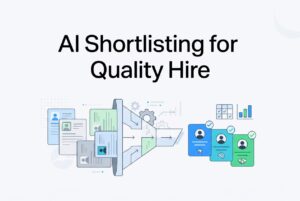
AI doesn’t fix this by just moving faster. It fixes inconsistency by applying defined criteria the same way, every time, and giving you something to measure. But it only works if you set it up right. Here’s a seven-step playbook for building a shortlisting process where AI does the heavy lifting, humans make the judgment calls, and you can actually prove that your quality of hire is improving.
Why “faster screening” doesn’t automatically improve quality of hire
Speed is a nice side effect of AI resume screening. It’s not the outcome you should be optimizing for.
The common failure mode: speeding up the same flawed criteria
When teams rush to add AI, they usually just paste their old job description into the tool and let it run. They celebrate when the queue drops from 200 resumes to 30. But if the original criteria were vague, like “5+ years experience, team player, strong communicator,” the AI just filtered faster using the same fuzzy signals. You’re left with a smaller pile of resumes that reflects the same old biases and guesswork.
Automating a bad process just gets you bad results faster.
The goal: a repeatable, explainable shortlist process
A better goal is creating a process where you can answer three questions after every hire. What signals did we screen for? How well did the shortlist reflect those signals? Did candidates who had those signals actually perform well? When you can answer all three, you have a system. Anything before that is just sorting piles of paper.
Step 1 — Define Quality of Hire (QoH) for this role (before touching AI)
Let’s be honest, this is the step everyone wants to skip. It’s also the one that costs you the most when you do. Before you configure any AI tool, you need a working definition of what “good” actually looks like for this specific role.
Choose 3–5 QoH outcomes you can actually observe
Quality of hire isn’t a single metric. It’s a small set of observable outcomes that you measure after someone has been on the job for 60 to 180 days. Common options include:
- Performance ratings at the 90-day mark or first review cycle
- Ramp-up time, which is how quickly they reach full productivity (especially for sales, support, and technical roles)
- Retention, meaning are they still there at 6 months or 12 months
- Hiring manager satisfaction, which should be a structured score, not just a feeling
- Team feedback from peer interviews or onboarding check-ins
Pick the ones your team can actually collect data on. A simple retention metric you track is worth more than a complex performance framework you haven’t built yet.
Convert outcomes into pre-hire signals (skills, behaviors, evidence)
Once you know what you’re measuring after the hire, work backward. If ramp-up speed matters for a sales role, what on a resume indicates someone hits quota fast? Maybe it’s proof of a short sales cycle or documented quota attainment. If retention is a priority for a senior engineer, what suggests someone will stick around? Look for role longevity and a clear trajectory within companies, not just a list of certifications.
This step translates your goals into resume signals. And if an outcome doesn’t map cleanly to a resume signal? That’s useful information too. It tells you where AI screening has limits and where human interviews need to carry the weight.
Decide what not to optimize for (and why)
Prestigious company names, degree pedigree, and raw years of experience are tempting signals to screen for. They’re easy to filter, but they are often weakly correlated with performance in your specific company.
I used to love pedigree as a shortcut. I was wrong. It just screened for people who went to fancy schools, not people who could actually do the job.
Explicitly decide which signals you are excluding and write it down. (Yes, write it down.) This becomes part of your governance record and stops hiring managers from quietly adding back proxies like, “I just want someone from a Series B company,” that have nothing to do with your defined outcomes.
Step 2 — Build role requirements that AI can match (without baking in bias)
Garbage in, garbage out. It’s true for AI, too. “Strong communicator with relevant experience” is not a matchable criterion. It’s a wishlist.
Must-haves vs nice-to-haves vs “screening questions”
You need to tier your requirements.
- Must-haves: These are dealbreakers. A specific license or a technical skill the role can’t function without.
- Nice-to-haves: Valuable, but not used for filtering.
- Screening questions: These add signal about behaviors or situations before an interview.
When every criterion carries the same weight, the AI can’t make meaningful distinctions. Tiering tells the AI, and your reviewers, what actually matters.
Evidence-based criteria (what counts as proof on a resume)
For each must-have, define what counts as evidence. If you need a “Python developer,” does a listed skill count? What about a GitHub link? Or a description of building data pipelines without naming the language? A shared definition prevents one recruiter from being strict and another from being lenient with the same criteria. This is exactly the kind of inconsistency AI is good at solving.
Bias pitfalls in requirements (and how to neutralize them)
Watch out for biased proxies in your job requirements. Phrases like “native-level communication skills,” an undefined “cultural fit,” or degree requirements for roles where a degree is irrelevant are common offenders.
Replace them with observable, job-relevant behaviors. “Can communicate technical concepts to non-technical stakeholders” is something you can test in an interview and map to resume evidence. “Native speaker” is neither testable nor relevant.
Step 3 — Use AI screening for what it’s good at: contextual matching + triage
With solid criteria in place, the AI can finally earn its keep.
Keyword filtering vs contextual/semantic screening
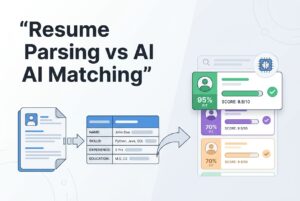
Traditional keyword filtering is painfully literal. It looks for the word “Salesforce” and completely misses a resume that says “CRM management using cloud-based tools.” Contextual screening, on the other hand, understands that people describe the same skills using different language. It finds candidates who would have been invisible to a simple keyword search, which directly improves the quality of your shortlist.
This is where tools like CVViZ’s AI Resume Screening come in. They can apply your clear criteria consistently across every applicant, matching concepts, not just words, to find likely fits. This is a lifesaver when you’re dealing with high volume.
Ranking is not selection: set human review checkpoints
Let me be very clear. An AI ranking tells you who to look at first. It is not a hiring decision. Every team using AI needs checkpoints where a human reviews the ranked list and validates the logic before anyone moves forward.
Ranking is triage. A human owns the shortlist. Tools like CVViZ’s Relative Resume Ranking help you prioritize who to engage first based on your job requirements, which is incredibly useful when you have 300 applications and two hours to spare.
Practical tool criteria: transparency, controls, and workflow fit
When you evaluate any AI screening tool, ask these questions. Can I see why a candidate was ranked a certain way? Can I adjust the weight of different criteria? Does it fit how my team already works? A black box tool gives you results no one trusts. This leads teams to either ignore it completely or over-rely on it, and both of those scenarios break the process.
Step 4 — Design the hybrid workflow (AI + humans) for consistent shortlists
A real workflow isn’t just “AI screens, humans hire.” It’s a defined process with rules, checkpoints, and a feedback loop.
A simple hybrid flow (intake → AI rank → human review → structured next step)
Here’s a template that works for most roles:
- Intake: An application is received, and the AI screens for must-haves. Clear mismatches get an automated (but respectful) decline.
- AI rank: The remaining candidates are ranked by how well they contextually match the full set of criteria.
- Human review: A recruiter reviews the top-ranked candidates, perhaps the top 15-20% of the pool, using a structured scorecard, not just their gut.
- Structured next step: Screened candidates all get the same first-step experience, like pre-screen questions or a scheduling prompt.
Document this flow. A process that only exists in one recruiter’s head isn’t a process at all.
Override rules: when to trust the model, when to challenge it
Your team will override the AI rankings. Sometimes, they should. But there has to be a rule: overrides must be documented with a reason. “Gut feel” is not a reason. “Candidate has direct experience in our exact tech stack, which the AI underweighted” is a valid reason.
Tracking these overrides shows you whether your criteria need tuning or whether someone is quietly reintroducing their personal biases. This is especially important for senior roles, where context matters more and AI signals are less reliable on their own.
Calibration rituals with hiring managers (to prevent “moving targets”)
We all know that one hiring manager. They say “yes, this is what I want” in the intake meeting, then reject every candidate who perfectly matches those criteria. The best way to prevent this is through calibration sessions. Review the criteria together against real candidate examples before it corrupts your entire funnel.
Step 5 — Measure what matters: AI-shortlisting KPIs + ROI over time
“We filled the role faster” is not proof that AI improved your quality of hire. You have to measure the right things.
AI-workflow KPIs (beyond time-to-fill)
Track these numbers alongside time-to-fill:
- Shortlist precision rate: What percentage of shortlisted candidates advance to an interview?
- Pass-through rates by stage: Where are candidates dropping out? Does it correlate with their initial AI score?
- Recruiter override rate: How often are top-ranked candidates being bypassed? A rising rate could signal a problem with your criteria.
- Time-to-qualified: How long does it take to find a candidate actually worth advancing, not just to fill the seat?
These metrics let you inspect the AI’s contribution. If shortlist precision is low, your criteria need work.
Long-term QoH measurement: connecting shortlist decisions to outcomes
Check in at 90 days and 6 months. Did the candidates who scored highest on your AI criteria actually perform well? Are the candidates hired through this process staying longer than previous cohorts? You might not get statistical certainty with small hiring volumes, but you will see directional patterns.
Recruitment analytics tools, like those inside CVViZ, can track funnel metrics and help you measure your process over time, showing stakeholders that the investment is actually working.
Building a lightweight reporting cadence
A simple reporting cadence can make a huge difference. Review shortlist precision monthly. Review override patterns quarterly. And every six months, assess whether your QoH outcomes are trending in the right direction compared to your pre-AI baseline. You don’t need a full analytics team for this, just consistency.
Step 6 — Governance: bias monitoring, transparency, and candidate privacy
Governance sounds like boring compliance paperwork. It’s not. It’s how you keep the system fair and trustworthy over time.
Auditing bias: what to monitor and how often
Run a quarterly review of your shortlist composition by demographic group. You’re looking for whether pass-through rates differ in ways that can’t be explained by job-relevant criteria. If one group is consistently ranked lower despite being qualified, something upstream needs attention. AI models can easily learn and amplify biases from your own hiring history if you don’t monitor them.
This isn’t about hitting quotas. It’s about catching drift before it becomes a legal or ethical disaster.
Explainability: what you should be able to say about any shortlist
For any candidate on your shortlist, your team should be able to explain what criteria they met, how they were evaluated, and what the next step is. “The AI recommended them” is not a complete answer. Explainability builds trust with hiring managers, who are more likely to engage with the process when they understand its logic.
Privacy & compliance moments in the workflow (especially global hiring)
Candidate data comes with legal obligations. If you’re hiring in the EU or for remote roles, GDPR applies. That means candidates have rights to access, correct, and delete their data.
Treat candidate data as governed data from the start. Tools like CVViZ include a GDPR Compliance Toolkit to help manage these requests without derailing your entire hiring pipeline.
Step 7 — Implementation plan: rolling out AI screening without breaking the team
Trying to roll out AI to everyone at once with no training is the fastest way to make everyone hate it.
Start small: one role family, one funnel, one definition of “success”
Pick one type of role you hire for repeatedly. Define what success looks like for that role in 90 days. Run your new hybrid workflow on three to five hires. Review what happened. Then, and only then, expand.
A small proof point that your team believes in is worth more than a company-wide rollout that nobody trusts.
Recruiter training essentials (and common misuses to avoid)
Recruiters need to know three things: how to set criteria correctly, what to do when they disagree with a ranking, and how to document their decisions. The most common mistakes are treating AI rankings as final decisions or ignoring them completely without logging a reason. Both break the feedback loop.
Close the loop: use post-hire learnings to refine criteria and screening
After you hire a few people with the new process, schedule a quick review. Did the candidates who ranked highest perform as expected? Which criteria predicted success? Which didn’t? Use those answers to refine your must-have list and AI configuration for the next round. This is how the system gets better over time.
Put the framework into practice with an AI-first shortlisting workflow
Every step in this playbook, from defining quality of hire to closing the loop, is something your team can start doing right now.
But if you’re ready to replace manual keyword searching with contextual AI screening and real-time candidate ranking, a tool like CVViZ is built for exactly this workflow. It’s GDPR-ready and designed for teams who want better shortlists, not just faster ones.
The question to ask yourself isn’t “should we use AI in hiring?” It’s “can we explain how we’re shortlisting candidates today, and can we prove it’s working?” If the answer is no, this is where you start.