If your team is still screening resumes by keyword, chasing hiring-manager feedback in Slack, and piecing together funnel data in spreadsheets, you do not have a talent acquisition strategy. You have a pile of manual work with an ATS logo on top.
That is exactly why an AI recruiting software RFP has to do more than ask “Do you have AI?” It should force every vendor to explain how they rank candidates, what data they use, how they source talent, what gets automated, how the system integrates with your ATS, and how they prove the platform is safe to run in production. The right recruiting software vendor questions do not just surface features. They expose whether the product can actually help a lean TA team hire faster without losing control.
For mid-market teams hiring 20 to 300 people a year, the bar is simple: show me context, show me evidence, and show me where the human stays in the loop.
The Problem: Why most recruiting systems still create manual work
Most ATS platforms store applications well enough, but they do not meaningfully reduce screening, sourcing, coordination, or reporting work. A lean team may get hundreds of applications for one role, review only the first slice, miss non-traditional candidates, and keep work scattered across inboxes and spreadsheets.
That problem gets worse when screening relies on keywords alone. Keyword matching misses transferable skills, synonyms, adjacent experience, career growth, and resumes written in unusual formats. It also over-ranks candidates who copy job-description language without proving capability.
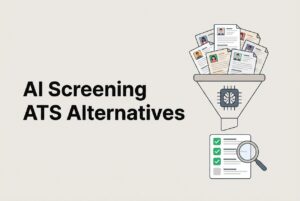
The real question is not whether the platform “uses AI.” It is whether it can produce a relevant, explainable, reviewable candidate priority list while preserving human control and auditable evidence.
Example: A remote operations role gets 300 applications. A keyword-only system may surface people who repeated the job post language. A contextual system should surface candidates with similar scope, progression, and relevant adjacent experience, even if their resume wording is different.
Key takeaway: Your RFP should test production behavior, not marketing language.
Why existing approaches fail
Feature-list RFPs usually invite vague answers like “AI-powered matching,” “seamless integrations,” or “enterprise-grade security.” Those phrases hide the details that actually matter.
A serious buyer needs to know:
- whether ranking is rules-based, ML-based, LLM-based, semantic, or a combination
- which fields affect the result
- whether the model learns from historical hiring decisions
- whether the output is a recommendation or an automated rejection
- whether recruiters can inspect, override, annotate, and audit results
- which ATS fields are read and written
- what happens when an ATS schema changes
- whether analytics can be exported at requisition, stage, source, demographic, and recruiter levels
- whether candidate records, model inputs, and audit logs can be retrieved at exit
A demo can show presentation quality. It does not prove production readiness.
Example: Ask a vendor to screen a hard-to-fill role using buyer-provided data, then show the reasons behind the ranking, not just the ranking itself. If they cannot explain the result in plain language, the system is not ready for a buying decision.
Key takeaway: The RFP should require written answers, product documentation, a live workflow demo, sample exports, security evidence, implementation assumptions, and references.
The Evidence-to-Outcome RFP Framework
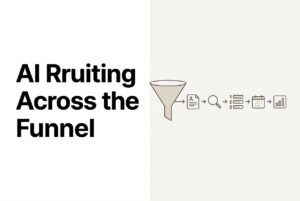
Use one framework to organize the whole process: Evidence-to-Outcome RFP Framework.
It has six gates:
- Understand — What does the AI evaluate, and how does it rank?
- Reach — Where can the platform source, import, and distribute candidates?
- Connect — Does it integrate reliably with the ATS and the rest of the stack?
- Orchestrate — Which workflow steps can be automated, under what conditions, and with what approvals?
- Prove — Can you measure quality, speed, source effectiveness, fairness, adoption, and ROI?
- Govern + Launch — Are data, privacy, security, human oversight, implementation, support, and exit defined?
Candidate data + job requirements
            |
            v
[1 Understand]   → contextual screening, ranking, explanations, human review
            |
            v
[2 Reach]        → job boards, web/social sourcing, referrals, rediscovery
            |
            v
[3 Connect]      → ATS, HRIS, email, calendar, SSO, assessments, collaboration
            |
            v
[4 Orchestrate]  → rules, triggers, messages, scheduling, feedback, handoffs
            |
            v
[5 Prove]        → funnel, quality, speed, source, fairness, adoption, ROI
            |
            v
[6 Govern+Launch]→ security, GDPR, oversight, migration, support, export
Score every answer as documented, demonstrated, customer-validated, or unconfirmed. Do not award points for “roadmap,” “customization,” or “partner-built” unless that is what you truly need.
Key takeaway: A good RFP is a proof request, not a feature checklist.
Understand: Questions about screening logic and ranking
This is the core of the evaluation. If the vendor cannot explain screening behavior, the rest of the platform does not matter much.
Ask:
- What exact candidate and job data does the screening system use?
- Is the result generated by deterministic rules, keyword search, Boolean search, semantic candidate search, vector retrieval, machine learning, an LLM, a scoring rubric, or a combination?
- Is the output a recommendation, a rank order, a threshold decision, a rejection, or a workflow trigger?
- How does the system distinguish required qualifications from preferred qualifications?
- Can recruiters assign weights, hard constraints, knock-out criteria, or minimum thresholds?
- How are synonyms, abbreviations, alternate titles, multilingual terms, transferable skills, adjacent industries, and equivalent credentials handled?
- How does the system evaluate career progression, recency, tenure, project scope, industry context, and depth of experience rather than counting keywords?
- How does the system avoid treating absence of a keyword as proof that a candidate lacks a skill?
- How does it handle resumes with tables, columns, graphics, scanned pages, unusual formats, non-English text, employment gaps, portfolio links, and incomplete profiles?
- Can the vendor show a false positive and a false negative from a controlled evaluation?
- What is the expected processing time for 100, 1,000, and 10,000 candidate records?
- Does the model learn from recruiter actions, interview outcomes, hiring outcomes, or historical ATS decisions?
- Can a customer turn off learning from historical decisions?
- How often are models, taxonomies, prompts, or scoring rules changed?
- Will a model or ranking change alter historical results?
- What explainability is available for each candidate?
- Can recruiters compare two candidates and see why their rank differs?
- Can recruiters override a score, add a reason, restore a candidate, or exclude a candidate from a recommendation?
- Are overrides logged with user, timestamp, old value, new value, and reason?
- Can the buyer export candidate scores, ranking factors, model version, decision history, and reviewer actions?
- What happens when the system is uncertain or has insufficient data?
- Does the platform support a human-review queue for borderline and rejected candidates?
- Can the buyer configure the AI so it recommends candidates but never makes a final employment decision?
Example: Test the system with a software role that includes transferable skills, a non-linear career path, and resumes written in different formats. Then ask the vendor to show why one candidate ranked above another.
Supporting statistic: There is no universal accuracy benchmark for AI resume screening. That is why the buyer has to test on its own candidate pool.
Key takeaway: You are not buying keyword search with a new label. You are buying a decision-support system that has to explain itself.
Reach: Questions about sourcing, distribution, and rediscovery
Sourcing coverage should be tested end to end: role creation, posting, import, deduplication, outreach, attribution, and deletion. A big board count alone proves very little.
Ask:
- Which free, paid, niche, social, and regional job boards can receive a posting today?
- How many job boards are included in the base subscription, and which require additional spend or separate accounts?
- Does distribution mean API feed, XML feed, direct posting, redirect, or partner marketplace?
- Can the buyer post once to multiple boards while preserving source attribution and campaign parameters?
- How are duplicate postings, expired postings, edits, closing dates, and reposts synchronized?
- How are paid promotions, sponsored placements, budgets, invoices, and approval controls handled?
- Can the platform publish to the buyer’s career page and support search-engine indexing?
- Which candidate sources can be searched or imported directly, including LinkedIn, GitHub, Stack Overflow, professional communities, personal sites, referrals, inbound email, and the existing ATS?
- Does the platform scrape, use a licensed database, provide a browser extension, use an official API, or require the recruiter to initiate each import?
- What permissions, terms-of-use restrictions, rate limits, or geographic restrictions apply to each source?
- Can recruiters import a profile, resume, contact record, portfolio, and source metadata in one action?
- Does the system detect duplicates across resumes, email addresses, phone numbers, profiles, and aliases?
- How does it merge duplicates, and can a user reverse an incorrect merge?
- Can the buyer search the existing talent database with full text, Boolean logic, structured filters, semantic matching, skills, title, seniority, location, source, stage, consent status, and last-contact date?
- Can the system find and rank silver medalists from past requisitions against a new job?
- Does the rediscovery workflow preserve the candidate’s prior application, interview feedback, consent, and communication history?
Example: For a hard-to-fill technical role, a good vendor should source from web and social channels, import profiles without duplication mess, preserve attribution, and surface past candidates who fit the new opening.
Supporting statistic: CVViZ publicly states one-click posting to 20+ free job portals and distribution to 2,000+ premium portals, plus sourcing from LinkedIn, GitHub, Stack Overflow, blogs, and personal sites. Treat that as a vendor claim to confirm in your own process.
Key takeaway: Reach is not just volume. It is source coverage, attribution, deduplication, and control.
Connect: Questions about integrations and architecture
Integration quality is determined by field mapping, event behavior, failure handling, version maintenance, and data ownership, not by the number of logos on a webpage.
Ask:
- Which ATS, HRIS, payroll, identity, calendar, email, assessment, background-check, e-signature, interview, sourcing, and collaboration systems do you support?
- For our ATS version, is the integration vendor-certified, native, partner-built, or a generic API connection?
- List every field the platform reads from and writes to the ATS, using the exact field names.
- Which custom fields, custom stages, requisition fields, candidate fields, attachments, notes, scorecards, and interview feedback are supported?
- Can the buyer map fields without engineering support?
- Which events can trigger synchronization?
- Is synchronization real time, scheduled, or manually initiated?
- What happens when an API call fails, a field is invalid, a rate limit is reached, or a source system is unavailable?
- Are retries, alerts, reconciliation reports, and dead-letter queues available?
- Does the integration create, merge, link, or overwrite candidate records?
- What happens when the ATS changes its API, data model, authentication, or version?
- Provide three customer references running the integration with the same ATS product and version.
- Is there a documented API with authentication, rate limits, webhooks, pagination, error codes, versioning, sandbox, and deprecation policy?
- Which capabilities are exposed by API: resume parsing, screening, matching, ranking, candidate import, job creation, stage changes, communication, and reporting?
- Can the platform operate as an AI layer on top of an existing ATS without forcing a replacement?
- Does it support SAML SSO, OIDC, SCIM provisioning, multi-factor authentication, IP restrictions, session controls, and automated deprovisioning?
- Does it synchronize email and calendars?
- Can it send email, SMS, WhatsApp, and voice communications?
- Does it integrate with Slack or Microsoft Teams for notifications, approvals, or hiring-manager collaboration?
- Can the buyer test integrations in a sandbox using non-production records?
- What integration monitoring, audit logging, and customer-visible status reporting are provided?
Example: If your ATS changes a field name or API version, the integration should not silently break candidate workflows. You want alerting, reconciliation, and a clear owner.
Supporting statistic: CVViZ product materials describe API-based integration as an intelligence layer on top of an existing ATS, plus email and calendar sync, inbox resume import, browser-extension importing, and communication connections around WhatsApp, Twilio, Zoom, Microsoft Teams, Slack, LinkedIn, and Indeed.
Key takeaway: A real integration is a maintained system, not a one-time connection.
Orchestrate: Questions about workflow automation and candidate experience
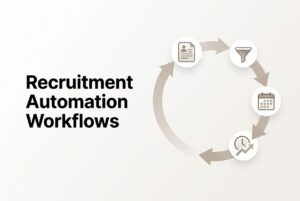
Automation should reduce repetitive work without creating silent, unreviewable employment decisions. Every automated action needs a trigger, condition, owner, approval rule, audit record, exception path, and rollback method.
Ask:
- Which events can trigger automation?
- Can triggers use multiple conditions and AND/OR logic?
- Can one trigger perform multiple actions, such as notify a recruiter, send a template, assign a task, update a field, and move a stage?
- Can automation be limited by requisition, department, geography, source, candidate consent, or user role?
- Can an automation require human approval before sending a message, rejecting a candidate, or changing a stage?
- Can automated rejection be disabled globally and by requisition?
- Can users configure rules themselves after go-live, and is there a change history?
- What happens when a candidate replies, unsubscribes, requests deletion, or becomes ineligible?
- Can the system send application confirmations, status updates, reminders, interview invitations, rejection messages, and nurture campaigns?
- Can recruiters personalize templates with controlled candidate and requisition fields?
- Does the system support email sync, bulk email, campaigns, open/click tracking, reminders, SMS, WhatsApp, and voice?
- How are consent, unsubscribe, quiet hours, frequency caps, and contact preferences enforced?
- Can candidates self-schedule interviews based on recruiter and panel availability, time zone, working hours, buffers, and meeting-room rules?
- Does the system support live video interviews, phone interviews, interview kits, scorecards, notes, and recording controls?
- Does it offer a live code editor or technical assessment workflow?
- Can hiring managers receive reminders for overdue feedback and see only the records they are authorized to see?
- Can candidates complete applications on mobile and in multiple languages?
- What is the candidate completion rate, and how is it defined?
- Can the candidate experience be demonstrated through a test account without sales intervention?
- What happens when automation fails?
Example: A solid recruitment workflow automation can confirm applications, pre-screen candidates, schedule interviews, and nudge hiring managers when feedback is overdue, all while logging every action.
Supporting statistic: CVViZ product materials describe rule-based workflow automation with triggers and conditions, multiple actions per trigger, flexible status workflows, email templates, interview scheduling, reminders, pre-screening questions, email campaigns, video interviews, and an integrated code editor.
Key takeaway: Automation should make the process faster, not less accountable.
Prove: Questions about analytics and measurable outcomes
Analytics should connect recruiting activity to outcomes. A dashboard that only counts applicants is not enough for a TA leader.
Ask:
- Which standard reports are included for requisitions, pipeline health, stage conversion, source performance, recruiter productivity, hiring-manager activity, candidate experience, and time-to-fill?
- Define every metric precisely.
- How are time-to-hire, time-in-stage, time-to-screen, time-to-interview, time-to-offer, and time-to-accept calculated?
- Can reports be segmented by department, location, role, seniority, recruiter, hiring manager, source, campaign, and date range?
- Can the platform show source-to-application, source-to-screen, source-to-interview, source-to-offer, source-to-hire, retention, and cost-per-hire?
- Can the buyer see the distribution of AI scores and compare AI recommendations with recruiter decisions and eventual outcomes?
- Can the buyer measure false positives, false negatives, restored candidates, overrides, and candidates who were initially rejected but later hired?
- Can fairness metrics be calculated by stage and demographic group where lawful and appropriately collected?
- Can the buyer report on candidate response rates, email opens, click-throughs, campaign conversion, interview completion, and application abandonment?
- Can reports be scheduled, shared by role, exported to CSV or Excel, and accessed by API?
- Can raw event data be exported for a data warehouse or business-intelligence tool?
- Are dashboards real time, near real time, or refreshed on a schedule?
- Are report definitions versioned and documented?
- What is the maximum data-retention period and record volume supported for analytics?
- Can hiring managers use reports without a data analyst?
- Which reports are included in the quoted subscription and which require an upgrade or professional services?
- Provide a sample report pack populated with anonymized data and explain every field.
Baseline these before implementation:
- applicant-to-screen rate
- screen-to-interview rate
- interview-to-offer rate
- offer-acceptance rate
- time from application to first qualified review
- time-in-stage
- time-to-fill
- time-to-hire
- source-to-hire conversion
- agency-sourced share
- cost-per-hire
- recruiter hours per requisition
- hiring-manager feedback latency
- candidate withdrawal rate
- candidate experience score
- AI override rate
- selection-rate ratios by demographic group where appropriate
The point is not to hit a magic universal benchmark. The point is to know whether the new system improves your own funnel.
Example: If your team wants to reduce agency spend, track source-to-hire, agency share, and the share of candidates rediscovered from your own database.
Supporting statistic: CVViZ materials say it provides recruitment analytics and dashboards for time-to-hire, source performance, recruiter productivity, time-to-fill, and effective sourcing channels, with reporting and export capabilities.
Key takeaway: If the dashboard cannot explain funnel movement, it is just decoration.
Govern + Launch: Questions about security, GDPR, implementation, support, and exit
For a mid-market company, implementation risk can outweigh feature differences. This gate protects you from buying something your team cannot safely launch.
Security and privacy questions
Ask for:
- a current system architecture and data-flow diagram
- hosting country and region options
- encryption in transit and at rest
- role-based access control and privileged-access logging
- SSO, MFA, SCIM, session timeout, password policy, IP allowlists, and automated deprovisioning
- current SOC 2 Type II, ISO 27001, penetration-test, vulnerability-management, and business-continuity evidence
- RTO and RPO
- backup frequency, restoration tests, disaster recovery, and regional failover
- incident detection, customer notification, breach response, and forensic support
- subprocessors, their locations, services, and change-notification process
- whether customer data is used to train or improve a shared model
- whether prompts, embeddings, parsed resumes, scores, and audit logs are treated as customer data
- security controls for browser extensions, APIs, exports, email, SMS, WhatsApp, recordings, and interview artifacts
- audit log retention and export
For GDPR, ask:
- what role the vendor plays in each processing activity
- the data-processing agreement and subprocessor list
- what candidate data is collected and inferred
- purpose, lawful basis, retention defaults, and deletion behavior
- how the system supports access, rectification, erasure, restriction, objection, portability, and consent withdrawal
- whether a data subject request can be completed across ATS records, resumes, parsed fields, notes, emails, campaigns, recordings, backups, indexes, logs, and subprocessors
- deletion SLA and deletion evidence
- how retention can be configured by country, requisition, candidate type, consent status, and business purpose
- how candidates are informed about automated processing and profiling
- whether the system supports human review when an automated decision materially affects a candidate
- how exports, duplicate records, source-imported data, and candidate communications are governed
- whether sensitive data can be blocked and field-level access configured
- whether the vendor has completed a data-protection impact assessment
- whether there is a DPO or named privacy contact
Implementation and support questions
Ask:
- What is the median time from contract signature to first production use for a customer of our size and complexity?
- Provide a week-by-week implementation plan covering discovery, configuration, security review, integration, data migration, testing, training, pilot, launch, and stabilization.
- Which tasks belong to the vendor, customer TA team, customer IT, customer privacy/security team, and third-party integrators?
- What information, credentials, API access, field definitions, historical exports, and decisions are required to begin?
- Which workflows, fields, reports, templates, permissions, and integrations are included in standard onboarding?
- What costs apply to configuration, migration, integrations, training, custom reports, and change requests?
- Which historical data can be migrated?
- How are duplicate records, corrupt files, missing fields, inactive candidates, and expired-retention records handled?
- What is the migration validation method and acceptance threshold?
- Is there a sandbox and user-acceptance-testing environment?
- What happens if an integration or migration dependency stalls?
- Can the buyer run a pilot with a representative requisition and candidate sample before full rollout?
- What training is provided to recruiters, hiring managers, administrators, and IT?
- What adoption and usage reports are available after launch?
Also ask for support hours, severity definitions, outage handling, named contacts, escalation ownership, proactive monitoring, 12-month and 24-month retention rates, and three references with similar hiring volume, ATS stack, geography, and migration complexity.
Exit and ownership questions
Ask who owns candidate records, resumes, parsed fields, recruiter annotations, workflow history, reports, scores, embeddings, prompts, and audit logs. Also ask what export formats are supported, whether data export is continuous or only at termination, what the termination export window looks like, how deletion works after termination, and what aggregated or de-identified information may be retained.
Example: If you cannot export candidate data, audit logs, and report definitions, you do not really own your recruiting history.
Supporting statistic: Public implementation guidance puts typical ATS deployments in a broad 4 to 16 week range, with complex enterprise configurations taking up to six months. Ask each vendor for its customer-specific median and 75th percentile timeline.
Key takeaway: Governance is not a legal side note. It is launch readiness.
Practical application: how to use the framework in an RFP
Here is the easiest way to run this process without turning it into a committee sport.
- Start with a real role. Use a hard-to-fill job, not a generic one.
- Ask for written answers first. Do not let the demo replace the paper trail.
- Run a live workflow test. Use buyer-provided, anonymized data.
- Inspect explanations. Ask why candidates ranked where they did.
- Test the edge cases. Duplicate records, borderline candidates, ATS field changes, and failed integrations.
- Export something. Scores, audit logs, funnel data, or candidate records.
- Check the human controls. Override, restore, annotate, pause, and review.
- Verify launch assumptions. Migration scope, support plan, dependencies, and training.
A good buying team should be able to see the difference between a platform that can demo well and a platform that can actually carry a live recruiting operation.
Example: For a technical role, ask the vendor to import candidates from approved sources, deduplicate them, rank them, schedule interviews, and report source-to-interview conversion. That one exercise tells you more than a 45-minute product tour ever will.
Key takeaway: The best RFPs look like operational tests.
Metrics to baseline before implementation
Before you compare vendors, establish your current numbers. Otherwise, every promise sounds better than it is.
Track:
- applicant-to-screen rate
- screen-to-interview rate
- interview-to-offer rate
- offer-acceptance rate
- time from application to first qualified review
- time-in-stage
- time-to-fill
- time-to-hire
- source-to-hire conversion
- agency-sourced share
- cost-per-hire
- recruiter hours per requisition
- hiring-manager feedback latency
- candidate withdrawal rate
- candidate experience score
- AI override rate
- selection-rate ratios by demographic group where appropriate
The point is not to hit a magic universal benchmark. The point is to know whether the new system improves your own funnel.
Example: If time-to-fill is already acceptable but recruiter hours per requisition are too high, then automation and sourcing coverage may matter more than a prettier dashboard.
Key takeaway: Measure the work you actually want to reduce.
Suggested RFP scoring model
Use a 100-point scorecard so every vendor is judged on the same terms.
| Category | Suggested weight | What earns a high score |
|---|---|---|
| Screening quality and explainability | 20 | Contextual ranking, configurable criteria, evidence, uncertainty handling, human override, repeatable test results |
| Sourcing and rediscovery | 10 | Relevant source coverage, permissions, deduplication, attribution, talent-pool search, consent controls |
| Integrations and API | 15 | Exact field mapping, reliable events, error handling, sandbox, documented API, version maintenance |
| Workflow and candidate experience | 10 | Configurable triggers, approvals, scheduling, communications, accessibility, exception handling |
| Analytics and measurement | 10 | Defined funnel metrics, source quality, recruiter productivity, exports, fairness and override reporting |
| Security and privacy readiness | 15 | Architecture, access controls, encryption, audit evidence, incident response, subprocessors, data-use controls |
| GDPR and AI governance readiness | 10 | Rights workflows, retention, human oversight, bias testing, documentation, audit support |
| Implementation and support | 10 | Credible timeline, migration plan, UAT, training, SLAs, references, exit exports |
Use gating questions for non-negotiables, such as no automated rejection without buyer control, no workable deletion process, no usable export path, or no security documentation.
Key takeaway: A high feature score should never rescue a failed gate.
Comparison table: feature claims vs proof you should ask for
| Vendor claim | What it really means | Proof to request |
|---|---|---|
| “AI-powered matching” | The system uses some combination of rules, ML, semantic search, or LLMs | Screening logic, fields used, sample explanations, false positive and false negative examples |
| “Seamless integrations” | Something connects to the ATS or related tools | Exact field map, event behavior, failure handling, ATS version support, sandbox testing |
| “Real-time analytics” | Dashboards refresh on some schedule | Metric definitions, refresh cadence, export options, raw event access |
| “Enterprise-grade security” | Security controls exist, but scope matters | Architecture diagram, access controls, encryption, audit evidence, subprocessor list |
| “GDPR ready” | The vendor supports certain rights workflows | DPA, deletion behavior, retention controls, subject-request workflow, privacy contact |
FAQ
What is an AI recruiting software RFP?
It is a structured request for written vendor responses about AI-assisted recruiting capabilities, data flows, integrations, workflow automation, analytics, security, privacy, implementation, support, and exit. It works better than a feature checklist because it forces evidence, limits, and ownership into the open.
What are the most important recruiting software vendor questions?
Ask how the AI ranks candidates, what data it uses, whether it can reject automatically, how humans override it, how fairness is tested, which ATS fields are read and written, how data is deleted, what reports are exportable, how long implementation takes, and what happens when the customer leaves.
How can a buyer tell whether AI screening is more than keyword search?
Ask for semantic or contextual processing details, synonym and transferable-skill behavior, scoring reasons, and a blind test with non-obvious qualified candidates and keyword-heavy resumes that are not actually good fits.
Should AI be allowed to reject candidates automatically?
A cautious default is no. Use AI to prioritize and recommend, keep human review for material employment decisions, require override and restoration, and log the decision path.
What accuracy percentage should an AI screening vendor promise?
There is no universal accuracy percentage that answers the question. Ask what task was measured, against which labeled population, using which metric, with what error tradeoff, and with what subgroup results.
What is the difference between an ATS and an AI recruiting platform?
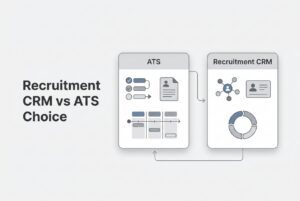
An ATS manages requisitions, applications, stages, interviews, and hiring records. An AI recruiting platform may add contextual screening, sourcing, rediscovery, automation, analytics, or AI services on top of an ATS. Your RFP should test whether the AI platform replaces, complements, or integrates with the current ATS.
How long should implementation take?
Public guidance puts typical ATS deployments in a 4 to 16 week range, with complex enterprise configurations taking up to six months. Ask for a customer-specific plan with dependencies, UAT, migration scope, training, and stabilization.
What should a buyer request before selecting a vendor?
Request written answers, architecture and data-flow diagrams, security evidence, model and fairness documentation, sample exports, API documentation, integration field maps, a migration plan, UAT scripts, pricing assumptions, service levels, customer references, and a live test using representative hiring scenarios.
Final takeaway
The best AI recruiting software RFP asks vendors to prove a complete recruiting operating system: understand candidates in context, reach the right talent, connect to the existing stack, automate routine work safely, prove outcomes with usable analytics, and govern the data and AI throughout the lifecycle.
That is the standard to hold them to. Not the prettiest demo. Not the loudest AI claim. Just the vendor that can show the strongest evidence across the full workflow.