You’re getting 300 applications for a mid-level engineering role. Forty are genuinely qualified. Your recruiter has three hours. The instinct is to grab whatever AI screening tool demos best and move fast.
That’s exactly when you make the wrong call.
The risk isn’t just about speed. It’s about automating flawed decisions at scale. Think about it: false negatives that miss your best people, biased rankings that penalize entire groups of candidates, and shortlists you can’t explain to a hiring manager or legal. These aren’t hypotheticals. They’re what happens when you buy ai resume screening as a speed tool instead of a judgment-assistance tool.
Here’s the right way to think about it: this software should help your team prioritize and surface candidates faster. It should not replace a recruiter’s judgment or make final calls on its own. The best tools aren’t the ones that rank the quickest. They’re the ones you can trust when a candidate challenges the outcome, a hiring manager asks “why not this person,” or legal wants an audit trail.
This guide is a concrete playbook for evaluating these tools. We’ll cover what to test for accuracy, which bias controls actually matter, what real explainability looks like, and how to run a pilot that tells you what’s real and what’s just a slick demo.
What Does “Accuracy” Mean in AI Resume Screening, and How Do You Verify It?
Let’s get one thing straight. Accuracy in ai resume screening isn’t about parsing a resume correctly. That’s just table stakes. Real accuracy is about ranking quality: does the shortlist find the same people your best recruiter would have, for your specific roles and your criteria?
You can get technical and talk about precision (fewer irrelevant candidates) and recall (not missing qualified people). Both matter, and they’re always in a trade-off. So when a vendor claims “95% accuracy,” ask them: “Accuracy against what?” If they can’t tell you how they’re measuring against your specific roles, it’s a marketing number, not a real validation.
Why generic demos mislead. Demo environments use curated sample resumes that are often perfectly formatted and skill-matched to the demo role. They’re tuned to look good. The real test is your actual applicant pool, including the career-changer, the candidate with a two-year gap, and the engineer who wrote “infrastructure automation” when your JD said “DevOps.”
What to ask vendors:
- How does the model evaluate fit? Is it reading skills in context, or is it just a fancy keyword matcher?
- Does it learn from our hiring process over time (feedback, rejections, who gets advanced)?
- How does it handle non-traditional resumes, like career breaks or non-linear paths?
What to test in a pilot. Use one to three real job requisitions and a batch of past resumes with known outcomes. Run the AI ranking and compare it to the shortlist your recruiters actually built. Quantify the overlap and the “misses.” How many candidates your team would have advanced did the AI rank too low? Then, test for stability. Make small edits to a mid-ranked resume and see if the rank swings wildly. Unstable ranking is a huge red flag that signals shallow pattern matching.
What “Contextual Screening” Should Catch That Keyword Screening Misses
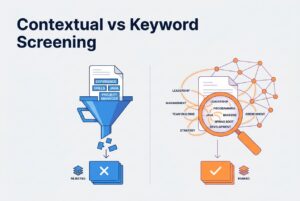
Keyword screening ranks a resume that says “Python, Django, REST APIs” ahead of one that says “built microservices backend for a fintech platform,” even if the second candidate is obviously stronger. Contextual screening is supposed to close that gap.
In practice, this means the system should recognize equivalent titles (like Senior SWE vs. Software Engineer III) and infer adjacent tool experience (Terraform experience is relevant for a Pulumi-heavy role). It should understand domain proximity (e-commerce is close to retail tech) and map transferable skills. A good system also de-weights keyword stuffing. A resume padded with endless skill lists shouldn’t outrank one with meaty project descriptions.
Which Bias Controls Are Table Stakes, and What’s Still Risky?
Every vendor will tell you they remove names, gender markers, and school names. That’s the baseline. It’s not enough.
Where bias still enters. The risk that nobody talks about enough is socio-linguistic proxies. Basically, the words people use correlate with their demographic background. If a model trains on your past hiring data where those patterns mattered (even unconsciously), the AI will learn to replicate those biases. Employment gaps disproportionately affect women. Certain past employers or zip codes can act as proxies for socioeconomic background. Even “culture fit” language can have a disparate impact.
The intersectional problem. Just because a report shows gender parity doesn’t mean you’re in the clear. What about specific subgroups? A model might look fair on gender and race individually but still systematically underrank Black women or candidates with non-Western names. Most vendors won’t show you this level of detail unless you push them. So, push them. Ask directly.
Procurement questions that matter:
- Do you run fairness testing by subgroup, including intersectional combinations? Can you show us the methodology?
- How often is fairness monitoring run, and what triggers a review?
- When bias drift is detected (meaning rankings are becoming less fair), what is your documented response process?
- What controls do we have to define standardized job criteria so the model evaluates against our explicit requirements, not inferred patterns?
Governance for mid-market and enterprise. You need a documented process, not a verbal assurance. Who on the vendor’s team owns fairness monitoring? What’s the SLA for responding to an issue? If you’re an agency using this for clients, you’re on the hook for any bias claims that surface.
What Does “Explainability” Look Like for Recruiters and Hiring Managers?
When a recruiter asks, “Why did this candidate rank 47th?” the answer can’t be, “The model scored them lower.” That’s not an explanation. It’s a shrug with a dashboard.
What minimum viable explainability looks like. For any ranked candidate, a recruiter must be able to see what signals drove the ranking (specific skills, experience alignment), what gaps exist, and whether those signals are stable. The explanation needs to be in plain language, not confidence scores and feature weights.
This needs to be local explainability, meaning the explanation applies to this candidate for this role, not a generic summary of how the model works. And it needs to be consistent. If the same resume gets a different explanation depending on who runs the query, you have a reliability problem.
Model architecture affects this. Some approaches are inherently easier to interpret. Others use deep learning models that require a separate explanation layer bolted on afterward. This adds complexity and can produce explanations that don’t perfectly reflect what the model actually did. Ask vendors which category they fall into.
Red flags to watch for:
- A proprietary “fit score” with no breakdown of what went into it.
- Explanations that change dramatically when you make minor resume edits.
- No way for a recruiter to log their reason for overriding a ranking, which means you’re flying blind.
The “Trust Checklist” for Explanations in Day-to-Day Use
Before you sign off on any tool’s explainability, run through these questions:
Recruiters need to know: Can I look at this for 10 seconds and understand why the ranking is what it is? Does it make sense?
Hiring managers need to know: Can I defend this ranking to a candidate if I have to?
Compliance and legal need to know: Is there an audit trail that shows the ranking logic and any human overrides?
If any of these groups can’t get what they need, the tool isn’t ready for prime time, no matter how good the model is.
How Should Human Oversight Work (and What Should You Measure)?
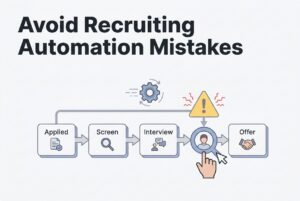
The right operating model isn’t “AI ranks, humans rubber-stamp.” It’s also not “AI ranks, humans re-screen everything from scratch.” You need a workflow that uses the AI’s speed without sidelining human judgment.
Recommended patterns:
- AI produces a tiered ranking. Recruiters review the top band and the “borderline” band. The bottom band gets a quick spot-check.
- For sensitive or senior roles, define which stages require human review before any candidate outreach happens. Don’t let automation get ahead of your process.
Override design. When a recruiter or hiring manager overrides an AI ranking (advancing someone ranked low or passing on someone ranked high), require a reason code or a brief note. This isn’t bureaucracy. It’s calibration data. If one recruiter is overriding 40% of rankings on a role and another is at 8%, that’s a signal. It could mean the criteria are fuzzy or the AI hasn’t calibrated to that role type yet.
Metrics worth tracking:
- Override rate by role and recruiter (tells you about calibration).
- Shortlist-to-interview rate over time (are the AI-assisted shortlists actually good?).
- Time-to-fill compared to your pre-AI baseline.
- System throughput during hiring surges (can the tool keep up when you need it most?).
What Integration and Change-Management Criteria Determine Time-to-Value?
A model that performs brilliantly in a demo but fails to integrate with your workflow is not an enterprise-ready tool. The path from “signed contract” to “recruiters actually using this” is where most implementations die.
Integration questions to ask upfront:
- Does it sit on top of our existing ATS via an API, or do we have to replace our current system? Both are viable, but the effort is completely different.
- How do resumes get in? Email inbox import, a Chrome extension for job boards, or a parsing API?
- What role-based access controls exist? Can we configure permissions for recruiters, hiring managers, and clients separately?
For example, some platforms like CVViZ are built to be flexible. They can act as a standalone AI recruiting system with all the bells and whistles (contextual screening, workflow automation, sourcing from LinkedIn, etc.) or they can plug into your existing ATS as an intelligent layer. That kind of flexibility is huge when you’re figuring out if a tool fits your stack or forces you to replace it.
Change management reality. Recruiter adoption is the risk everyone underestimates. If a tool requires two hours of training, it will be ignored within six weeks. Prioritize tools with an intuitive recruiter experience where feedback happens inside the normal workflow, not as an extra step.
For agencies specifically: You need multi-client separation, a client collaboration portal, and reporting that works for client updates. These aren’t nice-to-haves. They’re table stakes for running multiple reqs across different accounts.
What Should Be in Your Pilot Plan and Vendor Scorecard?
Months of demos won’t tell you what two weeks of structured testing will. Set up a short pilot with defined success criteria before you start, because moving the goalposts mid-pilot is how vendors win evaluations they shouldn’t.
Pilot setup (2–4 weeks):
- Choose two role types: one high-volume (where speed matters) and one specialized (where quality matters).
- Define “qualified” upfront. Get your recruiter and hiring manager to agree on a rubric before the AI sees a single resume.
- Use a mix of historical resumes (a backtest) and live applications (a real-time test). You need both.
Once criteria are defined, use the tool’s resume parsing and analytics to benchmark shortlist quality and throughput. This way you’re comparing real numbers, not demo impressions.
Decision hygiene. Set your go/no-go thresholds before the pilot begins. If you need 70% shortlist overlap with your recruiter’s judgment, write that down. If you need the tool to handle 200 applications in an hour, document it. Vendors are skilled at reframing results after the fact. Having written criteria prevents that.
Mini Scorecard Table
| Category | What to Test | What “Good” Looks Like | Red Flags |
|---|---|---|---|
| Accuracy / Ranking Quality | Shortlist overlap vs. recruiter; rank stability | 65–75%+ overlap; stable rank with minor changes | Wild rank swings on small edits; demo-only evidence |
| Bias Controls | Subgroup fairness testing; monitoring cadence | Documented method; intersectional testing; drift response plan | “We remove names” is the full answer; no audit trail |
| Explainability | Plain-language ranking drivers; consistency | Non-technical explanation per candidate; stable and auditable | Proprietary score only; no override logging |
| Human Oversight | Override workflow; reason-code capture | Structured override process; clear review rules | Fully automated advancement; no feedback capture |
| Integration | ATS fit; resume import methods; permissions | Clear integration path; role-based access; minimal setup | “Works with everything” without specifics |
| Reporting / Analytics | Time-to-fill tracking; sourcing data; exports | Exportable data; visibility into sourcing channels | Dashboard only; no export; no role-level data |
When Is AI Resume Screening the Wrong Tool (or the Wrong Time)?
Let’s be real: not every hiring problem needs an AI screening tool. Saying so is how you build credibility and avoid a failed implementation.
It’s probably not the right fit if:
- Your hiring volume is low enough for a good recruiter to handle the pool manually without creating a bottleneck.
- You don’t have consistent, written job requirements. An AI will just learn whatever patterns exist in your data, including noise, sloppy habits, or historical bias.
- No one owns the process. An unsupervised AI screening tool isn’t automation. It’s a liability.
Start smaller instead. Standardize your job criteria first. Add structured pre-screening questions to filter out misaligned applications. Centralize your pipeline. Then run a pilot for a single role family before you even think about scaling. Teams that do this get much better results.
What’s the Short Checklist to Bring Into Demos This Week?
You don’t need a day-long vendor evaluation. You need the right five questions that reveal whether a tool is enterprise-ready or just well-demoed.
Here are the five questions to ask in every demo:
- “Show me why this candidate outranks that one for this specific job.” This tests if the explanation is actually useful or just a bunch of data-science jargon.
- “Show me how a recruiter overrides a ranking and how you log that.” If they can’t log overrides, walk away.
- “Show me what you monitor over time: drift, fairness, override rates.” If the answer is “we can build that,” it means they haven’t built it yet.
- “Show me how resumes get into the system and how we get data out.” This cuts through the integration promises and gets to reality, fast.
- “What happens when your model produces a skewed shortlist? Walk me through your process.” Silence or a weak answer here is a major red flag.
Non-negotiables before you buy:
- Accuracy validated on your roles, not just vendor benchmarks.
- Bias governance with documented monitoring, not just anonymization.
- Explainability that works for recruiters, managers, and legal.
- A defined human-in-the-loop workflow that includes override logging.
- An integration path that matches your actual tech stack and has a realistic timeline.
If a vendor can nail all of these, they’re worth a pilot. Anything less is just a promise.