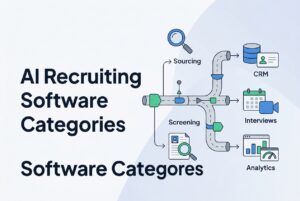
AI recruiting software is an umbrella term, not a single tool. In practice, it covers sourcing, ATS workflows, AI resume screening, recruitment CRM, interview automation, and recruitment analytics. The key question is not “Is this AI?” It is “Which part of hiring does it actually improve?”
That distinction matters. A sourcing tool finds people. An ATS manages active applicants. A CRM nurtures future candidates. Interview tools coordinate and collect evidence. Analytics explains what happened. If you are a TA leader at a mid-market company, that separation helps you avoid buying a flashy layer that does one job well and leaves the rest of the workflow untouched.
What are the main AI recruiting software categories?
The main categories each solve a different recruiting problem. Some tools combine several of them, but the workflow ownership is still different.
| Category | Primary job | Main users | Typical output |
|---|---|---|---|
| AI candidate sourcing | Find and engage people before or outside the active applicant pool | Sourcers and recruiters | Ranked prospect lists, enriched profiles, outreach campaigns |
| Applicant Tracking System (ATS) | Manage active requisitions, applicants, stages, interviews, offers and records | Recruiters, hiring managers and interviewers | Controlled candidate pipeline and system of record |
| AI resume screening and matching | Interpret applications and prioritize candidates against a role | Recruiters and hiring managers | Ranked applicants, match explanations and screening evidence |
| Recruitment CRM | Build and nurture long-term relationships with passive, former and prospective candidates | Recruiters, talent marketers and agencies | Talent pools, engagement history and nurture campaigns |
| Interview automation and assessment | Coordinate interviews and collect structured evidence about candidate skills | Recruiters, interviewers and hiring managers | Scheduled interviews, recordings, scorecards and assessment results |
| Recruitment analytics | Explain funnel performance, bottlenecks, cost and outcomes | TA leaders, recruiters and executives | Dashboards, reports and trend analysis |
| Recruiting workflow automation | Execute repeatable actions across the process | Recruiters and operations teams | Notifications, reminders, status changes, emails and handoffs |
Here is the practical filter I use: sourcing expands the pipeline, ATS controls the live process, CRM keeps relationships warm, interviews collect evidence, and analytics measures the system. If a vendor says it does all of this, test each function separately. A broad label does not mean deep execution.
What is AI candidate sourcing?
AI candidate sourcing helps recruiters find people who have not applied yet. It is most useful when the role is scarce, technical, passive, or underrepresented in inbound traffic.
A sourcing tool may support natural-language search, Boolean search, semantic search, candidate enrichment, duplicate detection, talent pools, outreach sequences, and response tracking. CVViZ offers automated candidate sourcing from job boards and platforms like LinkedIn, GitHub, and StackOverflow, plus import into a centralized pool. It also supports search across a large candidate database and rediscovery of past profiles.
For a recruiter filling a hard-to-fill developer role, that means starting with the skill set, not the job post. You search for people who fit the work, not just the title. That is where sourcing helps. It widens the top of the funnel before applications arrive.
Just do not confuse sourcing with distribution. Job distribution publishes an opening to boards and career pages. Sourcing actively looks for people. Both matter, but they solve different problems. If your issue is too few qualified applicants, you need both reach and outbound motion.
What is AI resume screening and candidate matching?
AI resume screening helps recruiters prioritize applicants against a role. Resume parsing turns unstructured resumes into structured data. Candidate matching compares that data with the job. These are related, but they are not the same thing.
| Function | What it does | Example output |
|---|---|---|
| Resume parsing | Extracts names, contact details, employers, titles, dates, education and skills | Structured candidate record |
| Skills extraction | Identifies skills, tools, certifications or domain experience | Normalized skills list |
| Candidate matching | Compares a candidate with a job or profile | Match score or fit explanation |
| AI resume screening | Prioritizes and evaluates applicants in a hiring workflow | Ranked review queue |
| Relative ranking | Orders candidates in relation to the role and the available pool | Candidate A before Candidate B |
| Prescreening | Collects answers to defined questions | Eligibility or evidence fields |
| Candidate rediscovery | Finds relevant past applicants or stored profiles | Shortlist from existing database |
CVViZ provides contextual AI resume screening using NLP and machine learning. It matches candidates to jobs beyond keyword search, then ranks them in real time based on job requirements and hiring pattern. That matters for a recruiter staring at 300 applications. You still review the finalists, but you are not sorting the pile by hand.
A useful rule: parsing structures information, screening prioritizes it, and ranking orders it. Do not treat a match score as an automatic hire decision. It is a decision support layer, not a replacement for recruiter judgment.
How is an ATS different from AI recruiting software?
An ATS is the operational system for active hiring. AI recruiting software is the broader umbrella. So yes, an ATS can be part of AI recruiting software, but it is not the whole category.
An ATS manages requisitions, applications, stage movement, interviews, offers, and records. It is the system of record for open roles. AI features inside an ATS may include resume parsing, contextual matching, candidate rediscovery, suggested outreach, or automated scheduling. However, the ATS still owns the live workflow.
That difference matters when you are cleaning up a messy process. If the stage definitions are broken, no AI layer will rescue you. If ownership is unclear, the system will only automate confusion faster.
CVViZ positions itself as an AI-powered ATS and recruiting automation platform. It supports jobs, pipelines, requisitions, interviews, approvals, offers, access controls, and reporting. For a lean TA team, that means one place to manage the candidate record and the active hiring flow.
ATS vs Recruitment CRM: what is the difference?
An ATS manages people applying for open jobs. A recruitment CRM manages relationships with people who may apply later. That is the cleanest way to separate them.
| Question | ATS | Recruitment CRM |
|---|---|---|
| Primary focus | Active hiring process | Long-term talent relationships |
| Typical people | Applicants for an open role | Passive candidates, former applicants, prospects and talent-community members |
| Main record | Application linked to requisition | Person, relationship, pool and engagement history |
| Main actions | Screen, interview, score, reject, offer and hire | Discover, segment, nurture, message and rediscover |
| Time horizon | Current requisition | Current and future hiring needs |
| Success measures | Stage conversion, time to fill, time to hire and offer acceptance | Engagement, response, pipeline growth and eventual conversion |
A TA team uses an ATS when the req is live. It uses a CRM when it wants to stay in touch with silver medalists, alumni, referrals, or agency contacts. In staffing, that CRM layer often carries extra weight because relationship history is the business.
CVViZ offers recruitment CRM features for agencies, including companies, contacts, leads, account managers, communication tracking, client portal, and collaboration tools. If you run internal talent acquisition, verify how deep the CRM layer needs to go for your workflow. If you run agency operations, the CRM layer becomes much more central.
What counts as interview automation and assessment?
Interview automation covers scheduling, live video interviews, on-demand interviews, scorecards, structured guides, feedback collection, and candidate routing. Scheduling alone is not assessment. Video alone is not AI evaluation.
Here is the clean split:
- Interview scheduling handles calendars, reminders, self-scheduling, cancellations, and rescheduling.
- Live video interviewing lets the candidate and interviewer meet in real time.
- On-demand video interviewing lets candidates answer preset questions on their own schedule.
- Assessments measure skills such as coding, writing, reasoning, or job knowledge.
- Structured interviewing uses consistent questions and scoring so comparisons are fairer and easier.
CVViZ supports automated scheduling and video interviewing, plus a live code editor for developer evaluation. For a remote technical role, that reduces back-and-forth and keeps the interview process moving. Still, the buyer should separate coordination tools from assessment design. A smoother calendar does not prove a stronger signal.
Why does recruitment analytics belong in AI recruiting software?
Recruitment analytics turns activity into evidence. It helps TA leaders see bottlenecks, compare channels, forecast capacity, and explain hiring performance to leadership.
Core metrics include:
| Metric | Definition or calculation |
|---|---|
| Time to fill | Time from opening a requisition to candidate acceptance of an offer |
| Time to hire | Time from a candidate’s application to offer acceptance |
| Cost per hire | Total annual recruitment spend divided by total hires |
| Offer acceptance rate | Accepted offers divided by offers received |
| Applicants per role | Count of applicants per role or applicants divided by open positions, depending on dashboard design |
| Source of hire | Where the candidate entered the process |
| Sourcing-channel effectiveness | Which channels produce the best downstream value |
| Application completion rate | Completed applications divided by started applications |
| Stage conversion | Candidates moving from one stage to the next divided by candidates entering the earlier stage |
| Time in stage | Time candidates spend in each pipeline stage |
| Quality of hire | Post-hire performance and contribution, often assessed during the first year |
| Attrition | The rate at which employees leave during a defined period |
For a mid-market TA team, the minimum useful dashboard should show open roles, pipeline volume, stage conversion, time in stage, time to fill, time to hire, offer acceptance, source performance, recruiter workload, and hiring-manager feedback delays.
CVViZ provides recruitment analytics and exportable reports. It also supports time-to-fill and effective sourcing channel tracking. That is useful, but only if your metric definitions stay consistent. Time to fill is not time to hire. If you mix those up, the dashboard stops being a management tool and turns into decoration.
How does recruiting workflow automation fit into the picture?
Workflow automation is the connective layer across all the categories. It uses rules, triggers, and actions to move work forward without manual chasing.
Typical examples include:
- Send an application confirmation when a resume arrives.
- Ask prescreening questions before recruiter review.
- Move a candidate when required conditions are met.
- Notify a recruiter or hiring manager when feedback is overdue.
- Send interview confirmations and reminders.
- Launch an approved email sequence.
- Stop outreach after a reply, opt-out, or stage change.
- Create a task when a candidate reaches a review stage.
- Record emails, SMS, or WhatsApp messages on the candidate record.
CVViZ supports workflow automation with rules and triggers, including emails and notifications when a resume is received, a job is added, or a candidate stage changes. It also supports pre-screening question-based automation. For a lean team, that is where the day gets easier. Recruiters spend less time nudging and more time recruiting.
How does CVViZ map to these categories?
CVViZ is built as AI recruiting software with ATS, screening, sourcing, automation, CRM, interviews, and analytics layered together. The useful part is knowing which function is doing the work.
| Category | CVViZ capability described publicly | Buyer interpretation |
|---|---|---|
| Sourcing | Search across 800M+ profiles, import prospects, build talent pools, rediscover candidates | Useful for outbound sourcing and historical candidate reuse |
| Job distribution | Publish eligible roles to LinkedIn, Indeed, career pages, and more than 2,000 free or paid boards | Broad distribution, separate from sourcing |
| AI screening | Contextual resume screening, ranking, candidate evidence, recruiter review | Prioritizes applications beyond literal keyword matching |
| ATS | Jobs, pipelines, requisitions, interviews, approvals, offers, access controls, reporting | Core system of record for active hiring |
| CRM | Agency CRM, customer and lead management, candidate communication, talent history | Especially relevant to staffing and agency workflows |
| Engagement | Email sequences, email sync, SMS, WhatsApp, templates, campaigns, tracking | Supports nurture and follow-up workflows |
| Interviews | Automated scheduling, video interviews, reminders, notes, coding editor | Covers coordination and selected assessment workflows |
| Analytics | Recruitment metrics and report export to Excel, PDF, and JPG | Helps with reporting and bottleneck analysis |
| Data layer | Resume parsing, cloud storage, duplicate identification, full-text and Boolean search, parser API | Creates a searchable candidate database |
| Governance | Role-based access, security claims, GDPR toolkit, recruiter decision control | Buyers still need to validate process and compliance details |
CVViZ publicly displays a 7-day free trial with no credit card requirement and plan pricing from $99 to $499 per month for the ATS tiers shown. It also displays pricing for an Integrate plan at $25 per job and resume parser credit packs at $625, $2,500, and $4,500. Pricing can change, so treat public display as current reference, not a permanent guarantee.
What should buyers ask before shortlisting AI recruiting tools?
The best buyer questions are simple and practical. They tell you whether the software fits your workflow or just looks good in a demo.
- What recruiting decision or task does the AI actually support?
- Does the tool find people, manage applicants, nurture relationships, coordinate interviews, or measure outcomes?
- Can recruiters see why a candidate matched or ranked the way they did?
- Does the system support human review before rejection or stage movement?
- Can it handle non-standard resumes, career changes, and transferable skills?
- Does the CRM fit internal recruiting, agency work, or both?
- Can automation be configured, audited, and reversed?
- Does reporting connect source activity to interviews, offers, and hires?
- What is the system of record for candidate data and stage history?
- Are the integrations native, or do they depend on add-ons and higher plans?
If your answer set is fuzzy, you are probably looking at a feature bundle, not a clear product fit. That is usually where teams get burned.
FAQ
Is an ATS the same as AI recruiting software?
No. An ATS is one category within AI recruiting software. It manages requisitions, applicants, stages, interviews, offers, and records. AI features may improve screening, search, scheduling, or workflow, but not every ATS offers the same AI functions.
What is the difference between AI sourcing and AI resume screening?
AI sourcing finds and engages potential candidates, including people who have not applied. AI resume screening evaluates applicants or stored profiles against a job and helps recruiters prioritize review.
What is the difference between an ATS and a recruitment CRM?
An ATS manages active candidates for open jobs. A recruitment CRM builds and nurtures relationships with passive candidates, former applicants, prospects, alumni, and talent-community members for current or future hiring.
Can one platform provide sourcing, ATS, CRM, interviews, and analytics?
Yes. Some recruiting platforms, such as CVViZ, combine these functions. Still, buyers should test each category independently because a product may be strong in one area and limited in another.
Does AI resume screening replace recruiters?
No. AI can parse, match, rank, and surface evidence, while recruiters define requirements, review results, investigate exceptions, and make or oversee decisions.
What should a buyer ask about AI bias?
Ask how the system was validated, what data it uses, how performance differs across groups, how outputs are monitored, whether ranking explanations are available, how recruiters override results, and how candidates are informed about automation.
What recruiting metrics should a lean TA team track first?
Start with open roles, pipeline volume, stage conversion, time in stage, time to fill, time to hire, offer acceptance, source effectiveness, application completion, recruiter workload, and hiring-manager feedback delays.
Is a large candidate database enough to reduce agency spend?
No. Database size may expand reach, but results also depend on profile accuracy, search quality, outreach relevance, response rates, recruiter workflow, and your ability to engage candidates.